Ban on the Sale of Foreign Alcohol in Lesotho in 1854

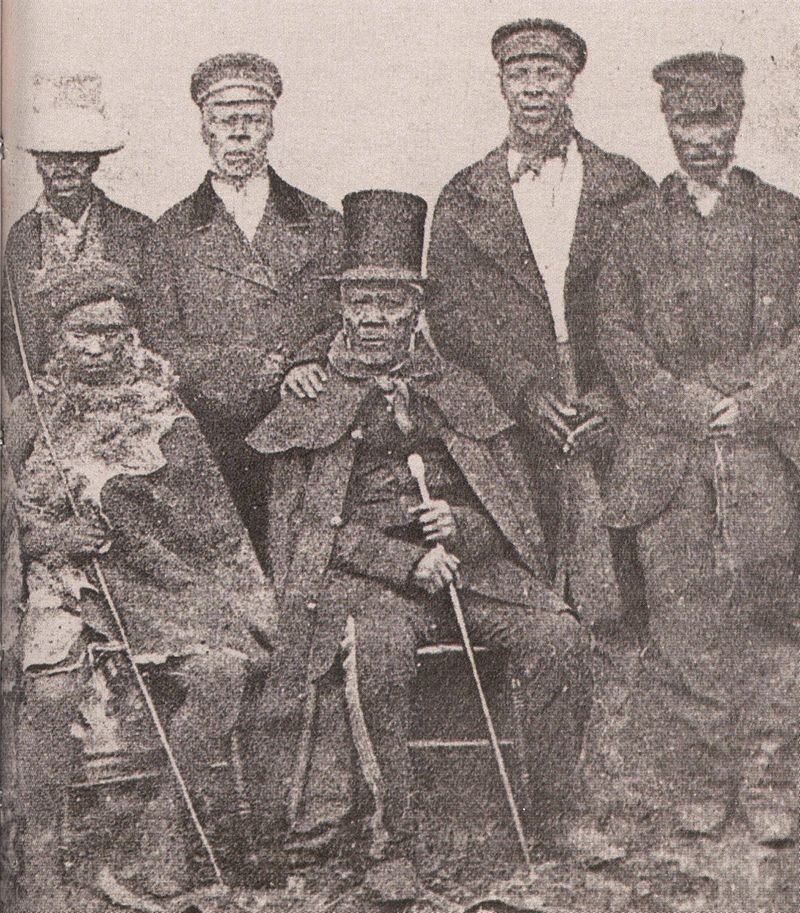
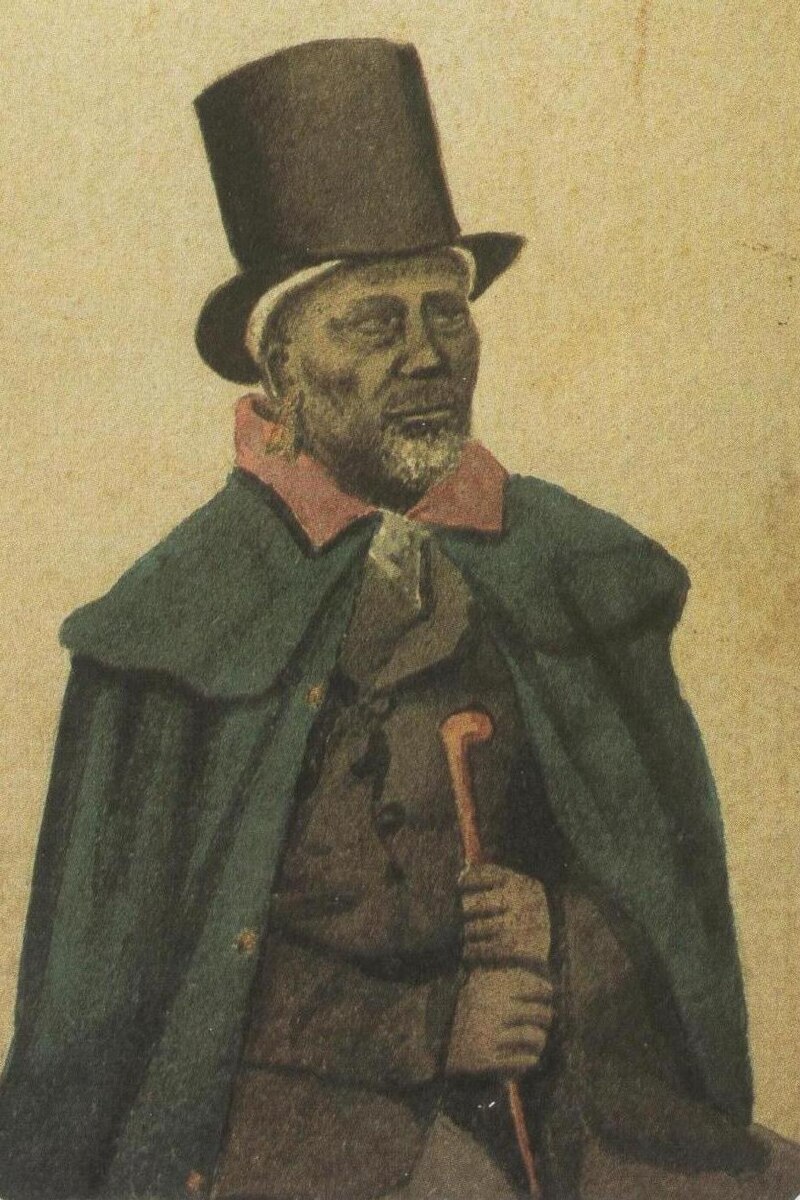
King Moshoeshoe I of Basutoland

As we have seen before, many African kings prohibited the sale of foreign alcohol on their soil. They could sense the harmful effect of alcohol on their men and on the society as a whole. They could also foresee the destruction of the soul of their societies via this foreign alcohol like Native Americans saw their destruction on another continent. Gungunyane: the Lion of Gaza or the Last African King of Mozambique, or Mirambo: the Black Napoleon, king of the Nyamwezi people in Tanzania, are just a few. Moshoeshoe I, the first king of Lesotho also prohibited the sale of foreign liquor on his soil. History Repeats Itself: the destabilization of Africa during slavery times via the use of alcohol as a tool, is continuing today, particularly in countries rich in resources. Current African leaders would do well to follow the example of their forefathers, as alcohol is destroying our societies and most of the beer companies are owned by Western multinationals; the alcohol level in beers and liquors in many African countries are significantly higher than in European countries, and the people are slowly being turned into drunkards while their resources are siphoned out. 

Below is the ban on alcohol imposed by King Moshoeshoe I on his homeland of Lesotho. The original can be found in Les Africains, Tome 8, p. 254, ed. Jaguar. Translated to English by Dr. Y., Afrolegends.com

=====

Ban on the sale of Foreign Alcohol

8 Novembre 1854

Whereas the alcohols of the Whites were unknown to previous generations of our tribe, that Matie (Matsie, that is Nkopane, father of Mohlomi) et Motlomi (Mohlomi) to the Bomonageng (BaMonaheng), and our father Mokhachane, now advanced in age, never consumed any other drinks than water and milk ; and whereas we believe that a good leader and judge cannot claim to be capable of performing his duties if he uses any stimulant whatsoever ; and whereas that alcohol causes quarrels and troubles, and paves the way to the destruction of society (it is evident that the white people’s alcohol is nothing but fire).

It is therefore made known to all that the introduction and sale of said alcohols in Basutoland is henceforth prohibited, and it is stipulated that for any person, whether white or colored, anyone who contravenes this decision will have their alcohol seized and spilled to the ground, without excuse or compensation.

This decision will be printed in the Basuto [Sotho] and Dutch languages and posted in public places and in Basutos villages.

Given with the advice and agreement of the men of our Tribe, by us the King of the Basutos, in Thaba Bosigo, on November 8th 1854.

King Moshoeshoe

King Moshoeshoe I: The First King of the Kingdom of Lesotho

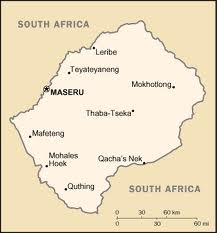
Map of Lesotho

Back in March 2025, the country of Lesotho was suddenly thrown in the spotlight when American President Donald Trump made a dismissive remark during a speech to Congress, saying « nobody has ever heard of » Lesotho while criticizing U.S. foreign aid spending. The comments sparked backlash from Lesotho’s government and prompted many to visit the country, or talk about the country. President Trump was not totally wrong… let’s be honest, before his remark, how many had heard about the country ?… maybe those who visit Afrolegends and who had read about its capital city of Maseru. Unknowingly, President Trump has most likely prompted added tourism to this beautiful landlocked country the size of Belgium entrenched within the country of South Africa.

King Moshoeshoe I of Basutoland during a visit to Prince Alfred of England in 1860

Today, we will talk about King Moshoeshoe I, the first king of Lesotho. 

King Moshoeshoe I was the founder and first monarch of Lesotho, known for his diplomatic genius, military leadership, and ability to unite diverse clans into a single nation. He ruled from 1822 until his death in 1870.

King Moshoeshoe I was the first king of Lesotho. At birth, he was named Lepoqo, which means Dispute, because of accusations of witchcraft which were levied on a man in Menkhoaneng around the time of his birth, between 1780 to 1794, where 1786. He was the first son of King Mokhachane, a minor chief of the Bamokoteli sub-clan of the Basotho people and his first wife Kholu, who was the daughter of the Bafokeng clan chief Ntsukunyane. Unlike Shaka Zulu, he had a happy childhood which he always referred to in adult life.

After his initiation ceremony in 1804, he took the name of Letlama, the Binder, and later chose the name Moshoeshoe, a name inspired by the sound of shaving – symbolizing his skill in cattle raids and leadership. It is said that it was chosen after a successful raid in which he had sheared the beards of his victims – the word ‘Moshoeshoe’ representing the sound of the shearing.

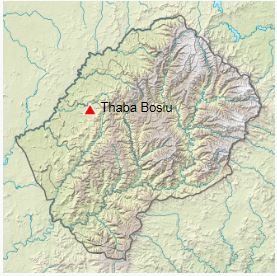
Thaba Bosiu on the map of Lesotho

In 1820, Moshoeshoe succeeded his father and formed his own clan and settled at Butha-Buthe Montain, and later moved to the mountain he named Thaba Bosiu  or “Mountain at Night” because his people arrived at night, a natural fortress that became the heart of the Basotho Kingdom. Thaba Bosiu served as the capital of the new Basotho nation. One can still find ruins from the 19th century of King Moshoeshoe I’s reign at the top of the mountain; it overlooks iconic Mount Qiloane, an enduring symbol of the nation’s Basotho people.

In 1810, Moshoeshoe married Mamabela, daughter of the Bafokeng chief, Seephephe, who was chosen for him by his father. She became his senior wife assuming the name ’MaMohato (Mother of Mohato – name that she took after the birth of her first son Letsie) with whom he had four sons including Letsie, MolapoMasopha and Majara as well as a daughter named Mathe. Their relationship was described by visiting British missionaries as deeply affectionate.  MaMohato died in 1838. Moshoeshoe practiced polygamy and is known to have had 30 wives in 1833 and close to 140 wives by 1865. After MaMohato, Moshoeshoe considered himself to be a widower. Only the children from his marriage to MaMohato constituted the royal line of descent. 

King Moshoeshoe I and his ministers

He was known for his generosity toward enemies, often integrating defeated groups into his kingdom. He united various displaced groups during the Mfecane (a period of widespread chaos and warfare in southern Africa), offering protection and forging a strong, centralized state. He also skillfully navigated threats from the Boers, British, and neighboring African groups, often using diplomacy to preserve his people’s autonomy. Due to constant hostilities and encroachments from Boers and wars, he signed an agreement with Queen Victoria of Great Britain to make Basutoland a British protectorate in 1868; the kingdom then became a crown colony in 1884, achieving independence in 1966 at which point the name was changed to Lesotho. Moshoeshoe died on 11 March 1870 and was succeeded by his oldest son Letsie I.

March 11, the day of his death , is celebrated throughout the kingdom as Moshoeshoe Day, a national holiday in Lesotho. The South African-made shweshwe fabric is named for King Moshoeshoe I who once received a gift of it and then popularized it throughout his realm.

Why the name: Maseru?

Map of Lesotho
Map of Lesotho

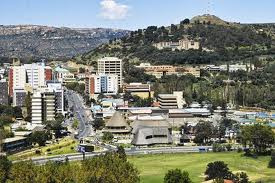
Today, I would like us to look into Maseru, the capital of Lesotho, a landlocked country located inside South AfricaMaseru is a Sesotho word which means “the place of the red sandstone.”  Maseru is located on the Caledon river, directly on the border with South Africa.  The city was first established as a police camp, and later on became the capital of the country when it was under British protectorate.  Maseru lies in a shallow valley in the Hlabeng-Sa Likhama foothills of the Maloti mountains.  Its elevation is 1,600 m above sea level.

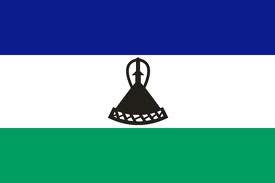
Flag of Lesotho
Flag of Lesotho

Lesotho is the world’s highest altitude country, in other words, it is the only country in the world which lies 1,000 m above sea level; its lowest point of 1,400 m  is thus the highest in the world.  Over 80% of the country lies 1,800 m above sea level.  Lesotho is the land of the Sotho people, and the official languages are Sesotho and English.

View of Maseru (from visitlesotho.org)

One may wonder how come such a small country (just over 30,000 km2) could reside independently inside South Africa, when we know very well the Boers’ expansion in South Africa and their thirst of land.  Well, in June 1838, when the TrekBoers attacked the country, the King Moshoeshoe I signed a treaty with the British governor of the Cape colony.  After fighting several wars with the Boers from 1858 to 1868, King Moshoeshoe I sought British protection who agreed to make Basutoland into a British protectorate in 1868. In 1869, the British signed a treaty at Aliwal North with the Boers that defined the boundaries of Basutoland, and later Lesotho, which by ceding the western territories effectively reduced Moshoeshoe’s kingdom to half its previous size (see… the colonists never really helped, they just assigned themselves big part of African kingdoms, like that pie Africa became after the Berlin Conference in 1884).  Enjoy this video, and discover Maseru.