UK Museums “Long-term Loan” looted Asante Gold Artifacts to Ghana

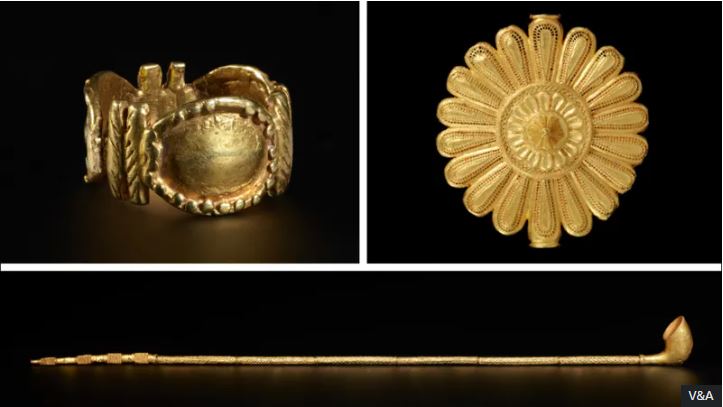
The V&A is lending 17 items including an Asante gold ring (top left), a gold badge worn by the king’s “soul washer” and a ceremonial pipe (Source: V&A / BBC)

Last week, the Victoria & Albert Museum (V&A) and the British Museum “returned” some artifacts looted from the Ashanti Kingdom in modern-day Ghana, after over 150 years. When one reads the headlines in the news, one can only clap, until learning that this is a “long-term loan“! Wait! What? About 32 gold and silver items which had been stolen from the court of the Asantehene (Asante king) in the 19th century, have been sent on a long-term loan back to the Asante court. First, how long is a “long-term loan”? Second, why is it a loan, when these objects were looted from the Asantehene’s court back in the 19th century? They were not gifted, they were not sold, they were STOLEN! And to top it off, there has been a chief negotiator on the Ghanaian side to ensure that the objects will be in safe hands in Ghana! What? So, these objects do not belong to Ghanaians, and if something were to happen to these Ghanaian objects that were stolen by the British but are now hosted in British museums while on Ghanaian soil on long-term loan, then one can only bet that the British would make the Ghanaians pay for something that is theirs! Which world are we living in? Knowing the treacherous nature of these people, who is to say that they will not orchestrate a new theft of these objects so as to further deepen the debts under which Ghanaians are already crumbling? Actually, long-term in this case means 3 years, with the option of renewing for 3 years! This loan is probably not even free! Why, oh why, do we, Africans, agree to such deals?

Read for yourself… excerpts from the BBC

=====

Burning of Kumasi by British troops in 1874

The UK has returned [how can it be called return when it is a loan?] dozens of artefacts looted from what is today Ghana – more than 150 years after they were taken [i.e. stolen].

Some 32 gold and silver items have been sent on long-term loan to the country by the Victoria & Albert Museum (V&A) and the British Museum.

They were stolen from the court of the Asante king, known as the Asantehene, during 19th century conflicts between the British and powerful Asante people.

The objects are expected to be returned [loaned – see how the writer of this piece wants to create confusion in our minds?] to the current king on Friday.

His chief negotiator, Ivor Agyeman-Duah, told the BBC that the objects are currently in “safe hands” in Ghana ahead of them being formally received. They are due to go on display next month at the Manhyia Palace Museum in Kumasi, the capital of the Ashanti region, as part of celebrations to mark the silver jubilee of the current Asante King Otumfuo Osei Tutu II.

British troops ransacking Fomena Palace en route to Kumasi in 1874

Among the returned artefacts are a gold peace pipe, a sword of state and gold badges worn by officials charged with cleansing the soul of the king. The gold artefacts are the ultimate symbol of the Asante royal government and are believed to be invested with the spirits of former Asante kings.

The loan, which was negotiated with the king and not with the Ghanaian government [always the divide-and-conquer scheme – negotiate with smaller entities, so as to exert more bending power over them], will last for three years with the option to extend for a further three years. [and they have the audacity to call it “long-term”! and for what belongs to you!]… The return of the Asante items comes a month ahead of celebrations marking the silver jubilee of the Asantehene.

The Asante people built what was once one of the most powerful and formidable states in west Africa – trading in, among others, gold, textiles and enslaved people. The kingdom was famed for its military might and wealth. 

Ghana Artefacts “Return” Home 150 years later … on Loan

Asante ceremonial cap worn by courtiers at coronations is among the items that will be loaned back to Ghana (Source: British Museum / BBC)

The news is everywhere, Asante gold artifacts are returning home after 150 years … on loan from the UK to Ghana. Let’s repeat that, Ghanaian artifacts looted 150 years by British forces in modern-day Ghana, are now being returned to Ghana on a loan from the UK. What the heck? So someone comes to your house, steals from you, and then years later, after you have begged, says “I am returning some of the stuff I stole from you on loan only!” How does that make sense? People say, “it is a step forward, we need to acknowledge it, and be grateful for progress.” Grateful? Grateful for what? Because the British are loaning things they stole from the Asante kingdom of Ghana, back to Ghana? Some of these loaned items are like the crown jewels of the kingdom, and have high spiritual values as well. And this comes after Ghanaians have negotiated for very long … can you imagine? … a loan!

Excerpts below are from the BBC.

=====

The V&A is lending 17 items including an Asante gold ring (top left), a gold badge worn by the king’s “soul washer” and a ceremonial pipe (Source: V&A Museum / BBC)

The UK is sending some of Ghana’s “crown jewels” back home, 150 years after looting them from the court of the Asante king.

A gold peace pipe is among 32 items returning under long-term loan deals, the BBC can reveal.

The Victoria & Albert Museum (V&A) is lending 17 pieces and 15 are from the British Museum.

Ghana’s chief negotiator said he hoped for “a new sense of cultural co-operation” after generations of anger.

Some national museums in the UK – including the V&A and the British Museum – are banned by law from permanently giving back contested items in their collections [somehow, they are not banned by law from taking stolen goods], and loan deals such as this are seen as a way to allow objects to return to their countries of origin .

But some countries laying claim to disputed artefacts fear that loans may be used to imply they accept the UK’s ownership. Tristram Hunt, director of the V&A, told the BBC that the gold items of court regalia are the equivalent of “our Crown Jewels“.

The items to be loaned, most of which were taken during 19th-Century wars between the British and the Asante [known as the Anglo-Ashanti wars, series of conflict wars which lasted from 1824 to 1900], include a sword of state and gold badges worn by officials charged with cleansing the soul of the king.

British troops ransacking Fomena Palace en route to Kumasi in 1874

Mr Hunt said when museums hold “objects with origins in war and looting in military campaigns, we have a responsibility to the countries of origin to think about how we can share those more fairly today. It doesn’t seem to me that all of our museums will fall down if we build up these kind of partnerships and exchanges.” [that’s why they only loan a minuscule number at a time … so their museums don’t fall apart].

However, Mr Hunt insisted the new cultural partnership “is not restitution by the back door” – meaning it is not a way to return permanent ownership back to Ghana. [The UK are still the owners of these Ghanaian artifacts stolen from Ghana].

The three-year loan agreements, with an option to extend for a further three years, are not with the Ghanaian government but with Otumfo Osei Tutu II – the current Asante king known as the Asantehene – who attended the Coronation of King Charles last year. [Did the negotiation include attending the British King’s coronation, as a condition for loaning?]

The items will go on display at the Manhyia Palace Museum in Kumasi, the capital of the Asante region, to celebrate the Asantehene’s silver jubilee.

The Asante gold artefacts are the ultimate symbol of the Asante royal government and are believed to be invested with the spirits of former Asante kings.

They have an importance to Ghana comparable to the Benin Bronzes – thousands of sculptures and plaques looted by Britain from the palace of the Kingdom of Benin (Benin City: the Majestic City the British burnt to the ground), in modern-day southern Nigeria. Nigeria has been calling for their return for decades.

Nana Oforiatta Ayim, special adviser to Ghana’s culture minister, told the BBC: “They’re not just objects, they have spiritual importance as well. They are part of the soul of the nation. It’s pieces of ourselves returning.” She said the loan was “a good starting point” on the anniversary of the looting and “a sign of some kind of healing and commemoration for the violence that happened“.

UK museums hold many more items taken from Ghana, including a gold trophy head that is among the most famous pieces of Asante regalia. The Asante built what was once one of the most powerful and formidable states in west Africa, trading in, among others, gold, textiles and enslaved people. The kingdom was famed for its military might and wealth. …

Burning of Kumasi by British troops in 1874

Europeans were attracted to what they later named the Gold Coast by the stories of African wealth and Britain fought repeated battles with the Asante in the 19th Century. In 1874 after an Asante attack, British troops launched a “punitive expedition”, in the colonial language of the time, ransacking Kumasi and taking many of the palace treasures.

[The items on loan] include three heavy cast-gold items known as soul washers’ badges (Akrafokonmu), which were worn around the necks of high ranking officials at court who were responsible for cleansing the soul of the king. …

The British Museum is also returning on loan a total of 15 items, some of them looted during a later conflict in 1895-96, including a sword of state known as the Mpomponsuo.

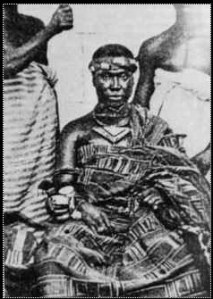
Prempeh I: The Last Asantehene Before British Colonization

prempeh_i
Asantehene Prempeh I

Prempeh I was the Asantehene (King) of the Kingdom of Ashanti. He was born as Prince Kwaku Dua III Asamu of the Kingdom of Ashanti, and he took the name of Prempeh I upon ascension on the throne at the young age of 16. His reign was a troubled one as it fell during the time of British invasion/colonization of the Gold Coast. In essence, he was the last king of the Kingdom of Ashanti before the Gold Coast fell under British protectorate.

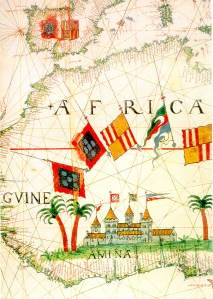
Europeans were already installed in the region and had been trading on the coast since the 15th century for gold and slaves (as we saw with the slave castles of Elmina and Cape Coast). By the beginning of the 19th century, the British government decided to formalize its control of the Gold Coast. They dispatched a force to conquer the Ashanti. They only won the war against the disciplined Ashanti because of the superiority of their artillery and rifles over the traditional muskets of the Ashanti. Once in Kumasi, the capital, the British hastily looted the royal palace and burned the town to the ground. The defeated Ashanti had already released their prisoners and subsequently were forced into agreeing to a treaty to give up claims on coastal territories, to cease the practice of human sacrifice and to pay a huge indemnity of 50,000 ounces of gold. This was known as the Wolseley’s expedition. The Gold Coast was then declared a Crown Colony.

Elmina 16th century
16th Century map of West Africa with Fort Elmina

Having lost their invincibility in war, the Ashantis were now faced with rebelling neighboring tribes, and the Ashanti confederation was descending into civil war. The Ashanti had become so weak that, in 1888, they asked the British governor to send an arbitrator from the coast to decide who, amongst rival claimants, should be the next Asantehene. The governor’s delegate decided in favor of the 16 year-old Prempeh. But Prempeh I turned out to be no puppet and refused to agree that Ashanti should become a British Protectorate.

Asantehene Prempeh I began an active campaign of the Ashanti sovereignty. The British offered to take the Kingdom of Ashanti under their protection, but Asantehene Prempeh I of the Kingdom of Ashanti refused each request. Asantehene Prempeh I stated, “My Kingdom of Ashanti will never commit itself to any such policy of protection; Ashanti people and the Kingdom of Ashanti must remain an independent sovereign state as of old, and at the same time be friends with all white men“.

prempehi_1
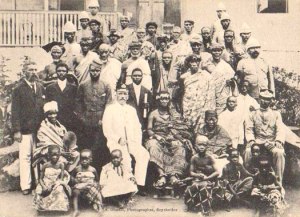
Prempeh I and his suite in the Seychelles (taken by F.A.L. Ramseyer) ca 1900-1903

Still wary of the French in Ivory Coast and alarmed by a resurgent Ashanti, the British now (1894) “remembered” that the Wolseley indemnity had never been paid. Prempeh I tried to appeal directly to a fellow sovereign, Queen Victoria, and sent an embassy to London to plead his cause. But the British government refused to give his delegates an audience for almost a year and mounted another elaborate British army expedition to Kumasi. Prempeh I refused to allow the Ashanti to fight, partly because of the memory of the Wolseley expedition and partly because of the British support for him during the succession dispute. Instead, he diplomatically greeted the troops as his guests when they marched into Kumasi, in January of 1896. The British governor arrived and coldly received Prempeh I and his chiefs. Prempeh I desperately tried to placate the invaders and to the horror of his people, he demeaned himself by prostrating himself before the governor in a sign of submission. The governor’s only response was to demand the gold promised to Wolseley. Prempeh could not provide such a huge indemnity at once but offered to pay in instalments starting with 680 ounces as a down payment. This was refused and then, to the astonishment of the Ashantis, Prempeh and some of his main chiefs were suddenly arrested.

Prempeh I’s place was looted. His throne is still displayed in the Royal Signals Museum at Blandford in England. The abducted Asantehene, Prempeh I, some of his relatives and advisors were first taken to Elmina for about a year, then to Freetown in Sierra Leone until 1900 when, upon the outbreak of Yaa Asantewaa (story for another day), the British feared proximity and sent the royal party to the Seychelles, in the Indian Ocean.

Once there, Prempeh I spent time in his villa on Mahe, the largest of the Seychelles’ island in the Indian Ocean. Prempeh I’s villa, and 16 new wooden houses with sandy floors and roofed with corrugated iron-sheets were built in Seychelles and allocated to the various Asante’s nobles. The place was called the Ashanti Camp. Prempeh made an effort to educate himself in English and made sure that the children received education.

prempehi_back-in-kumasi
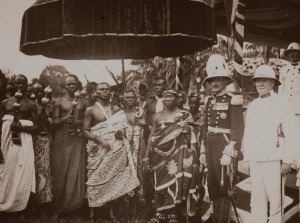
Prempeh I reinstated in Kumasi in 1926 (Source: thekingdomofAsante.com)

On 27 December 1924, Prempeh I and the other remaining members of the exiled Ashanti court were allowed to return to Ashanti Kingdom. Upon his return, and to appease the Ashanti people, the British created for Prempeh I the official position of Kumasehene in 1926, position which he held until his death in Kumasi, Ghana, on 12 May 1931. He was succeeded by his heir apparent Prempeh II of the Kingdom of Ashanti.

Prempeh I was definitely a king caught between trying to hold the sovereignty of his people, and keeping peace, while working with the British invader peacefully. Was his approach the correct one when faced with a greedy, heartless, and treacherous opponent? For more information, please check out Kreol magazine, The Kingdom of Asante, asantekingdom.org websites which are full of great articles.