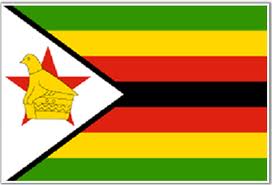
As of June 2025, the Zimbabwean government has announced that exports of raw lithium concentrate will be banned starting in January 2027. This move is meant to push mining companies to build local processing plants and keep more of the value chain within the country, thus helping towards the country’s development, and stopping the cycle of exports of raw materials and barely anything (The Lithium of Zimbabwe). This should also create employment for the locals.
Lithium
Several Chinese firms—like Sinomine and Zhejiang Huayou Cobalt—are already building lithium sulfate plants at the Bikita and Arcadia mines. These facilities will refine lithium concentrate into lithium sulfate, a key ingredient for battery-grade chemicals like lithium carbonate and hydroxide.
There is not yet a full refinery built, but this ban indicates Zimbabwe’s clear shift from being just a raw exporter of lithium. Given the importance of lithium in the electric car revolution as a material for batteries, this is really a game changer. We applaud Zimbabwe, and call other countries to learn from Zimbabwe, Mali, Burkina Faso, and Niger.
Kwame Nkrumah
This is where the dream of Kwame Nkrumah, of a real African Union, comes back; we are not talking about the current union which is just a puppet organization serving the interest of the Western powers. Kwame Nkrumah: African Visionary and Ghana’s First President. Currently, each country is negotiating individually, which may yield good or not so good results, if they do not have good negotiators or good mining lawyers in the case of lithium for instance. However, some would end up being taken advantage of just because they are not exposed to the new changes, don’t know, and could accept really low prices which may affect even their neighbors. Being United would insure good negotiations across the board learning from others, and also ensure that the multinationals respect the local governments and populations; and if they are kicked out of one country because of law or contract infringements, that they do not just run to another to perpetuate the cycle. This is what the AES is doing (The AES Creates a Joint Military Force), and all African countries should.
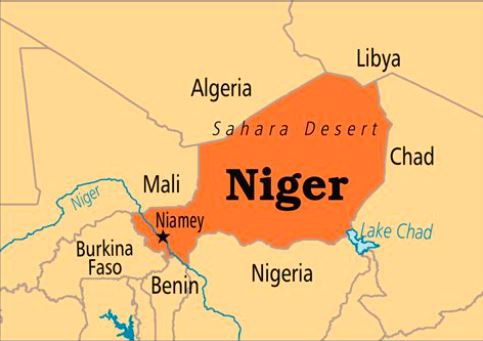
We cannot repeat it enough! All eyes are on Niger, particularly after ECOWAS decided to follow Ouattara who urged for a military intervention, and brought in the African Union with Moussa Faki who authorized the use of military in Niger.
ECOWAS Logo
Can we really be surprised by Ouattara who was installed in Côte d’Ivoire by France’s canons and military joined with the UN? After the ECOWAS meeting last week, Côte d’Ivoire’s president, Alassane Ouattara, said his country would take part in the military operation, along with Nigeria and Benin. “Ivory Coast will provide a battalion and has made all the financial arrangements … We are determined to install Bazoum [prior Niger president and France’s puppet] in his position. Our objective is peace and stability in the sub-region,” Ouattara said on state television. The ECOWAS bloc decided last Friday to deploy a “standby force” aimed at restoring constitutional order in Niger after its Sunday deadline to reinstate ousted President Mohamed Bazoum expired. To this, Niger responded by recalling its diplomatic envoy to Côte d’Ivoire.
The African Union (AU) has called for an urgent intervention in Niger to reinstate President Mohamed Bazoum to power. In a statement issued in support of resolutions by ECOWAS, AU Commission Chairperson Moussa Faki (another puppet) said the international community must act to stop an anti-constitutional change in Niger. “The Chairperson calls on the entire international community to unite efforts to save the moral and physical integrity of President Mohamed Bazoum,” Faki’s office said on Friday.
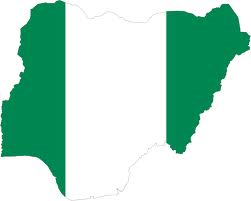
Flag and map of Nigeria
Isn’t it crazy that the AU does not think that the embargo on medical supplies to the whole country of Niger is a problem? Isn’t it surprising that the AU has no voice when it comes to defending Africans from foreign interventions on African soil, but is always on the wrong side of history against Africans?
Now, the newly appointed Niger’s prime minister is in Chad for peace talks. Northern Nigeria’s religious and political leaders are also making considerable efforts for a peaceful resolution of the situation. Similarly, the religious leaders of Togo have asked for a removal of all ECOWAS sanctions against Niger which will then allow for more peaceful talks. Religious and political leaders of Benin and Togo have warned their presidents against any military interventions in Niger, interventions that serve the West. That is why Ouattara had to call on the African Union (AU) trying to find mercenaries from other African countries (not neighboring ones – ECOWAS region) who would not feel so strongly against an intervention in Niger, or have brotherly links that extend beyond borders with the people of Niger.
Flag of Niger
On Sunday night, Niger’s rulers declared they had gathered sufficient evidence to prosecute Bazoum for “high treason and undermining internal and external security“. After all, wasn’t Bazoum working for the West against Niger’s interests? Who knows what sort of back-door deals he made? Then today, Jihadist armed groups have ambushed and attacked a detachment of Niger’s military killing at least 17 Niger soldiers and injuring 20 others near the border with Mali, the country’s Ministry of Defence said.
The situation is very fluid and tense, and requires our entire attention and prayers. Without Niger, France might not have enough electricity this winter (and this will have nothing to do with Ukraine or climate change). Losing Niger is not quite a possibility for France or the West in the region. Niger will be the 4th country in the region and it might not be seen as a good.
Please read the article from the Christian Science Monitor which summarizes the situation well. It ends with, “The putschists’ aim will be to get France and Ecowas to move towards recognizing their de facto regime,” says Mr. Vallet. “[But] France and Ecowas will need to figure out how they can support the Bazoum loyalists if the putschists remain in power and manage to get them reintegrated in any future political process. … This is going to be the condition for their future relationship.” What this article and many fail to recognize is that the era of empty negotiations, or of half governments like France did in Cote d’Ivoire for many years (with Marcoussis I & II, Ouaga, etc) where a legitimate government was forced to share power with military rebels is long gone, as this later led to an un-governable situation and then France installing its puppet Ouattara while bombing the presidential palace… We are no longer negotiating for half territories… we will no longer sit back and negotiate and give away inches upon inches of our territories to satisfy the West.
Nkrumah’s sculpture at the Kwame Nkrumah Mausoleum in Accra
President Kwame Nkrumah, the great, and first president of Ghana once wrote a poem on Ethiopia. Kwame Nkrumah was the mind behind the creation of the Organisation of African Unity (Organisation de l’Union Africaine) which has become the African Union (Union Africaine). He believed in the unity of Africa, not just economic, but in the cooperation within the different states, and their independence. So here is his poem entitled ‘Ethiopia shall rise‘. Remember that Ethiopia is the only African country which was never colonized by Europeans, and as such is the siege of the African Union. Here is his entire speech followed by his poem. In reality, in his eyes, Ethiopia symbolizes the whole of Africa, and his wish is for Africa to rise again! Enjoy!
=========
Addis Ababa, May 25, 1963 YOUR; IMPERIAL MAJESTY, MR. CHAIRMAN, YOUR EXCELLENCIES BROTHERS AND FRIENDS,
Flag of Ethiopia
We have come to the end of a historic and momentous Conference. The decisions we have taken here have made African Unity a reality and we can see clearly a Union Government of Africa in the horizon.
This is the goal which we set ourselves when we struggled in our separate States for Independence. It is also the compelling force which brought us together in Addis Ababa.
As I have said over and over again, the independence of our separate State is meaningless, unless the whole of Africa becomes free and united.
broken chains
The resolutions we have made here are a symbol of our determination to become united and to remain united in an African Community with common aspirations and common objectives. Freedom Fighters in all parts of our Continent can now be assured that they are not alone in their struggle. The whole weight and power of a united Africa is behind them.
After centuries of colonial exploitation and domination, Africa has been re- born. We have discovered our common identity, a force with which we can re-assert our African personality.
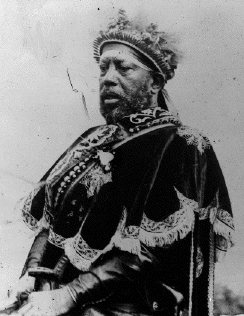
Emperor Menelik II, of Ethiopia
We shall from now on think, plan and work together for the progress and development of our great Continent. In this way, we shall eliminate completely the handicaps, set-backs and humiliation we have suffered under colonialism and imperialism.
We should be happy that at long last, by the adoption of this Charter, we have seen the end of the various groupings and regional blocs. It only remains for me, Your Majesty, on behalf of my colleagues to convey to the Government and people of Ethiopia especially to His Imperial Majesty, my sincere expression of gratitude for a happy and memorable stay in Addis Ababa.
The ancient Greeks identified Ethiopia with the Black Race. I would therefore like to leave with you a little poem on this:
Ethiopia shall rise
Ethiopia, Africa’s bright gem Set high among the verdant hills That gave birth to the unfailing Waters of the Nile Ethiopia shall rise Ethiopia, land of the wise; Ethiopia, bold cradle of Africa’s ancient rule And fertile school Of our African culture; Ethiopia, the wise Shall rise And remould with us the full figure Of Africa’s hopes And destiny.
I have often wondered about the meaning of the name Addis Ababa or Addis Abeba, the capital of Ethiopia. The name always sounded so poetic, and full of beauty somehow.
You can imagine my surprise when I found out that the name of the largest city of Ethiopia, Addis Ababa or Addis Abeba, actually meant “New Flower.” No wonder the sound of it was always so pretty.
The region where Addis Ababa is founded is called Finfinne, or Natural Springs, by the local Oromo population; it is an area rich with fauna and flora. In the southwest, can be found Mount Wachacha, and in the north Mount Entoto. Before the foundation of Addis Ababa, Emperor Menelik II and the empress Taytu Betul were installed in the area of Mount Entoto as it was used a military base for operations in the south of the realm; however that area had a rude climate, was cold, and very windy. So the imperial couple used to visit the thermal sources of Filwoha, hot mineral springs, located at a lower altitude.
Empress Taytu Betul
In 1886, while Empress Taytu Betul was admiring the landscape, she saw a flower of rare beauty. Enchanted by the nice climate, she asked her spouse, Emperor Menelik II, to build her a house in the area. Menelik II agreed and promised Taytu to build her a residence there. The choice of the precise location of Addis Ababa followed the prophecy of Menelik II’s grandfather, Sahle Selassie, Negus of Shewa from 1813 to 1847. During a game of chess, Sahle Selassie declared: “This country is covered with scrub and vegetation, but the day will come when my grandson will build a house here, and will found a city.” Menelik II founded the city at the exact location where his grandfather was practicing fencing. The name was Empress Taytu’s choice: she had been stunned by that beautiful flower she had never seen before, hence she named the city Addis Ababa, or “New Flower” in Amharic.
Emperor Menelik II
Menelik expanded his wife’s house to become the Imperial Palace which remains the seat of government in Addis Ababa today. Addis Ababa became Ethiopia’s capital when Menelik II became Emperor of Ethiopia. The town grew by leaps and bounds. One of Emperor Menelik II’s contributions still visible today is the planting of numerous eucalyptus trees along the city’s streets. The city lies at an altitude of 2300 meters, and is a grassland biome.
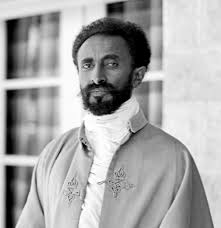
Following reconstruction, Haile Selassie helped form the Organisation of African Unity in 1963 and invited the new organization to keep its headquarters in the city. The OAU was dissolved in 2002 and replaced by the African Union (AU), also headquartered in Addis Ababa. The United Nations Economic Commission for Africa also has its headquarters in Addis Ababa. It is home to Addis Ababa University. The Federation of African Societies of Chemistry (FASC) and Horn of Africa Press Institute (HAPI) are also headquartered in Addis Ababa. Ethiopia has often been called the original cradle of humanity due to various humanoid fossil discoveries like the AustralopithecineLucy. Recent DNA evidence have suggested origins in south central Ethiopian regions like present-day Addis Ababa: after analyzing the DNA of almost 1,000 people around the world, geneticists and other scientists claimed people spread from what is now Addis Ababa 100,000 years ago. Enjoy video about the new flower, and all its cultural wealth.
Few men on the continent have had the aura of President Kwame Nkrumah, one of the greatest pan-africanist of the continent and the first president of Ghana. Kwame Nkrumah was born on 21 September1909 in Nkroful, Gold Coast (the pre-independence name of Ghana) the world’s largest cocoa producer. Hailing from a modest traditional family, He trained to be a teacher at the Achimota School in Accra from 1927 to 1930. For the following five years, he then taught in elementary schools across the Gold Coast. He later on attended Lincoln University in Pennsylvania, where he graduated with a BA in theology in 1942. He went on to attend the University of Pennsylvania, where he earned a Master of Science in education, and a master of arts in philosophy in 1943. During his time in the US, he preached at black Presbyterian churches in Philadephia, and New York city. Moving to London after World War II, Nkrumah helped organize Pan-African congresses, linking the emergent educated groups of the African colonies with activists, writers, artists, and well-wishers from the industrial countries. It was a time of great intellectual ferment, excitement, and optimism. Gandhi and India‘s achievement of independence in 1947 stirred dreams of freedom for the other colonies. “If we get self-government,” Nkrumah proclaimed, “we’ll transform the Gold Coast into a paradise in 10 years.”
Flag of the Gold Coast
In 1947, Nkrumah was invited to serve as the general secretary of the United Gold Coast Convention (UGCC), exploring paths to independence of the Gold Coast from British rule. After the riots of February 1948, and arrests of UGCC leaders by British rule, Nkrumah emerged as the party leader upon release. He proclaimed that the Gold Coast needed “self-government now,” and built a large power base including cocoa farmers, women (at a time when women were not invited in the political process) and trade unions. On 12 June 1949, he organized a new political party based on these groups: the Convention People’s Party (CPP). Within two years the CPP had won limited self-rule elections, and Nkrumah became “Leader of Government Business” in 1951 after a landslide CPP win in the first general election– a de facto prime minister, responsible for internal government and policy. He set his sights firmly on independence. No amount of autonomy or self-rule, he argued, could match the energy, commitment, and focus of a government and people in a truly independent country. It was a precondition for growth. He summarized his philosophy in a slogan that became famous and influential across Africa: “Seek ye first the political kingdom, and all else shall be added unto you….”
Map and Flag of Ghana
As a leader of this government, Nkrumah faced many challenges: first, to learn to govern; second, to unify the four territories of the Gold Coast; third, to win his nation’s complete independence from the United Kingdom. Nkrumah was successful at all three goals. Within six years of his release from prison, he was the leader of an independent nation. At 12 a.m. on 6 March 1957, Nkrumah declared Ghana independent. The country became independent as a Commonwealth realm. He was hailed as the Osagyefo – which means “redeemer” in the Twi language.
On 6 March 1960, Nkrumah announced plans for a new constitution, which would make Ghana a republic. On 19, 23, and 27 April 1960 a presidential election and plebiscite on the constitution were held. The constitution was ratified and Nkrumah was elected president over J. B. Danquah, the UP candidate, 1,016,076 to 124,623. In 1961, Nkrumah laid the first stones in the foundation of the Kwame Nkrumah Ideological Institute created to train Ghanaian civil servants as well as promote Pan-Africanism. In 1964, all students entering college in Ghana were required to attend a two-week “ideological orientation” at the Institute. In 1963, Nkrumah was awarded the Lenin Peace Prize by the Soviet Union. Ghana became a charter member of the Organization of African Unity in 1963.
Kwame Nkrumah on Cedi notes
The Gold Coast had been among the wealthiest and most socially advanced areas in Africa, with schools, railways, hospitals, social security and an advanced economy. Under Nkrumah’s leadership, Ghana adopted some socialist policies and practices. Nkrumah created a welfare system, started various community programs, and established schools. Nkrumah’s time in office was successful and ambitious (could you blame him? With a newly independent country, there was so much to build), with forestry, fishing, and cattle-breeding expanded, production of cocoa (Ghana’s main export) doubled, and modest deposits of bauxite and gold exploited more effectively. The construction of a dam on the Volta River (launched in 1961) provided water for irrigation and hydro-electric power, which produced enough electricity for the towns as well as for a new aluminum plant. Government funds were also provided for village projects in which local people built schools and roads, while free health care and education were introduced. Ghana adopted the Ghana Cedi (GHC) as a currency in 1965; the word “cedi” being the Akan word for cowry shells, which were used as currency in the old days.
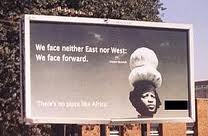
Billboard in Lusaka, Zambia, with Kwame Nkrumah’s famous quote for non-alignment
He generally took a non-aligned Marxist perspective on economics, and believed capitalism had malignant effects that were going to stay with Africa for a long time (and rightly so, we can all see the effects of IMF, and World Bank policies in Africa today: poverty to the grave). Nkrumah argued that socialism was the system that would best accommodate the changes that capitalism had brought, while still respecting African values. At a time when there were East & West blocks from the cold war, and where Africa was stuck in the middle, with no way out but to bend to some of the East-West politics (which could not work for us), Nkrumah believed in non-alignment. He made a famous quote on non-alignment which said: “We face neither East nor West; We face forward.” To show that we, as Africans, could not be forced to adhere to politics or economics which had no respect for us as human beings and for our cultures.
Celebrating the birth of the OAU
In Africa Must Unite(1963) Nkrumah called for the immediate formation of a pan-African government. Later he sat on a unification movement that emanates from the base, while anti-imperialist governments and between the Western-backed “puppet regime” could be no common ground. He was a true visionary to have seen that Africa needed to unite in order to survive, because as it stood divided in 50-something states it was an easy prey to Western imperialists. Nkrumah’s biggest success in this area was his significant influence in the founding of the Organization of African Unity (OAU).
Nkrumah’s sculpture at the Kwame Nkrumah Mausoleum in Accra
Truth be told, Nkrumah was too big for his own good. He wanted Ghana and Africa to be truly independent: politically, and economically. He was a strong advocate for pan-Africanism, and the true instigator and founder of the Organization of African Unity (now African Union) whose goals were to raise Africa, and promote unity and strength across the continent. He also helped several independent movements in Africa, such as those from Rhodesia (Zimbabwe). He was ousted in February1966 by a military coup, while on state visit to Vietnam.
After the coup, Nkrumah lived in exile in Conakry, Guinea, as the guest of President Ahmed Sekou Toure who made him honorary co-president. He read, wrote, corresponded, gardened, entertained guests, and continued to push for his vision of African unity. 50 years later, Kadhafi who was trying to revive, and reinvigorate the African Union, and almost succeeded, was also brought down by Western Imperialism; and his country, the beautiful Libya (one of the few countries in the world without debt) bombed and brought down in flames.
Centenary of Kwame Nkrumah
Nkrumah died in 27 April1972 of skin cancer in Romania. One can tell the greatness of the man by the number of universities who carry his name during his lifetime. If you are ever in Accra, visit the Kwame Nkrumah Mausoleum which is a true piece of art, as well as the Kwame Nkrumah University of Science and Technology in Kumasi. Check out Nkrumah.net to learn more about this great African leader, and read some of his speeches. Check out this great video which talks about Kwame Nkrumah’s fight for Ghana’s independence, as well as his struggle to maintain his vision for an independent Ghana (check out all parts 1-4). Don’t forget to read some of his books: Africa Must Unite (1963), Neo-colonialism: the Last Stage of Imperialism (1965), African Socialism Revisited (1967), Dark Days in Ghana (1968), Handbook of Revolutionary Warfare (1968), I Speak of Freedom (1973), and many more.











 African Heritage