Last week, the Kente cloth, Ghana’s national textile, has been recognized and added to the UNESCO list of Intangibla Cultural Heritage of Humanity. A few years ago, we published the article Kente Cloth: An Ashanti Tradition dating Centuries back. Here, we will go down memory lane.
=====
Have you ever seen those beautiful bright multicolored scarves worn on graduation day by thousands of African Americans and African students across the United States? Those scarves are usually hand-woven, bright, and multicolored, worn to represent the membership to a Black sorority, fraternity, or to just an African student organization at the different colleges and universities.
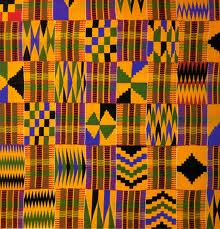
Kente cloth
Well, those scarves are made from a material commonly known as Kente cloth, which originates from the Ashanti people of Ghana and Cote d’Ivoire. The Ashanti people used to (and still do) hand weave these bright multicolored clothes for their kings and noblemen. The tradition of kentecloth is said to have been developed in the 17th century, and stems from ancient Akan weaving techniques dating as far back as the 11th century AD (this is one of Africa’s textile tradition). Kentecloth is known as nwentoma (meaning woven cloth) in Akan language, and is a type of silk, cotton, or rayon fabric made of interwoven cloth strips which is native to the Akan/Ashanti ethnic group of Southern Ghana (and also Cote d’Ivoire). It is woven on a wooden loom, which produces a band about 10 cm wide; several bands will then be sewn together to make a larger cloth. The elaborate patterns arise from the mixture of different weaving techniques applied to the same band of cloth. The quality of the fabric, and weaving indicates the rank of the person, the best being reserved for the kings. It is worn by men as a toga, and by women as upper and lower wrappers. The art of weaving kenteis passed down only to males, from generation to generation. The main center of weaving kenteis around the Kumasi region of Ghana.
“Quand l’Africain était l’or noir de l’Europe” de Bwemba Bong
I came across a gem in the book of Professor Bwemba Bong, “Quand l’Africain était l’or noir de l’Europe. L’Afrique: Actrice ou Victime de la Traite des Noirs? – Démontage des mensonges et de la falsification de l’histoire de l’hydre des razzias négrières transatlantiques” (When the African was the black gold of Europe. Africa: Actress or Victim of the Slave Trade ? – Dismantling the lies and falsification of the hydra history of the transatlantic Slave Raids).” This text talks about the advanced textile industry in the Kingdom of Kongo in the 16th century. We had previously discussed the History of African Fabrics and Textiles and the falsification of history by Western media who are always trying to pretend that African textile industry started with the Dutch company Vlisco! We had also shared a description by Italian explorer Alvise Cadamosto, of clothing worn by Africans in the 15th century (Description of African Dressing in 1400s).
The Kingdom of Kongo with Queen Nzingha’s Kingdom in the south and east
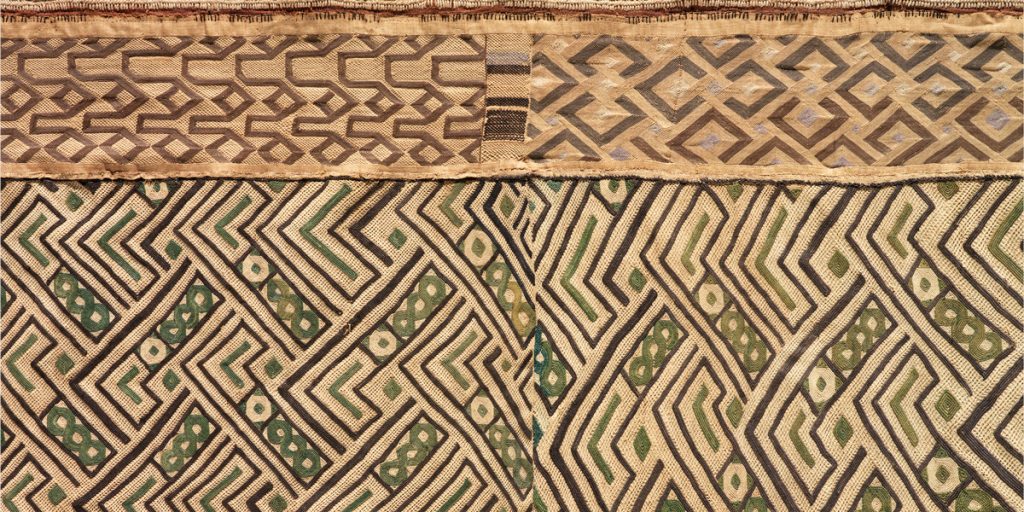
In the 16th century, the Portuguese Filippo Pigafetta et Duarte Lopez wrote about the Kingdom of Kongo describing the economic situation of precolonial Africa, and reported that Africa had nothing to envy to Europe. Some of the fabrics described then, resemble fabrics weaved today by the Kuba people of the Democratic Republic of Congo, who use raffia and make some of the most beautiful hand-woven blankets, clothing, and sculptures. In the text, Lopez described not only the quality of the fabric, but the entire industry needed to create this type of fabric: the kind of tree used, the way the tree was pruned, and the value of the fabric. Another important point is that everyone was dressed within his/her means… thus the idea that Africans were walking naked, as we have previously seen, is another falsification of history!
Filippo Pigafetta et Duarte Lopes, Le royaume de Congo et les contrees environnantes (1591), Chandeigne/Unesco, 2002, p.112-113 (trad. Willy Bal, présentation et notes Willy Bal); Bwemba Bong, Quand l’Africain était l’or noir de l’Europe. L’Afrique: Actrice ou Victime de la Traite des Noirs?, MedouNeter 2022, p.180 (translated to English by Dr. Y, Afrolegends.com). Enjoy!
=====
Women’s ceremonial overskirt from the 20th century, made by the Bushongo people. Image courtesy of The Textile Museum and The George Washington University Museum.
“And since we are here, I must decry the extraordinary art with which the inhabitants of this country and neighboring regions weave various kinds of fabrics, such as velvets with pile and without pile, brocades, satins, taffetas, damask, armoisins and other similar fabrics, which are certainly not made of silk, since we do not know the silkworm; if some people dress in silk, it is silk imported from our regions. But these fabrics that we have just listed are taken from the leaf of the palm tree; it is therefore necessary to keep the trees low, and to do this, prune and prune them each year, so that in the new season the leaves will grow more tender.
le palmier de raphia/ Raffia palm tree
After having treated these leaves in their own way, they draw threads from them, all equally fine and delicate; the longer the thread, the more it is valued because it allows larger pieces to be weaved. In different ways, they make fabrics with pile, resembling velvets, on each side, and sheets called damask with decorative patterns and varied textures, as well as brocades that are called high and those that are called low, which are worth more than our brocade. Only the king and those whom he deems good to do this favor can wear this fabric. The largest pieces are of brocade: they reach four or five palms in length, and three or four in width. The brocade is called incorimbas (named after the region where it is made, which is located around the Vumba river [in northern Congo]). Velvets have the same width: they are called enzacas, damasks are called infutas, satins are called maricas, taffetas are tangas and Anziques are the largest pieces which reach six palms in length and five in width. It is out of these fabrics that we commonly dress, each according to their means. Furthermore, they are light and very robust in water. The Portuguese began to use them as tent canvases: they wonderfully resist to water and wind.”
As I read the account of Dr. Robert W. Felkin of a successful C-section in the Bunyoro kingdom, I could not help but realize that in Africa, and particularly in this instance in the Bunyoro kingdomthere was superior anesthetics, antiseptics, and advanced medicine which allowed them, at a time when in Europe this was considered a desperate measure performed only on dying mothers, to successfully deliver both mother and child.
Caesarean delivery in Uganda, 1879 (Felkin RW. Notes on labour in Central Africa. Edin Med J
1884;29:922-30.)
One important oddity in Felkin’s account is the illustration of the native doctor and his assistants and the pregnant mother. Note that in his written account, Felkin said of the woman that, “she was perfectly naked. A band of mbugu or bark cloth fastened her thorax to the bed, another band of cloth fastened down her thighs…” The oddity is in the drawing: why would Felkin draw the native doctor and the assistants all naked, when he stated that the woman was naked? If the native doctor and assistants were all naked, wouldn’t he have stated that also? If he stated that she was naked, that means that, that was already something that stood out, i.e. that in normal days, the woman would be dressed, and for this operation only was she naked. This also implies that the native doctor and assistants were clothed, and only the patient was naked! Lastly, this may mean that either it was not Felkin who drew the image, or that Felikin was so astonished by the superiority of the Bunyoro doctor and assistant, and Bunyoro superior medicine, that he felt the need to present them in some ways as inferior people, savage men. What better way than by drawing them as primitive people all naked?
See… this is another case of falsifying history, denigrating a people, and debasing them. How low! Remember how I told you about the rich history of African Fabrics and Textiles and the falsification performed by The New York Times, and also about the account by Cadamosto in the 1400s of very well dressed Africans (Description of African Dressing in 1400s) he met on the coast of most likely modern-day Gambia!
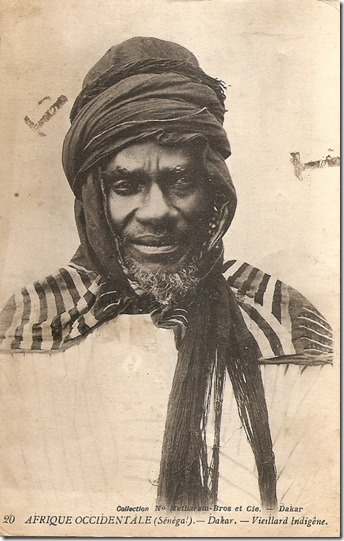
I recently learned about the Diisa, a long fringed indigo shawl worn by men in Mali, and men across the Sahara Desert. I knew of the shawl, but never knew its name. I also knew of the shawl and always wondered why it was always blue, and not any other color. The Diisa has been worn by African men for centuries. Its ‘blue-ness’ comes from the ‘diisatogène‘ which is one of the strongest artificial component of Indigo dye.The shawl itself takes a long time to weave, and is later on indigo dyed. Our ancestors probably knew all this chemistry that I just learned today, and probably honed down the recipe. Samori Toure, the great African leader, can be seen wearing his diisa shawl on several occasions.
Malian artist and master dyer Aboubakar Fofana commented:
Samori Toure wearing his diisa
“… The dissa shawl was such an important piece for a man from this region.It was given to a young man by his mother when he got married. She would have saved for this shawl since her son was very young–they were a lot of workand wereworth the same as 10 head of cattle. They wereindigo dyed, andwhen the man died, this shawl would be his shroud. The celestial blue of indigo would help him pass from this world to heaven. I’m very proud to be making a modern interpretation of the dissa, with its long fringes, and I hope I am carrying on the tradition of something important in my culture.”
And Belgian art historian Patricia Gerimont, who is working on a book on indigo dyeing in Mali, supplied this information on indigo in Burkina Faso (my translation): “the indigo shawls and wrappers in Burkina are dyed by a specific group called the Yarsé, and also by other groups of Marka dyers. The Yarsé speak Mossi but are of Marka origin, you also find them in Dogon country under the name Yélin.”







 African Heritage