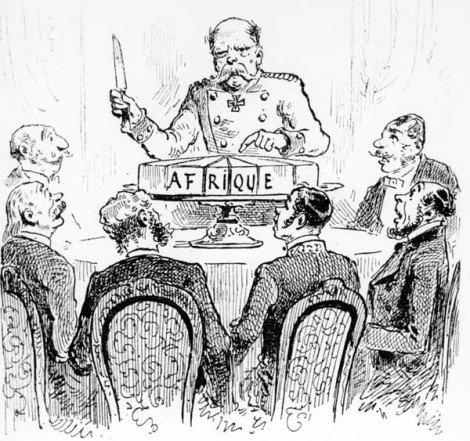
Le partage de l'Afrique à la Conférence de Berlin de 1884
As we talk about neo-colonialism, and the new conquest of Africa, I thought about sharing this poem ‘They Came‘ by the Cameroonian writer François Sengat-Kuo published in Fleurs de Latérite, Heures Rouges Éditions Clé, 1971. In the poem, he talks about colonization and how Africans were fooled by European missionaries who were always preceding European explorers and armies. I particularly like the sentence: “they came, … bible on hand, guns behind.” How true! In the days of colonization, Europeans claimed to be bringing civilization and christianity to pagans across the globe. Today, they bring development, globalization, and democracy… same ol’ thing → submission and slavery of the people. Enjoy!
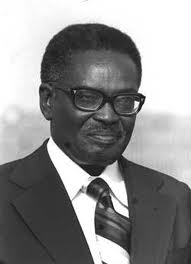
Agostinho Neto was the a medical doctor, a poet, and most importantly the first president of Angola. Today, I would like you to sit back and enjoy a poem written by this great African leader
This poem by David Mandessi Diop was my favorite. By the time I was 9 years old, I knew it by heart… I loved it so much! It symbolizes so much about Africa, and the love we, all African children, should have for her. Oh how I wish David Diop had lived longer to see the effect of his ‘ode to Africa‘ on other generations. Enjoy!!!
Afrique mon Afrique Afrique des fiers guerriers dans les savanes ancestrales Afrique que me chantait ma grand-mère Au bord de son fleuve lointain Je ne t’ai jamais connue Mais mon regard est plein de ton sang Ton beau sang noir à travers les champs répandu Le sang de ta sueur La sueur de ton travail Le travail de l’esclavage L’esclavage de tes enfants Afrique dis-moi Afrique Est-ce donc toi ce dos qui se courbe Et se couche sous le poids de l’humilité Ce dos tremblant à zébrures rouges
Qui dit oui au fouet sur les routes de midi Alors gravement une voix me répondit Fils impétueux cet arbre robuste et jeune Cet arbre là -bas Splendidement seul au milieu de fleurs blanches et fanées C’est l’Afrique ton Afrique qui repousse Qui repousse patiemment obstinément Et dont les fruits ont peu à peu L’amère saveur de la liberté.
Africa my Africa Africa of proud warriors in ancestral savannahs Africa of whom my grandmother sings On the banks of the distant river I have never known you But your blood flows in my veins Your beautiful black blood that irrigates the fields The blood of your sweat The sweat of your work The work of your slavery The slavery of your children
Africa, tell me Africa Is this your back that is unbent This back that never breaks under the weight of humiliation This back trembling with red scars And saying no to the whip under the midday sun But a grave voice answers me Impetuous child that tree, young and strong That tree over there Splendidly alone amidst white and faded flowers That is your Africa springing up anew Springing up patiently, obstinately Whose fruit bit by bit acquires The bitter taste of liberty.
Agostinho Neto was the first president of Angola, and served from 1975 to his death in 1979. He was born in a Methodist family (his father was a Methodist pastor), attended high school in Luanda, and studied medicine in Lisbon (specializing in gynecology). In Lisbon, he befriended future political leaders such as Amilcar Cabral (Guinea Bissau and Cape Verde) and Marcelino dos Santos (Mozambique). He combined his academic life with covert political activities.
In 1948 he published his first volume of poetry and was arrested for the first time. There followed a series of arrests and detention, which interrupted his studies. He joined the Movimento Popular da Libertação de Angola (MPLA, People’s Movement for the Liberation of Angola) when it formed in 1956. He was released from detention and allowed to complete his studies in 1958, retuning shortly afterwards to Angola (1959), where he set up a private medical practice.
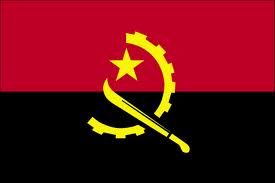
Flag of Angola
On 6 June 1960, Agostinho Neto was arrested at his practice as a result of his campaigning against the Portuguese colonial administration of Angola. When patients, friends, and supporters marched in demonstration for his release, the police opened fire and 30 were killed, 200 more injured. This became known as the Massacre de Icolo e Bengo (his birthplace). Neto was exiled to and held in captivity initially in Cape Verde and then in Portugal, where he wrote his second volume of poetry. After international pressures, the Portuguese government put him under house arrest, where he escaped to Morocco and later to Zaire (Congo).
He became president of the MPLA in 1962, and looked for support in the American government against Portugal, but was turned down. He received the support of Cuba and the Soviet Union for the fight for the freedom of the people of Angola from Portuguese imperialism.
After the Revolução dos Cravos (Carnation Revolution) in 1974 in Portugal, which took down the government by a military coup, Portugal’s foreign policy changed in its African colonies. On 11 November 1975, Angola became independent, and Neto was proclaimed president on that day. The country was effectively held under the rule of three independence movements, with the MPLA holding the central section and the capital.
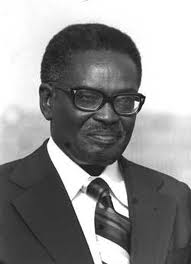
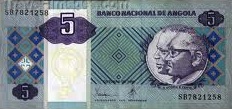
Agostinho Neto & Jose Eduardo dos Santos
Neto’s rule was marked by armed conflict with Holden Roberto’s FNLA (supported by Mobutu of Zaire, and the US) and Jonas Savimbi‘s UNITA which had military support from South Africa. While Neto enjoyed the help and support of the Soviet Union and Cuba, he still encouraged Western investment in the country – especially in oil production. He died of cancer on September 10th, 1979 in Moscow. After his death, the civil war in Angola lasted for over a quarter of a century opposing Jose Eduardo dos Santos (his successor) and Jonas Savimbi.
Agostinho Neto was not only Angola’s first president, he was also a medical doctor, and a poet; he is actually one of Angola’s most acclaimed writer and poet. Please check out the website of the Fundação António Agostinho Neto, which has done a brilliant work in presenting Neto’s writings, debates, and comments by other leaders on Neto. Now I leave you with his great saying: “A luta Continua … A Vitória é certa!”






 African Heritage