African Art Restitution: France puts out 9 Conditions

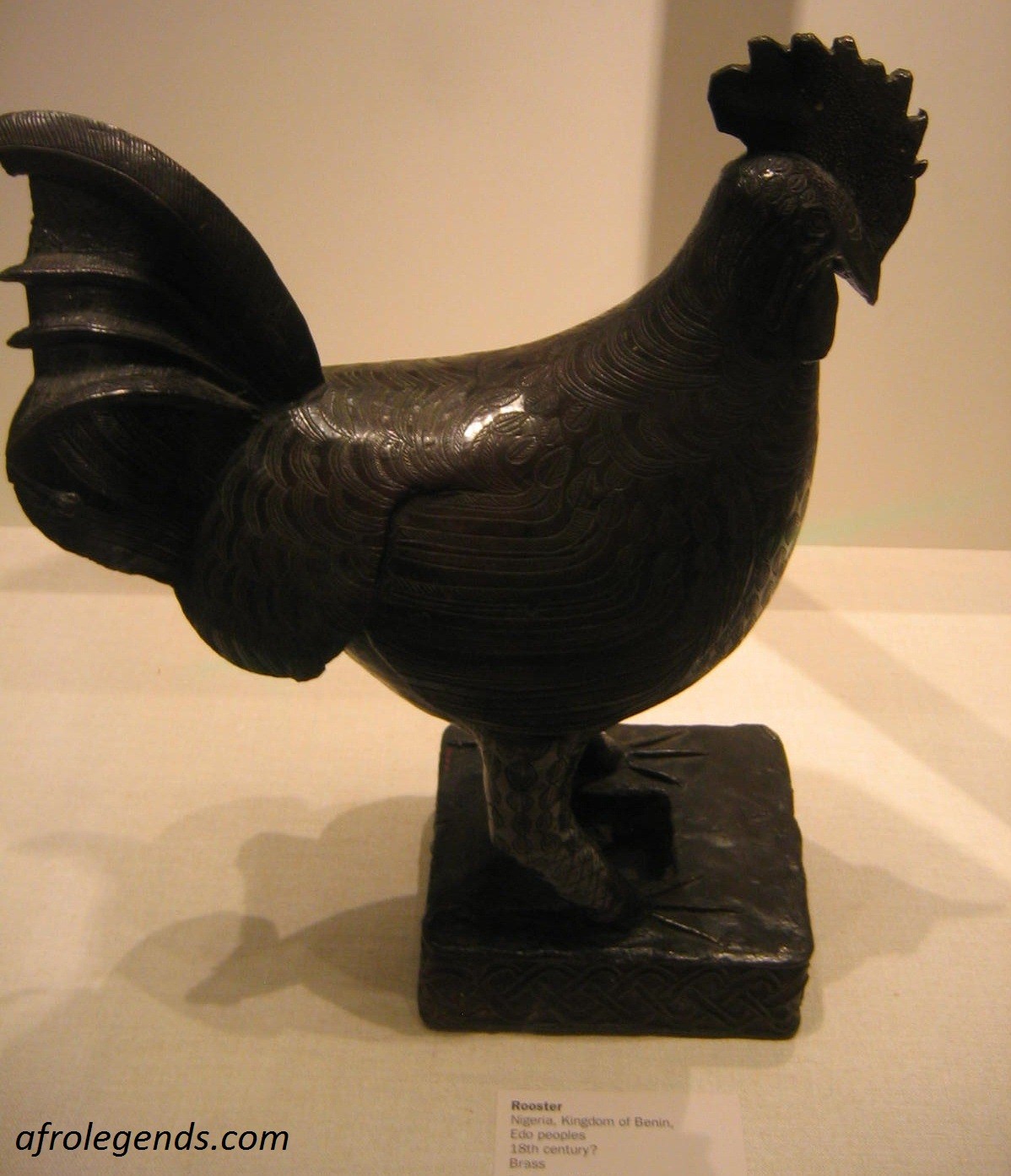
Rooster from Benin Kingdom (18th century)
Rooster from Benin Kingdom (18th century), exposed at the MET

A thief comes to your house, steals from you, and then years later when you try to recover what is yours, he gives you conditions for the return of what he looted from your house. Does it not sound unbelievable? This is what is currently going on with the restitution of African artifacts: everyday new conditions are given for the return of African art. Conditions such as “the works be well kept and exhibited after their return,” make no sense given that these objects in African cultures were mostly not used for art-sake but rather held functional values. It is sad, but hey, if you have no power, it is hard for others to return what they have stolen from you. Just because one artifact is returned here and there, it does not account for all of them. As stated countless times before, united we stand, divided we fall. As African nations ask for the return of what is rightfully theirs, each country should not go on its own to ask for the return of its national treasures, we should all be united. A couple of years back, Madagascar paid for the return of the belongings of Queen Ranavalona III. Similarly, this past April, Algeria recently got the return of a 17th-century manuscript written by the venerated leader of Algerian fight against colonialism Abd el Kader, which had been confiscated by French authorities in 1842; Algerian diaspora mobilized to combine money and resources to recover this Islamic manuscript. Being united will also help in countering conditions like “the object must not be claimed by another nation and the request cannot be accompanied by a request for monetary reparations,” especially since the current boundaries of African countries were formed after independence, thus there are bound to be common artifacts between countries.

Below are excerpts from The Art Newspaper. To learn more, also read new French laws on restitution of looted art on RFI, and Hyperallergic…  simply appalling.

====

Queen from Benin kingdom
Queen from Benin kingdom, exposed at the MET

France is finally releasing its long-awaited policy on the charged issue of the restitution of cultural property… The report was commissioned by President Emmanuel Macron [to ex-Director of the Louvre Museum Jean-Luc Martinez, who has since then been charged with complicity in fraud and concealing the artworks’ origins] and the government has already implemented some of its recommendations, most notably a bill on art looted by the Nazis, which will be discussed by the Senate on 23 May.

And a further two laws will be passed in coming months, … One could apply to items from the former colonies of Western empires, which the report defines in global terms, rather than just Africa and its former French dominions. The other pertains to human remains.

… Martinez tells the Art Newspaper that his report recommends studying the requests for restitutions by eight African countries to establish a “criteria of returnability”. Rather than basing this on an ideological or moral standpoint, he says he wishes to take a “pragmatic approach in order to define a framework policy of restitutions“.

He has come up with two main criteria as the basis for restitutions: “illegality and illegitimacy“. For example, according to French law at the time of France’s colonial invasion of Algeria in the early 19th century, weapons can be legally seized from an enemy but cultural goods had to be returned after battle. So the books and clothes of the rebel leader Abdelkader ibn Muhieddine (commonly known as Abdelkader) should have been given back to him when he surrendered, making their status in France “illegitimate“.

Likewise, if an officer handed looted goods to a French museum, as was the case for many objects looted from the Kingdom of Benin, the donation should be considered “illegal because such personal war booty is not allowed.” A key recommendation of the report is that requests for restitution be studied by a bilateral scientific commission which will publicly provide an opinion before the final decision of French courts [more bureaucracy].

… This report comes nearly six years after Macron publicly called for the “return of African heritage” during a state visit to Burkina Faso. And it has been four-and-a-half years since the academics Bénédicte Savoy and Felwine Sarr made the case for systematic restitutions to African countries. Since then, the issue has been somewhat downplayed, but it remains a sensitive subject.

France Returns Sword of Senegalese Hero Omar Tall … Temporarily

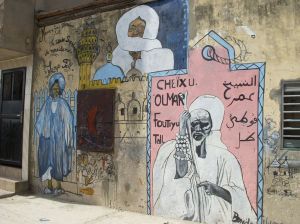
Omar Tall
Mural in Dakar showing Omar Tall (Source: Wikipedia)

At first I was thrilled by the news that France had returned the sword of the Senegalese hero Omar Tall, … until I read the fine prints! Then I read that this was a temporary return, more like a 5-year loan to Senegal, until the French parliament approves whether to permanently return it or not. Moreover, the sword was already on loan at a Museum in Senegal. Nevertheless, you will notice like me that the media titled it a ‘return.‘ In reality, this is more like a publicity campaign for the French who seemingly appear to be returning looted treasures.

Before delving into the excerpt below from the BBC article, it is good to say a few words about Omar Saidou Tall or Umar Tall, and why he is so venered by Senegalese. Omar Saidou Tall was a religious, political, and military leader who fought against French colonization in the region then known as French Sudan which encompassed Senegal, Mali, and Guinea. He opposed a fierce resistance to the French from 1857 to 1859. Senegalese tend to remember him as a hero of anti-French resistance, while Malian sources tend to describe him as an invader who paved the way for the French by weakening West Africa. We will go deeper into his life and legacy in the next post.

======

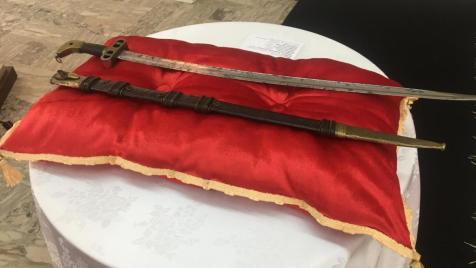
France has restored to Senegal a sabre that belonged to a 19th Century Islamic scholar and ruler.

It is part of a commitment to return to its former West African colonies key items of their cultural heritage.

The artefact originally belonged to the revered west African leader Omar Saidou Tall, who led an anti-colonial struggle against the French.

… Mr Philippe [France’s prime minister] said it was “the first step” in a project aimed at returning more Senegalese artefacts currently in French museums, which hold at least 90,000 artefacts from sub-Saharan Africa.

Last year a group of experts commissioned by France’s President Emmanuel Macron recommended that African treasures in French museums be returned to their countries of origin.

sabre_0
Omar Tall’s Sword (Source: RFI)

Their official report states that most of the Africa collection in Paris’ Quai Branly museum – approximately 46,000 pieces – was acquired with some degree of duress [not sure that they will return all these artefacts and leave their museums empty].

It’s symbolic. It had been lent to us before, but now it is being restored to us,” the head of Dakar’s Museum of Black Civilisations Hamady Bocoum told AFP news agency about the sabre.

The curved iron, brass and wood sword has been kept in its leather sheath in the museum in Senegal’s capital on loan from France. But Sunday’s ceremony saw the item formally returned for a period of five years.

The next stage will be for French MPs to vote on whether to permanently return this and other artefacts.

Europe’s Largest Museums to “Loan” Looted Benin (Nigerian) Artifacts back to Nigeria

Queen from Benin kingdom
Cast Bronze figurine from Benin City at the MET museum

Unbelievable! I had to share this article about European museums loaning looted African artifacts back to Africans. It sounds so mind-boggling! How can someone steal from you, steal your cultural work, the work of your ancestors, your sweat, and then several years later loan it back to you, not even return it? and they call that progress! For the entire article, go to  Europe’s Largest Museums Will Loan Looted Benin Bronzes to Nigeria and What do you know about Africa’s looted art treasures.

=======

Major museums across Europe have agreed to loan important artifacts back to Nigeria for a new museum the country plans to open in 2021. The African nation’s Royal Museum will house a rotating display of artifacts, including the Benin bronzes that were looted during the Benin Expedition of 1897. The agreement marks a significant step after years of negotiations among European institutions and Nigerian authorities.

Art from Benin kingdom (18th century)
Benin City art exposed at the MET Museum, NYC

… Together, museum leaders from Austria, Germany, the Netherlands, Sweden, and Britain agreed to facilitate a display at the planned institution within three years. Further specifics—including which objects will be loaned over what period of time—have yet to be confirmed.

… The objects in question were looted by the British army during a so-called “punitive expedition” in 1897. The army took around 4,000 intricate sculptures, including bronze works now known as the Benin bronzes, from the king’s palace in the former Kingdom of Benin.

A century later, the vast majority of these bronzes have ended up in some of the world’s most important museums, including the British Museum in London and the Metropolitan Museum of Art in New York. …

Benin City-Cast_brass_plaques_from_Benin_City_at_British_Museum-1024x721
Cast brass plaques from Benin City at the British Museum. Photo: Andreas Praefcke