We have been told by many that “Africans sold their brothers” into slavery. However, we have seen before, When the Kongo King, King Mvemba a Nzinga, most commonly known as Afonso I of Kongo, or Nzinga Mbemba, wrote to the King of Portugal against Slavery, that many kings fought against such. King Afonso I was concerned about the depopulation of his kingdom through the exportation of his own citizens into slavery, and complained to the Portuguese king against it. Below, we will see that the above statement is mostly a false statement invented by the guilty to turn the victim into an accomplice.
Here is Guillaume Bosman in La Traite des Noirs au Siècle des Lumières (Témoignages de négriers), p.38 who also confirms the disorganization of Black Africa by slave-trading Europe. He writes:
“there are many people among us who imagine that fathers sell their children here, husbands their wives, and brothers their brothers, but they are wrong. This never happens except out of necessity and for some crime; most of the slaves taken to us are people who have been taken prisoner in war, and whom the victor, considering as his booty, has sold to make a profit.”
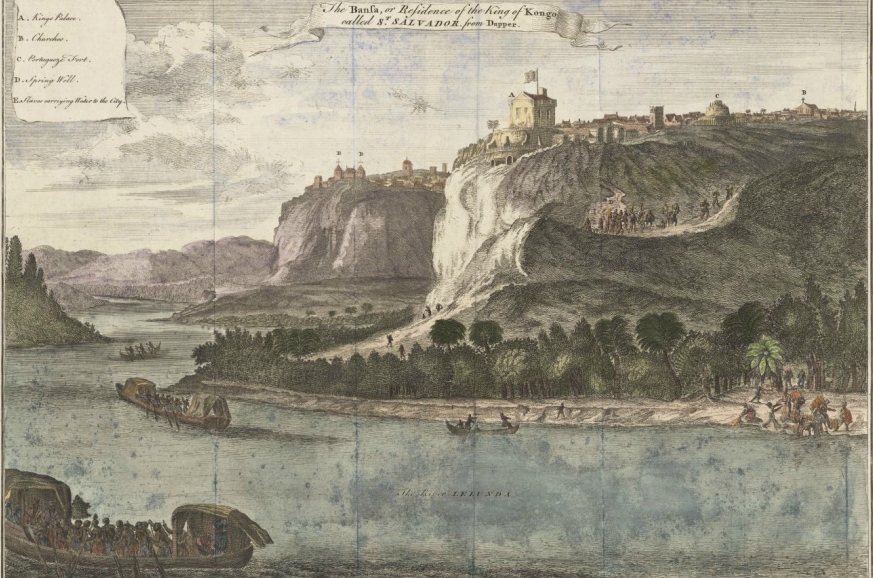
Mbanza Kongo, capital of the Kingdom of Kongo, in 1745
King Mvemba a Nzinga, most commonly known as Afonso I of Kongo, or Nzinga Mbemba, was a Kongo king who ruled over the Kongo Empire from 1509 to late 1542 or 1543. He wrote a letter in 1526 to the Portuguese king decrying the capture of his subjects to be taken as slaves in the transatlantic slave trade. The Portuguese were also assisting brigands in Kongo and illegally purchasing free people as slaves. This letter contradicts the story that African kings sold their own into slavery, as has been re-told countless times in history books; moreover, this is also similar to Queen Nzingha‘s stance against slavery a century later; she fought almost 40 years against the Portuguese for the freedom of her people. Afonso I of Kongo wrote:
=====
“Each day the traders are kidnapping our people – children of this country, sons of our nobles and vassals, even people of our own family. This corruption and depravity are so widespread that our land is entirely depopulated. We need in this kingdom only priests and schoolteachers, and no merchandise, unless it is wine and flour for Mass. It is our wish that this Kingdom not be a place for the trade or transport of slaves.”
Many of our subjects eagerly lust after Portuguese merchandise that your subjects have brought into our domains. To satisfy this inordinate appetite, they seize many of our black free subjects…. They sell them. After having taken these prisoners [to the coast] secretly or at night….. As soon as the captives are in the hands of white men they are branded with a red-hot iron.
Afonso was also concerned about the depopulation of his kingdom through the exportation of his own citizens into slavery. The king of Portugal responded to Afonso’s concerns, writing that because the Kongo purchased their slaves from outside of the kingdom and converted them to Christianity and then intermarried with them, the kingdom probably maintained a high population and probably was not affected by the missing subjects. To lessen Afonso’s concerns, the king [of Portugal] suggested sending two men to a designated point in the city to monitor who was being traded and who could object to any sale involving a subject of Afonso’s kingdom. The king of Portugal then wrote that if he were to cease the slave trade from the inside of the Kongo, he would still require provisions from Afonso, such as wheat and wine.



 African Heritage