Ne fais pas attention à la façon de marcher d’un caméléon; là où il veut arriver, il arrivera(Proverbe Basuto – Lesotho, Afrique du Sud, Botswana). Il est déterminé.
Do not mind the way the Chameleon walks; where he wants to get to, he will get to(Sotho proverb – Lesotho, South Africa, Botswana). He has a sense of purpose.
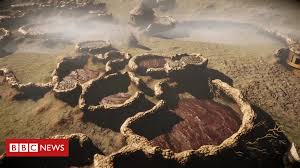
The Ancient city of Kweneng, in South Africa (Source: BBC)
A few days ago, the ancient lost city of Kweneng in modern-day South Africa was uncovered using LIDAR (light detection and ranging) technology. LIDAR is a surveying method that measures the distance to a target by illuminating the target with pulsed laser light and measuring the reflected pulses with a sensor. Differences in laser return times and wavelengths can then be used to make digital 3-D maps of the targeted area. A few months back, scientists and archaeologists had unearthed an ancient Mayan megalopolis the size of New York City or Mexico City (Hidden Kingdoms of the Ancient Maya Revealed in a 3-D Laser Map), buried under Central American jungles using LIDAR.
Now, Archaeologists using the same technology have rediscovered the ancient city of Kweneng, just outside Johannesburg in South Africa. The settlement dates back to the 15th Century, and was home to up to 10,000 people from the Tswana ethnic group. This is an amazing step forward, and I am sure many more ancient cities around the globe, and in Africa in particular, will be uncovered!
Today, I have translated Mariam Sankara‘s declaration on the day of the 30th-year anniversary of the death of her husband, the president of the Faso, the great revolutionary Thomas Sankara.
Very often we forget women’s contributions to revolutions, history acts as if these men had been all alone. If Mariam Sankara had not been home to take care of their two children, to take care of Thomas when he got home after a hard day, do you think we would have had a revolution? If Winnie Mandela had not carried on the battle, do you think the world would have known about Nelson Mandela? Maybe not… because during those 27 years while Nelson was living a ‘somewhat’ cozy life in prison, Winnie was being jailed, attacked, harassed, beaten to death, had to run to exile several times, but she kept his name high up. Now, today, history chooses to only count his contributions, forgetting hers!
So here is the declaration from Mariam Sankara, that she made last year on 15 Oct 2017. The original on ThomasSankara.net; the text has been translated to English by Dr. Y., Afrolegends.com
========
Thomas Sankara a Ouagadougou
Ladies and gentlemen, dear friends,
The assassination of President Sankara and his companions on October 15, 1987, interrupted an original and promising development experience in the history of contemporary Africa.
I would like to thank you for your support to the whole Sankara family and to me as well as for your loyalty to the memory of President Thomas Sankara.
Through his policy, Thomas defended, by giving the example himself, essential values such as integrity, honesty, humility, courage, will, respect and justice. By mobilizing the various components of society, he fought hard against the debt, for the well-being of all Burkinabé, the promotion of Burkinabé cultural heritage and the emancipation of women. He urged his fellow citizens to take care of themselves to live with dignity. In short, he refused submission to the diktat of the most powerful in this world, took the defense of the weakest and most disadvantaged. Impregnated with these values and ideas, you have, through the popular uprising of October 30 and 31, 2014, put an end to the dictatorial regime of Compaoré. This insurrection has allowed the people to take back the floor to demand, among other things, the end of impunity, the reopening of the justice file on the assassination of Thomas Sankara and his companions, that of Norbert Zongo and many others.
Flag of Burkina Faso
The decision taken in Burkina Faso by the transitional authorities to finally bring justice to Thomas Sankara has generated immense hope in Burkina, in Africa in general and in the world. But we are still waiting for justice.
The request of the civil society and families is clear. We want to know as soon as possible the sponsors and the executors of this assassination and those of the other crimes.
To delay the quest for truth is to play the game of the assassins of Thomas Sankara and his companions. To do no justice is to refuse a dignified burial for Thomas Sankara and his companions, it is to prevent families from mourning.
That is why the people of Burkina Faso and their friends must remain mobilized and relaunch the campaign so that thirty years later, justice is finally done for Thomas Sankara and his companions.
Dear compatriots, our family welcomes your initiative to erect a memorial to Thomas Sankara.
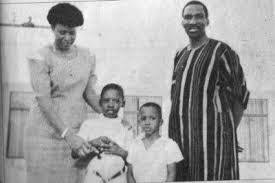
Mariam and Thomas Sankara with their children
Like many of our compatriots, we are committed to the defense and safeguarding of Thomas Sankara’s memory. I would like to salute this initiative of the civil society, led by the association CIMTS (International Committee for the Thomas Sankara Memorial). This Memorial project enjoys popular support. A consensual and inclusive approach should allow to realize a quality work which will testify to the vitality of the ideas of Thomas and his faithful companions of the revolution of August 4, 1983. However, the family wants this memorial not to be built in the enclosure of the Council of the Entente which brings back painful memories because of the assassinations and the tortures which have marked this place.
With all these wishes for the valorization of the memory of Thomas observed around the world, one realizes with the time that Thomas Sankara was a visionary. Aware of the actions of the critics of the revolution, he knew he was misunderstood because he was ahead of his time. He said back then: “kill Sankara, thousands of Sankara will be born”. This has become a reality. Today, we see that the youth is immersed in its progressive ideas to transform society.
Thirty years after his death, Thomas’s thought remains alive and of actuality.
Once again, I congratulate you on your commitment and your loyalty to the memory of President Thomas Sankara.
30 years of resistance!
30 years of impunity!
Finally bring justice to Thomas Sankara and his companions and to all the victims of unpunished crimes!
One of Seychelles’ most acclaimed and prolific author is the writer Antoine Abel, who had been an ambassador of the indigenous culture of the island nation. He is considered by many as the father of Seychelles’ literature, and had an extensive career writing novels, short stories, poetry and plays in French, English, and Creole. Most of his work dealt with the folklore of the Seychelles, and the natural environment of the islands, in which he wove in colorful personalities and histories inspired from the local culture. Descending from a family of slaves, he is the first Seychellois writer to expose to wide world to the literary gems of the country.
Below is one of his poems, ‘Dances d’hier‘ translated to English by Dr. Y., Afrolegends.com. Enjoy the poem below, and also check out The Seychelles Ministry for Youth Sports and Culture which ‘remembers Antoine Abel.’
Danses d’hier
J’entends encore les staccatos Le prolongement des sons des tam-tams Des tam-tams du temps jadis
Alors les collines s’enflamment Dans la nuit sèche Les pieds des danseurs Se baignent dans la fine poussière De latérite Et leurs pas scandent sauvagement Un rythme endiablé
J’entends encore les notes rapides La voix étouffée du « commandeur » Se modulant dans l’air tiède du soir.
Alors les échines s’arc-boutent Les unes aux autres Et les hanches roulent comme des houles Les ventres des danseuses voluptueuses Ondulent lascivement… Et des voix confuses s’interpellent Impudemment.
Je perçois toujours les staccatos Les grondements des “grosses caisses” Par delà les années de mon enfance … Je les porte en moi Comme des stigmates.
Dances of Yesterday
I still hear the staccatos The extension of the sounds of the drums The drums from the old days
Then the hills ignite (flare) In the dry night The dancers’ feet bathe in the fine dust of laterite And their steps wildly chant A frenzied rhythm
I still hear the quick notes The muffled voice of the « commander » Modulating in the warm evening air.
Then the backs bridge One with the other And the hips roll like swells The bellies of the voluptuous dancers Wave sensually… And confused voices call out Impudently.
I still perceive the staccatos The rumblings of the “big drums” Beyond the years of my childhood… I carry them in me Like stigmas.
Have you ever wondered about the meaning for the name of the country Seychelles? Somehow to me, it has always felt like it should be a derivative of ‘sea shells’, especially given that it is an island country located in the middle of the Indian ocean. I picture sandy beaches, blue waters, coconuts, and then ‘sea shells‘ seems like a perfect name for such a beautiful place. How far am I from the truth?
Victoria, capital of Seychelles, in the 1900s
Well, it turns out that the Seychelles islands were named after Jean Moreau de Séchelles, Louis XV‘s Minister of Finance, in 1756 when the French set a Stone of Possession on the islands Mahé. Before then, it was a transit point for trade between Africa and Asia. The first visitors to the island were probably Arab traders, but the earliest recorded sighting by Europeans took place in 1502 by the Portuguese Admiral Vasco da Gama, who passed through the Amirantes and named them after himself (islands of the Admiral). The earliest recorded landing was in January 1609, by the crew of the “Ascension” under Captain Alexander Sharpeigh during the fourth voyage of the British East India Company.
The islands went under British control in 1814 after the Napoleonic wars. Seychelles became a crown colony separate from Mauritius in 1903. In 1976, Seychelles became independent from the United Kingdom as a republic within the Commonwealth.
Seychelles national bird: The Seychelles black parrot
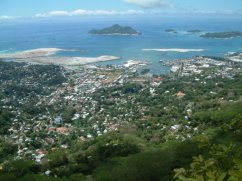
Seychelles is located in the Indian Ocean, northeast of Madagascar and about 1,600 km (994 mi) east of Kenya. The capital of the 115–island country, Victoria, lies 1,500 km (932 mi) east of mainland East Africa. The majority of its islands are uninhabited with many dedicated as nature reserves. With a population of roughly 94,228, it has the smallest population of any sovereign African country. Its population is a melting pot of African, French, Indian, and Chinese, where the largest group is of African descent. The food and music duly reflect this fusion of cultures.
Victoria, Seychelles, today
After proclamation of independence from the United Kingdom in 1976, Seychelles has developed from a largely agricultural society (main exports were cinnamon, vanilla, and copra) to a market-based diversified economy, with agriculture being supplanted by rapidly rising service and public sectors as well as tourism. Seychelles is among the world’s leading countries to protect lands for threatened species, allocating 42% of its territory for conservation. Seychelles today is known for success stories in protecting its flora and fauna.
Thus, if you visit Seychelles today, be amazed by its ‘sea shells’, sandy beaches, beautiful fauna, and flora. Enjoy!
Below is the testimony of one of Fossi Jacob ‘s daughters. If you ever get a chance, you should read “My Dad was Fossi Jacob: Itinerary of a martyr of the Cameroonian Independence” written by Fossi Jacob’s first son, Abraham Sighoko Fossi (“Papa s’appelait Fossi Jacob: Itinéraire d’un martyr de l’indépendance du Cameroun“). To learn more about France’s genocide in Cameroon, the books ‘Kamerun. La guerre cachee de la France en Afrique noire‘ (Kamerun. France’s Hidden War in Black Africa) and Mongo Beti ‘s ‘Main Basse sur le Cameroun, autopsie d’une décolonisation‘ (Cruel hand on Cameroon, autopsy of a decolonization).
12 September should be commemorated in Cameroon in memory of Fossi Jacob, a man who, by his selfless act, saved countless lives, and in memory of all the victims of the French genocide.















 Below is the testimony of one of
 African Heritage