Today, Oliver Mtukudzi, one of Zimbabwe’s most renowned musicians, has changed his plane of existence. He passed away to join his ancestors, after over a four-decade career. He, like Bra Hugh, Hugh Masekela, was a giant of African music, particularly Afro-Jazz. Just like Bra Hugh, he passed away on the same day, a year later.
To his fans he was affectionately known as Tuku. With his deep voice, he came to prominence in the 1970s as one of the voices of the revolution fighting white-minority rule.
The singer and guitarist mixed several different styles to create his own distinctive Afro-jazz sound, known to his fans as “Tuku Music“.
In 2018, Mtukudzi spoke to Eyewitness News about why he chose to stay in the music business: “My music is about touching the hearts… never mind how old. If a baby is born today, she/he must be able to relate to my music.”
I live you here with one of my favorite from Tuku: Neria.
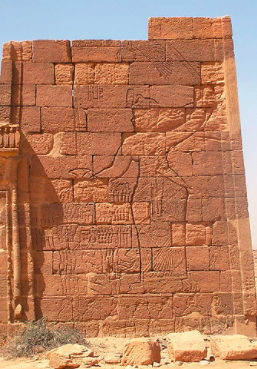
Sculpture of Candace Amanirenas on a pyramid wall in Barwa, Sudan
Amanirenas was a great Candace, queen, of the Nubian kingdom, mother to queen Amanishakheto, and grandmother to queen Amanitore. Amanirenas was a great warrior queen. She built considerable pyramids and temples at Wad Ban Naqa, where she was buried with great treasures.
Her full name and title was Amnirense qore li kdwe li (“Ameniras, Qore and Kandake“). She reigned from about 40BC to 10BC, and is one of the most famous Kandakes, because of her role leading Kushite armies against the Romans in a war that lasted five years, from 27 BCE to 22 BCE. After an initial victory when the Kushites attacked Roman Egypt, they were driven out of Egypt by Gaius Petronius and the Romans established a new frontier at HiereSycaminos (Maharraqa).Amanirenas was described as brave, and blind in one eye. Some say that her name means ‘Amani is her name’. Amani is the Nubian name for Imana/Amon, Unique God of Africa.
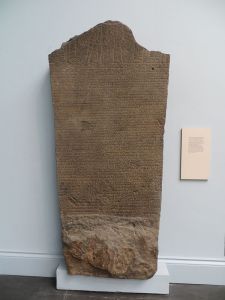
Hamadab stela showing Queen Amanirenas and Prince Akinidad facing various Egyptian deities Amun and Mut
Meroitic inscriptions give Amanirenas the title of qoreas well as Kandakesuggesting that she was a ruling queen. She is usually considered to be the queen referred to as “Candace” in Strabo‘s account of the Meroitic war against the Roman Empire. Her name is associated with those of Teriteqas and Akinidad. King Teriteqas died shortly after the beginning of the war. She was succeeded by Akinidad (possibly the son of Teriteqas) who continued the campaign with his mother Amanirenas. Akinidad died at Dakka c. 24BC. The loss of one eye during battle made Amanirenas even stronger and braver. She despised death, and her fearlessness forced the admiration of Strabo, the Greek historian, who said, “this queen has a courage above that of her gender.”
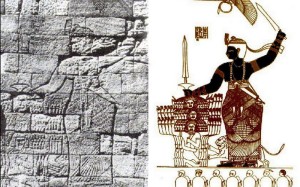
When Aelius Gallus, the Prefect, or chief magistrate, of Egypt, was absent on a campaign in Arabia in 24 BC, the Kushites launched an attack on Egypt. Amanirenas and Akinidad defeated Roman forces at Syene and Philae, and drove the Jews from Elephantine Island. They returned to Kush with prisoners and loot, including several statues of Emperor Augustus ; the Queen buried a bronze likeness of the Emperor beneath the entranceway to her palace so that she and all who came and went could tread on the head of her enemy. The head, found in Meroë in 1912, now resides in the British Museum
Stela showing Candace Amanirenas crushing Roman enemies. This also appears in Cheikh Anta Diop’s book cited below
The Kushites were driven out of Syene later in the year by Publius Petronius, who now held the office of Roman Prefect in Egypt. According to a detailed report made by Strabo, the Roman troops advanced far into the Kingdom of Kush, and finally reached Napata. Although they withdrew again to the north they left behind a garrison in Qasr Ibrim (Primis), which now became the border of the Roman Empire. The Kushites made a renewed attempt to seize Primis, but Petronius forestalled this attempt.
A peace treaty was signed between the Meroites and Augustus in the year 21/20 BC, which continued until the end of the third century AD, with relations between Meroë and Roman Egypt remaining generally peaceful during this time. However, the Kingdom of Kush had begun to fade as a power by the first or second century AD.
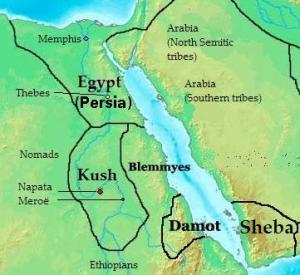
Nubia or the Kingdom of Kush in 400BC
Thereafter a preponderant place falls to two queens, Amanirenas and
Amanishakheto. Their husbands remain forgotten and we do not even know the name of Amanishakheto’s. The throne was also occupied for some years by a king, the former prince Akinidad, son of Queen Amanirenas and King Teriteqas. Nevertheless, it is important which of these two queens came first, both of them ‘Candace’, which is the transcription of the Meroitic title Kdke according to the tradition of the classical authors.
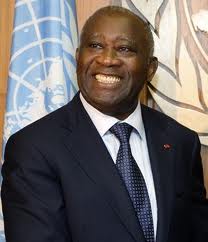
Joy is in our hearts! It has taken us 8 years but we have overcome, or rather Laurent Gbagbo and Charles Blé Goudé (How long shall they kill our prophets…?)have overcome. The hour is to joy, and gratitude, because truly perseverance has been their motto for the past few years. All these tough years of claiming their innocence, all these years of constant support and people’s prayers, dedication, love, and determination have born fruits. Yesterday, January 15th 2019, Laurent Gbagbo and Charles Blé Goudé were acquitted of war crimes at the ICC. I rejoice in this step forward. I live you with snippets of the article from the NPR below. In latest news, the prosecution is trying to bar Gbagbo and Blé Goudé from returning to their home country of Côte d’Ivoire, and instead wants to keep them roaming through in Europe: this is another case of Deportation of African Heads of States. We will keep fighting to the last drop! As Agostinho Neto said: “La luta continua e la victoria e certa!”
====
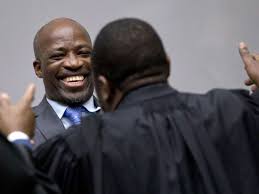
Charles Blé Goudé celebrating with his legal team on 01/15/2019 (SkyNews)
A panel of judges at the International Criminal Court has dismissedcharges of war crimesagainst former Ivory Coast President Laurent Gbagbo, the first former head of state to stand trial at the ICC. Charges against his former youth minister, Charles Blé Goudé, also were dropped.
[…] A majority of the three-judge panel concluded that prosecutors had failed to show that there was a “common plan” to keep Gbagbo in power, nor “the existence of patterns of violence from which it could be inferred that there was a ‘policy to attack a civilian population,’ ” the court said in a press release.
Public speeches by Gbagbo and Blé Goudé did not constitute ordering, soliciting or inducing the alleged crimes, the judges said – adding that they needed no further evidence from the defense.
[…] After refusing to hand over power, Gbagbo was pulled from an underground bunker at the presidential residence in Abidjan in April 2011, and thenwhisked to The Haguein November 2011. He was held in custody for more than seven years.
Roy Allela has developed a glove that translates sign language to speech via a bluetooth-enabled smartphone. Photograph: Brett Eloff/Royal Academy of Engineering
I once observed the communication of a mute person on his tablet via Skype to his relative. While waiting in the airport that day, I marveled at the beauty of technology, at what had been made possible: that someone born mute or deaf could communicate, via sign language, to his loved ones, make up a ‘video’ call to tell them ‘I am catching up my plane’ or ‘I made it safely to the airport, we should be taking off shortly’. Now this invention out of Africa tries to make into audible speech Sign language so that all could be able to communicate. Simply love it! The article is from the Guardian.
======
Roy Allela’s six-year-old niece was born deaf. She found it difficult to communicate with her family, none of whom knew sign language. So Allela – a 25-year-old Kenyan technology evangelist who works for Intel and tutors data science at Oxford University – invented smart gloves that convert sign language movements into audio speech.
The gloves – named Sign-IO – have flex sensors stitched on to each finger. The sensors quantify the bend of the fingers and process the letter being signed. The gloves are paired via Bluetooth to a mobile phone application that Allela also developed, which then vocalises the letters.
“My niece wears the gloves, pairs them to her phone or mine, then starts signing and I’m able to understand what she’s saying,” says Allela. “Like all sign language users, she’s very good at lip reading, so she doesn’t need me to sign back.”
Allela piloted the gloves at a special needs school in rural Migori county, south-west Kenya, where feedback helped inform one of the most important aspects of the gloves: the speed at which the language is converted into audio.
“People speak at different speeds and it’s the same with people who sign: some are really fast, others are slow, so we integrated that into the mobile application so that it’s comfortable for anyone to use it.”
The Sign-IO app, which vocalises words signed by the person wearing the gloves. Photograph: Brett Eloff/Royal Academy of Engineering
Users can also set the language, gender and pitch of the vocalisation through the app, with accuracy results averaging 93%, says Allela. Perhaps most importantly, the gloves can be packaged in any style the user wants, whether that’s a princess glove or a Spider-Man one, he says. “It fights the stigma associated with being deaf and having a speech impediment. If the gloves look cool, every kid will want to know why you have them on.”
The gloves recently won the hardware trailblazer award from the American Society of Mechanical Engineers (ASME) and Allela is using the prize money to land more accurate vocal predictions.
“I was trying to envision how my niece’s life would be if she had the same opportunities as everyone else in education, employment, all aspects of life,” says Allela.
“The general public in Kenya doesn’t understand sign language so when she goes out, she always needs a translator. Picture over the long term that dependency, how much that plagues or impairs her progress in life … when it affects you personally, you see how hard people have it in life. That’s why I’ve really strived to develop this project to completion.”
Beth Koigi plans to use her Majik Water innovation to increase access to drinking water among low-income households. Photograph: Brett Eloff/Royal Academy of Engineering
I had to share this beautiful invention coming out of Africa, helping thousands get clean water, and water in times of drought. The article can be found on The Guardian‘s website.
======
When Beth Koigi moved into her university dormitory in eastern Kenya, she was horrified that the water coming out of the tap was filthy and laden with bacteria. Within months, she had built her first filter and was soon selling filters to others. When drought hit in 2016 and water restrictions saw Koigi’s water supply turned off entirely, she began thinking about water scarcity and its relation to climate change.
“Going for months without any tap water became a very bad situation,” she says. “Where I used to live, we didn’t get any tap water at all, so even doing simple things like going to the toilet – I would go to the mall instead. Having no water at all is worse than just having unpurified water, so I started thinking about a way to not have to rely on the council.”
While on a four-month programme at the Silicon Valley-based thinktank Singularity University, Koigi, 27, joined up with two other women – American environmental scientist Anastasia Kaschenko and British economist Clare Sewell – to create Majik Water, which captures water from the air and converts it into drinking water using solar technology.
The device – which won first prize this year at the EDF Africa awards – could provide a solution for the 1.8 billion people predicted to have a shortage of water by 2025, according to the UN, says Kaschenko.
The Majik Water system, which can generate up to 10 litres of filtered water a day. Photograph: Brett Eloff/Royal Academy of Engineering
“There’s an interesting relationship between climate change and the water in the atmosphere,” she says.
“There’s six times more water in the air than in all the rivers in the world. With every 1F increase in temperature, water begins to evaporate on the ground but increases by about 4% in the atmosphere, and that’s water that’s not being tapped.”
Majik Water – from the Swahili maji for water and “k” for kuna (harvest) – uses desiccants such as silica gels to draw water from the air. The gels are then heated up with solar power to release the water. The current system can generate up to 10 litres of filtered water per day, with the team looking to scale up to 100-litre systems at a cost of only £0.08 per 10 litres.
The solar panels used for the prototype are the most expensive input on the device, says Koigi, who is looking for ways to drive those costs down.
Fellow readers, we wish you all an AMAZING new year. May the year 2019 mark the beginning of new chapters, the fulfillment of some, and also the closure of old ones. May this new year bring you a lot of joy, may your dreams be fulfilled, and last a lifetime.We would like to express our profound gratitude for your constant support, as your readership has carried us forward. Thank you to all those who visited the blog, reblogged articles, commented, corrected us, and to all future visitors. 2018 was a beautiful year: Afrolegends.com had lots of views, subscribers, contributors, and many articles reblogged on multiple sites.
Happy 2019!
The top 6 posts of 2018 are listed below. For this new year, 2019, we will bring you even more amazing, fun, and rich articles. Keep trusting, reading, sharing, reblogging, and liking. We wish you all a beautiful, full, and amazing new year, rich in blessings, and rich in greatness. May 2019 be the year of greatness!Keep your heads up, and may your year be as bright and plentiful as the petals of this flower! As always, like Agostinho Neto said, “A luta continua … a vitória é certa!”
Who or what did we celebrate in 2018 in Africa. Here are 10 people, events and things, which marked the year 2018 (if there are some other you would like to share, please send them in):
Sahle-Work Zewde, Ethiopia’s first female president, with the Prime minister Abiy Ahmed, on the day she was elected
1. Abiy Ahmed Ali became prime minister of Ethiopia this year, and brought in a wave of new measures. He is particularly noted for ending decades of border disputes between Eritrea and Ethiopia, bringing in the 2 sisters back together, releasing thousands of political prisoners and for having half of his government made up of women, some in key positions including the ministry of defense.
2. Ethiopia welcomed its first female president in the person of Sahle-Work Zewde. Mrs. Zewde was unanimously elected president by members of the Federal Parliamentary Assembly on 25 October 2018. Sahle-Work’s appointment makes her the first female Ethiopian head of state since Empress Zewditu.
3. Peace between Eritrea and Ethiopia. Peace at last with the end of the border dispute in June and July of this year, marking the end to decades of tension between the 2 sisters.
4. The release from jail of Simone Gbagbo. The former first lady of Côte d’Ivoire was released on 8 August 2018, after 7 years in prison. We are so grateful; it took us 7 years, but Simone is free at last. Free at Last: Simone Gbagbo Liberated.
10. Not sure whether to applaud this or not: Major museums across Europe have agreed to loan important artifacts back to Nigeria for a new museum the country plans to open in 2021 (Europe’s Largest Museums to “Loan” Looted Benin (Nigerian) Artifacts back to Nigeria). How someone can loan you something they stole from you is beyond me! They should just return it!
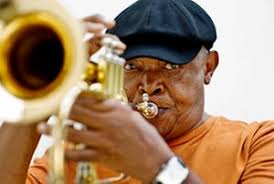
The trumpetist Hugh Masekela… no more “Strawberries” for me… but I still love dancing to the sound of the “The Boy is doing it!“. His genius, spirit and music remain with us. So Long to Africa’s Jazz Maestro: Hugh Masekela
We said goodbye to the name ‘Swaziland‘ for the country Swaziland, and welcomed Eswatini, officially known as the Kingdom of Eswatini.
The world said goodbye to Aretha Franklin, the African American singer, who reveled us with ‘I say a little prayer for you‘, ‘Respect‘, and so many other hit tubes.
Over 200 people lost their lives when a ferry capsized on Lake Victoria, in Tanzania. This marked the second-most deadliest ferry disaster in Tanzania.





 On lâche vite un couteau qu’on a pris par la lame


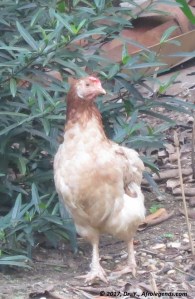 Un grain de maïs a toujours tord devant une poule






 African Heritage