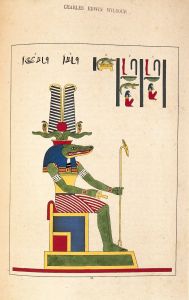
I really enjoyed this photojournal on The Guardian‘s website about crocodiles and the ancient art of crocodile raising in Nubia. Taming crocodiles was a part of the culture of ancient Nubia; and it is still done today in Nubia (northern Sudan /part of Southern Egypt). One of the deities of ancient Egypt was Sobek, who was represented with a human body and a crocodile head. He was associated with the Nile crocodile or the West African crocodile. Sobek was also associated with pharaonic power, fertility, and military prowess, but served additionally as a protective deity with apotropaic qualities, invoked particularly for protection against the dangers presented by the Nile, or intended to turn away harm or evil influences.
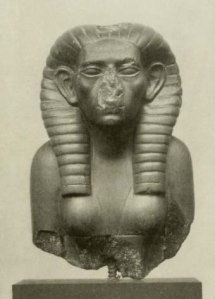
Head of ruling Pharaoh Sobekneferu
The strength and speed of the crocodile was thought to be symbolic of the power of the Pharaoh, and the word “sovereign” was written with the hieroglyph of a crocodile. It was thought that Sobek could protect the Pharaoh from dark magic. Coincidentally, when the cult of Sobek took off during the Twelfth and Thirteenth Dynasties, a number of rulers incorporated him in their coronation names, including the first fully attested female pharaoh – Sobekneferu. To learn more about Sobek and other deities of ancient Egypt, check out Wilkinson, Richard H.,The Complete Gods and Goddesses of Ancient Egypt. (2003).
In ancient times, tamed crocodiles were kept in a sacred pool and hand fed choice cuts of meat and honey cakes and adorned with precious jewels. The pratique has not changed much over the centuries as you will see in the photojournal on The Guardian‘s website. Enjoy!
Quand les herbes envahissent une parcelle, c’est que le propriétaire est absent (Proverbe Bahumbu – République Démocratique du Congo (RDC)). Une fois parti, on ne pense plus à vous.
When weeds take over a parcel of land, that means that the owner is absent (Bahumbu proverb – Democratic Republic of Congo (DRC)). – Once gone, nobody thinks about you anymore.
In order to prevent the return of misunderstandings which have brought between France and the Dahomey a state of hostility prejudicial to the two countries’ interests, –
Us, undersigned
Bertrand de Montesquiou-Fézensac
The king’s messengers
Aladaka
Do-De-Djé
Assisted by:
Cussugan – acting as Yeroghan*
Zizidoque – cabécère†
Zououhoucon – cabecere†
Aïnadou – Treasurer of Gore
Designated by his Majesty the King Béhanzin Ahy Djéré
And
Ship Captain de Montesquiou Fezensac [Bertrand de Montesquiou-Fézensac] commanding the cruiser Le Roland – artillery Captain Decoeur, designated by Rear Admiral Cavelier de Cuverville [>Jules de Cuverville] Commander-in-chief of the land and sea forces acting as governor of the gulf of Benin, acting on behalf of the French government.
Have jointly agreed on the following arrangement which leaves intact all past treaties or conventions agreed upon between France and the Dahomey.
I
The King of Dahomey agrees to respect the French Protectorate of the Kingdom of Porto Novo, and to abstain from all incursions on the territories forming part of that Protectorate.
Jules de Cuverville
He recognizes the right of France to occupy Kotonou indefinitely.
II
France engages to take such action, on the King of Porto Novo, as to prevent any legitimate cause of complaint being made in future by the King of Dahomey.
By way of compensation for the occupation of Kotonou, France will pay an annual sum, which will in no case exceed 20,000 francs (in gold or silver).
The blockade will be lifted and the present arrangement will take effect from the day of the exchange of signatures. However this arrangement will become final only after it has been submitted for ratification to the French government.
Made in Whydah on the third of October eighteen hundred and ninety.
*someone who governs a city on behalf of the King – a governor
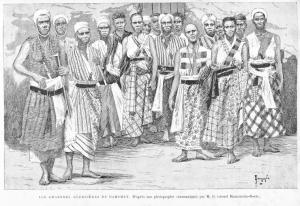
Below is a description of the army of King Béhanzin by a French prisoner made on 13 March 1890. This Frenchman is stunned by the number of warriors in Behanzin’s army, by their discipline, strength and muscular stature. More importantly, he also describes the Dahomey Amazons (locally known as Mino), the Fon all-female military regiment of the Kingdom of Dahomey (in present-dayRepublic of Benin) who formed the king’s special bodyguard unit, and his secret weapon! Remember that inBehanzin’s Farewell Speech in Dahomey, the king had sung praises of his beloved Mino. Here the narriator is amazed by their sight and confirms, “Old or young, ugly or beautiful, they are wonderful to contemplate. Just as muscular as the Black warriors, their attitude is just as disciplined and correct, …” Translated to English by Dr. Y.Afrolegends.com.
====
Dahomey Amazons ca 1890
We are right in the Dahomean camp!
At least 15000 men are in front of us, arranged in order of battle in front of their tents made up of palm leaves, immobile, in such a deep silence that at 100 meters from our prison, in the same courtyard, separated by a simple wall, we could not have imagined their existence.
It is really a painting of a sublime horror and which painfully squeezes our heart. Fifteen thousand men, armed with guns and machetes! There is nothing to say, they are beautiful robust and muscular warriors under their white loincloths, which brings out the ebony of their stature even more. Not a cry, not a single movement, not a noise.
Quiet ourselves and deeply moved, we cross the hay that they form, lined up like the long rows of ears on a wheat field. Black and human harvest of which the one who is there can freely pick or mow heads.
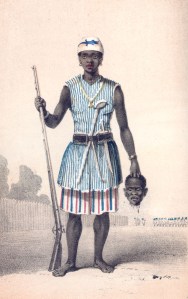
Seh-Dong Hong-Beh, leader of Dahomey Amazons (painted by Frederick Forbes in 1851)
The main officers of the army came to surround us. Our group starts to walk, it takes us more than a quarter of an hour to cross the first rows, given that their battle ranks are so deep. Then we cross an empty space, on the other side of which the Black army continues. Here it is no longer just warriors. The second line, in fact, consists of amazons in three tight ranks, surrounding in a huge circle the very throne of the king whom we cannot yet see.
They are there the four thousand female warriors, the four thousand Black virgins of Dahomey, bodyguards of the monarch, immobile under their war shirts, gun and knife in the fist, ready to pounce on a signal from the master.
Old or young, ugly or beautiful, they are wonderful to contemplate. Just as muscular as the Black warriors, their attitude is just as disciplined and correct, lined up like them in ranks.
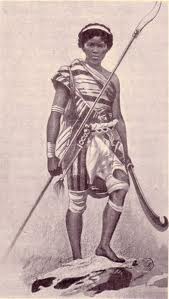
An Amazon warrior ca 1890
The chiefs are in rows, at the head of the columns, recognizable by the richness of their shirts, by their proud and resolute air. Such are the amazons at rest with their arms. There is a long way from this discipline, this order, to the savage and barbaric hordes that we imagine. His Majesty Behanzin can be calm, these viragos will not let him be taken away easily. The triple circle that they form is immense, without a void, gap, or hole.
E. Chaudoin, extract from the Illustration of 26 July 1890, Les Africains Tome X, Editions J.A., 1978, P. 250
Did you know that ancient Egyptians did not only mummify humans, but animals also? Animals such as cats, crocodiles, mongooses, and ibises have been found in Egyptian pyramids. In ancient Egypt, the ibis was a special bird who represented the god Thoth, god of wisdom, magic, writing, hieroglyphs, science, art, judgment, and the dead. For the longest times, scientists could not understand where millions of ibises which had been mummified came from. Now, they seemingly have cracked this mystery.
DNA analysis helps work out origin of nearly 6 million mummified ibises
An ancient Egyptian mystery has been solved, according to researchers, who say they have cracked the conundrum of where millions of mummified birds came from.
While some have been discovered alongside human burials, others – most notably the sacred ibis bird – were mummified as part of rituals designed to curry favour with the gods.
More than 4 million sacred ibis mummies have been found in the catacombs of Tuna el-Gebel and 1.75 million have been discovered in the ancient burial ground of Saqqara. The vast majority were votive offerings to the god Thoth, a practice that had its heyday between 450BC and 250BC.
“The ibis was considered [to represent] the god Thoth, the god of wisdom, the god of magic, the god of judgment, writing all sorts of things,” said Sally Wasef, a research fellow at Griffith University in Australia and first author of the research.
“If you had a boss that annoys you and you don’t feel like you are getting a good judgment from him or you want fairness and justice, you go and ask Thoth to interfere and in return you promise to offer him an ibis, a mummified ibis, in his annual feast.”
But the sheer quantity of mummified ibises left experts scratching their heads – where did all these birds come from?
One suggestion is that they were reared on an industrial scale in hatcheries. That idea appears to have some support in ancient texts, such as the writings of Hor of Sebennytos, a priest and scribe in the second century BC, who wrote about feeding tens of thousands of sacred ibis with bread and clover.
The god Thoth
To explore the possibility, Wasef and colleagues analysed DNA from 14 mummified sacred ibises found in ancient Egypt and 26 modern samples from across Africa.
… The results, published in the journal Plos One, reveal the level of diversity in the mitochondrial DNA among the ancient birds is similar to that among modern wild birds, and have similar levels of potentially harmful mutations. However, the team says if the ancient Egyptians farmed sacred ibises, the genetic diversity in ancient birds would probably be lower due to high levels of inbreeding.
Wasef said this suggested that, rather than being bred in a mass-farming situation, sacred ibises were tempted to local areas and kept in a natural habitat – or perhaps captured and kept in farms for a short time, ready for sacrifice. “[The most likely thing is ] next to each temple there was like a lake or a wetland – it is a natural habitat for the ibis to live in and if you are giving them food they will keep coming,” she said. Indeed, she notes, there was a swamp near Tuna el-Gebel and the Lake of the Pharaoh near Saqqara. …
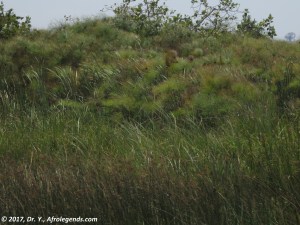
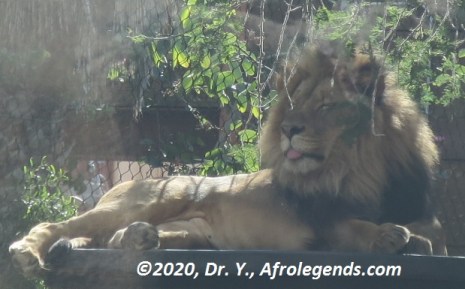
The image of this lion made me think so much of peace and serenity that I had to share with you all. In these uncertain times, there is not so much we can do… fretting might not add much… but some tranquility, calm, peace, and quiet might do us all some good.





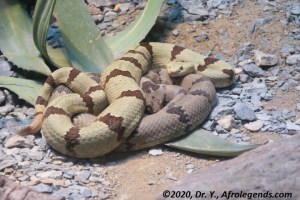 Le serpent pris au piège n’évitera pas le bâton







 Sur l’oeil on gratte doucement
 African Heritage