Le soleil n’oublie aucun village (Proverbe Ambede – Gabon). – Egalité pour tous.
The sun does not forget any village (Ambede proverb – Gabon). – Equality for all.
I have always wondered why the second largest city of Gabon is named Port-Gentil… Is it full of kind agreeable souls? Is it a gentle town, very laid-back? Otherwise, why will it be named that way?
Well, to my surprise, Port-Gentil is named after the French colonial administrator Émile Gentil who served there in 1902. I have a lot of doubts that the man was a kind or gentle soul. From stories of these colonial administrators in Africa, many were more on the ruthless and disagreeable side, particularly towards Africans, whom they saw as savages. Indeed, after investigation into Emile Gentil, it turns out that he had been accused of massacres in Congo in 1905, but had been cleared by the Lanessan commission (what are indigenous’ words against a European’s?… particularly in those days); he was also part of the expedition that was trying to conquer Rabah, a powerful warrior leader in Chad. Gentil is best known for heading two military missions to conquer and consolidate territories north, from modern Gabon up to Chad. … Thus it is only a tiny shot to imagine the atrocities left in his wake… So why is the second largest city of Gabon still named after someone like that? Someone who murdered Gabonese, and other Africans? I know, it sounds sweet, “gentil”, but knowing the source of the name and the atrocities committed against the indigenous populations, why keep the name? If “gentle” is so important, why not translate it into the local language, or roll back to the original name, which is Mandji. It absolutely makes no sense for a city on African soil to bear the name of someone who has been accused of massacres by contemporaries on that very land!
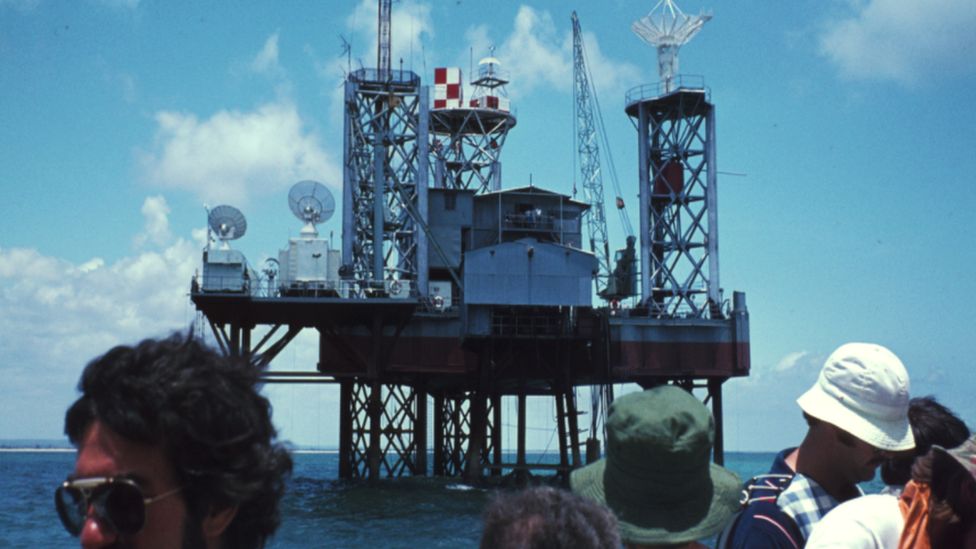
For completeness, Port-Gentil is located on Lopez Island (in the mouth of the navigable Ogooué River) and on a bay sheltered by Cape Lopez, which juts into the Atlantic Ocean. As the nation’s chief port and industrial centre, it is linked by air to Paris and major West African hubs as well as many Gabonese towns. Life in Port-Gentil is much more laid-back than Libreville. It is Gabon’s economic engine, and massive oil and gas rigs loom just off the coast. The city stretches along the beach, is full of pleasant wide streets and a bustling port. One block back from the corniche, Ave Savorgnan de Brazza (named after another European who massacred Africans) has most of the banks, shops and restaurants. Port-Gentil sits on a peninsula; it is actually an island, cut off from the mainland by the delta of the Ogooué River.
Surprisingly, just like many places coveted by Europeans on the African continent, there are no roads connecting Port-Gentil to the rest of the country. How outrageous! How come in 2021, there are no roads connecting the second largest city of a country, the industrial hub, to the rest of it? This seems like a wanted political decision, especially when the country, Gabon, has been the milk cow of Elf, the defunct French oil company (now Total), and is still a big milk cow of France today.
So even though, as always, I would like you to visit the sandy beaches of Port-Gentil, and enjoy the warm hospitality of the Gabonese, I think it is about time that the city be renamed! Lastly, ROADS, connections to the rest of the country are a MUST!!!
For this year’s Valentine, we will introduce you to “Souffrance d’Amour” by the Cameroonian singer Ben Decca. The song, “Souffrance d’Amour” translated as “Love suffering” tells of a love so deep, so strong between two people, but which does not work. So it is, in the words of Ben Decca himself, “proof that two people can go their separate ways and remain in love despite everything. “Souffrance d’Amour” is a shout-out to people who give themselves entirely to the other with sincerity and loyalty, but unfortunately, in general they receive the opposite of what they put in… sad reality…” [“Souffrance d’Amour” est la preuve que deux personnes peuvent se quitter et demeurer amoureuses l’une de l’autre malgré tout. Souffrance d’Amour” est une dédicace aux personnes qui se donnent à l’autre entièrement avec sincérité et loyauté, hélas en général ils reçoivent l’opposé de ce qu’ils ont misé… triste réalité…]. “To love is to forget oneself and to think only of the one we love” [“Aimer c’est s’oublier soi-meme, et ne penser qu’a celui qu’on aime…”]
For those who do not know him, Ben Decca, he is the ultimate crooner of Cameroon… You could think of a Luther Vandross type… His career spans over 40 years of constantly amazing music. He is a pure talent, and hails from a family of musicians, with 3 younger siblings who are also renowned singers Grâce Decca, Dora Decca, and Isaac Decca, and nephew to the great Cameroonian legend Eboa Lotin, and great grandson to Lobe Lobe Rameau one of the pioneers of Makossa in Cameroon. His work has been the legendary, and he has lightened to lives of so many of us lovers of life, given life to our feelings of joy, pain, grace, hurt,…. Kudos to the great, and only Ben Decca.

King Mvemba a Nzinga, most commonly known as Afonso I of Kongo, or Nzinga Mbemba, was a Kongo king who ruled over the Kongo Empire from 1509 to late 1542 or 1543. He wrote a letter in 1526 to the Portuguese king decrying the capture of his subjects to be taken as slaves in the transatlantic slave trade. The Portuguese were also assisting brigands in Kongo and illegally purchasing free people as slaves. This letter contradicts the story that African kings sold their own into slavery, as has been re-told countless times in history books; moreover, this is also similar to Queen Nzingha‘s stance against slavery a century later; she fought almost 40 years against the Portuguese for the freedom of her people. Afonso I of Kongo wrote:
=====
Afonso was also concerned about the depopulation of his kingdom through the exportation of his own citizens into slavery. The king of Portugal responded to Afonso’s concerns, writing that because the Kongo purchased their slaves from outside of the kingdom and converted them to Christianity and then intermarried with them, the kingdom probably maintained a high population and probably was not affected by the missing subjects. To lessen Afonso’s concerns, the king [of Portugal] suggested sending two men to a designated point in the city to monitor who was being traded and who could object to any sale involving a subject of Afonso’s kingdom. The king of Portugal then wrote that if he were to cease the slave trade from the inside of the Kongo, he would still require provisions from Afonso, such as wheat and wine.
This year, Kenya is celebrating the fact that no new rhinos were killed by poachers in 2020, this is a first in 20 years. I know, this is an odd thing to celebrate, and it is a pity to be in a world were we have to celebrate another species not being killed by our own. Isn’t it weird…? We celebrate the fact that rhinos were not killed by poachers, as if we were powerless against their killing by members of our species. Are we powerless? When we can send men to space, build satellites, self-driving cars, nanobots, artificial intelligence, and so many technological innovations, yet… protecting another species (from us) is a challenge! I guess we take wins where we can… Enjoy… Excerpts below are from an article on the BBC.
====
Conservationists in Kenya are marking some good news: for the first time in more than 20 years there have been no rhino deaths due to poaching.
Director General of Kenya Wildlife Service Brigadier John Waweru told BBC Newsday they intend to enforce the same tactics applied last year to end poaching.
“Through my teams, I have enhanced anti-poaching and intelligence led operations as well as strengthening cooperation and intelligence with stakeholders, law enforcement agencies and local communities,” he said.
….
I found this really good video on the story of the last monarch of the Kingdom of Madagascar, Queen Ranavalona III. It is a short documentary, very well done with footage from those years… As you can see the queen had a gentle nature, and calm resolve around her. She was also beautiful and fashionable. A tiny note, in the video, it is said that Princess Marie-Louise Razafinkeriefo, heiress to the queen, was the daughter of Ranavalona III’s sister. In reality, Marie-Louise was the grand-daughter of the Queen’s sister Princess Rasendranoro, and was born in exile. Her mother was Princess Razafinandriamanitra, a daughter of Princess Rasendranoro and a niece of Ranavalona III. Please enjoy!

Last December, there was an auction in England of Queen Ranavalona III, the Last Monarch of the Kingdom of Madagascar photographs, letters, and fashion belongings. These were collected by Clara Herbert, who worked for the Madagascan royal family from the late 1890s to the 1920s, and were passed down through her family, and ended up in the attic of a house in Surrey. Auctioneer Kerry Taylor pieced together Ranavalona’s story from the box of photographs, postcards, souvenirs, receipts and diaries and sold them on auction. The government of Madagascar was able to purchase a lot of it. I was quite moved because this is part of the history and pride of Madagascar, and I am glad the government of Madagascar worked to have it returned. Enjoy! Excerpts below are from an article from The Guardian.
======
An archive of fashion, photographs and letters telling the remarkable story of the last queen of Madagascar will return home after it was bought at auction by the island’s government.
The jumble of ephemera, along with an ornate 19th-century dress, all relates to the life of Queen Ranavalona III, who was dethroned by the French and exiled to Algiers.
… The president of Madagascar, Andry Rajoelina, said: “Madagascar attaches great importance to the acquisition of these royal items as part of the reappropriation of Malagasy national history and cultural heritage. They will be installed in the newly reopened, restored Queen’s palace, where they will be displayed to the general public.”
… Taylor [the auctioneer] said she was delighted the archive was heading to Madagascar. … “The queen and princess were separated during their lifetimes from their people and it gives me enormous satisfaction to know that this collection will soon be on its way home where it will be fully appreciated, admired and cared for in perpetuity.”
Today we will talk about the last queen of the Kingdom of Madagascar, Queen Ranavalona III. She reigned from July 30, 1883 to February 28, 1897. Like many African kings and queens of the late 1800s and early 1900, she was deposed by the European colonizer, in this case the French, and sent into exile first on the island of Reunion, and then later in Algeria (just like the King of Dahomey, Béhanzin) where she died, never to see her native Madagascar again.
Who was Ranavalona III? Well, as her name goes, she was the third Malagasy queen with the name Ranavalona. She became queen after the death of her grand-aunt, queen Ranavalona II. Ranavalona III was born Princess Razafindrahety in 1861. She was raised as a protestant, and taught by instructors from the London Missionary Society. Upon completion of her education, she married nobleman Ratrimo, but he died under suspicious circumstances in May 1883, just 2 months after Queen Ranavalona II’s passing. Rumor had it that the prime minister Rainilaiarivony had poisoned her husband, Ratrimo so as not to relinquish power. The young princess then ascended the throne of Madagascar at the tender age of 22, on July 13, 1883. It is said that she was chosen over her older sister, Rasendranoro, because of her conciliatory nature which the prime minister and other members of the Andriana looked for.
At the time of Ranavalona III’s ascension, Madagascar was navigating a shift from absolute rule (power in the hands of the king/queen) to constitutional monarchy. Under the new system, true authority was vested in the prime minister: in this case, Rainilaiarivony, who secured his grasp on power by marrying the newly crowned—and recently widowed—queen. In accordance with tradition, Rainilaiarivony had previously wed both of Ranavalona III’s predecessors, Ranavalona II and Rasoherina. Lucky man, wouldn’t you think? One man married to 3 successive queens! Probably the only one in history (this will be the story for another day)! Rainilaiarivony largely oversaw the day-to-day governance of the kingdom and managed its foreign affairs.
As a queen, Ranavalona III inherited a kingdom which was assaulted by the French who wanted her country to be part of their protectorate. Throughout her reign, she tried to strengthen trade and diplomatic relations with the United States and Great Britain, in an effort to keep the French at bay. In 1886, the queen solicited U.S. intervention to help protect Madagascar from the French but was ignored. She, like many kings and queens of Africa back then, was probably not aware of the scramble for Africa, and the Berlin Conference (Selection from the 1885 Berlin Conference Final Act, The Berlin Conference 1884 – 1885 – Final Act (Continuation)), where Europeans allocated areas of the continent to themselves. She was forced to sign a treaty that gave France a certain control of Madagascar in order to prevent war, but the French wanted full control over Madagascar and did not back down. Ranavalona III successfully kept the French at bay until 1896 when the French declared Madagascar as their colony. Repeat French attacks on coastal port towns and an assault on the capital city of Antananarivo ultimately led to the capture of the royal palace in 1895, ending the sovereignty and political autonomy of the century-old kingdom (French Colonial Treaty in Madagascar : 18 January 1896).
The newly installed French colonial government promptly exiled prime minister Rainilaiarivony to Algiers, Algeria. Ranavalona and her court were initially permitted to remain in Madagascar as symbolic figureheads, but the outbreak of a popular resistance movement – the menalamba rebellion – and discovery of anti-French political intrigues at court led the French to exile the queen to the island of Réunion on February 27, 1897.
Rainilaiarivony died that same year in Algiers, and shortly thereafter Ranavalona was relocated to a villa in Algiers, along with several members of her family. Despite Ranavalona’s repeated requests, she was never permitted to return home to Madagascar. Like many African kings and queens, she was deported (Deportation of African Heads of States). She died of an embolism at her villa in Algiers on May 3, 1917 at the age of 55. Her remains were buried in Algiers but were disinterred 21 years later and shipped to Madagascar, where they were placed within the tomb of Queen Rasoherina on the grounds of the Rova of Antananarivo (Rova de Manjakamiadana). you remember Queen Ranavalona III, remember that she was a queen who fought against the foreign invasion to the best of her ability, but above all remember that all she wanted was the independence of her people and culture.