Just saw this article on how an audiometer made in South Africa is helping NASA research hearing aboard the International Space Station, and thought to share with all. As you probably guessed, South Africa has one of the strongest and biggest space programs in Africa, with its South African National Space Agency (SANSA). For the full article go to Africanews.space. Enjoy!
====
NASA has recruited the help of South African company eMoyo, in a bid to research the biological effects of noise in space and aboard the International Space Station (ISS) on the astronauts. eMoyo is a South African company that seeks to create a future where medical technology and the care it provides to humanity are merged into a ubiquitous system.
NASA had previously faced challenges in accomplishing this research due to lack of equipment, as it needed a lightweight product which was easy to operate. It is in this respect that eMoyo’s KUDUwave provides the answers to NASA’s plight.
The KUDUwave is a portable high-frequency audiometer featuring booth-free operation and high-frequency hearing testing up to 16 kHz. It has been used to test audio deficiencies, in South Africa as far back as 2009. The KUDUwave Pro combines the sound booth, audiometers, bone conductor, and extended high-frequency headset in a single, lightweight device. It includes the full battery of testing options as well as the ability to test almost anywhere.
NASA recruited the KUDUwave portable boothless audiometer and has transported it to the ISS via a commercial resupply mission known as the Northrop Grumman NG, aboard the CRS-15 Cygnus spacecraft. The audiometer, while innovative in its own right, had to be “slightly modified for self-testing in space”, according to eMoyo executive John Tidy. …
I love this poem by Bernard Dadié which I have posted earlier “Seche tes pleurs, Afrique / Dry Your Tears, Afrika“. The imagery is so clear and the words so deep: O Africa, “our senses are now opened to the splendor of your beauty, the smell of your forests, … your charms…” Africa is so rich,… and it is about time that her sons and daughters stand up to reclaim their inheritance, and feel her beauty, and enjoy her bounty-ness… Yes there is so much adversity, but dry your tears African… and rise up!
Sèche tes pleurs, Afrique Ayant bu À toutes les fontaines d’infortune et de gloire, Nos sens se sont ouverts à la splendeur de ta beauté à la senteur de tes forêts, à l’enchantement de tes eaux à la limpidité de ton ciel à la caresse de ton soleil Et au charme de ta verdure emperlée de rosée.
Dry your tears, Africa! We have drunk From all the springs of ill fortune and of glory, Our senses are now opened To the splendor of your beauty To the smell of your forests, To the charm of your waters To the clearness of your skies To the cares of your sun And to the charm of your foliage pearled by the dew.
Do you know about the Italian-run Broglio Space Centre (previously known as the San Marco Equatorial Range) located off the coasts of Kenya? Yes… you heard me right, there is an an Italian space center in Malindi, Kenya. As you recall, Malindi was the first African city the most venerated Chinese maritime admiral Zheng He reached on the horn of Africa in 1418, even before Vasco da Gama? Indeed, Zheng He’s great armada rich of more than 300 ships and as many as 30,000 troops entered the coastal town of Malindi, in modern day Kenya, in 1418. If you are like me, this is quite a news: a space center off the coast of an African country (if you know of others, please let me know), and an Italian presence in Africa tends to be sparse, especially since its defeat at the hands of Ethiopia at the Battle of Adwa, and later during world war II. Can you imagine that the presence of this space center has created such a Kenyan-Italian synergy to the point that the lingua franca on Malindi is Italian? I wonder if they ever hire or train the locals to operate this space center, or to be engineers, technical workforce? From past experience, they probably don’t. Excerpts below are from the BBC. Enjoy!
=====
Flag of Italy
Malindi, a seaside town by the Indian Ocean that was founded in the 13th Century, is 120km (about 75 miles) north-east of Mombasa and has been known as “Little Italy” since the late 1960s.
The tourist resort is brimming with Italian restaurants, pizzerias, delis and gelato shops – billboards advertise in Italian, restaurant menus offer after-dinner liquors such as Limoncello and Amaro.
Most people speak Italian – from the Kenyan housekeeper where I stayed and the tuk-tuk drivers who ferried me around, to the waiters and the fisherman hanging around on the beach.
It is the town’s lingua franca. …
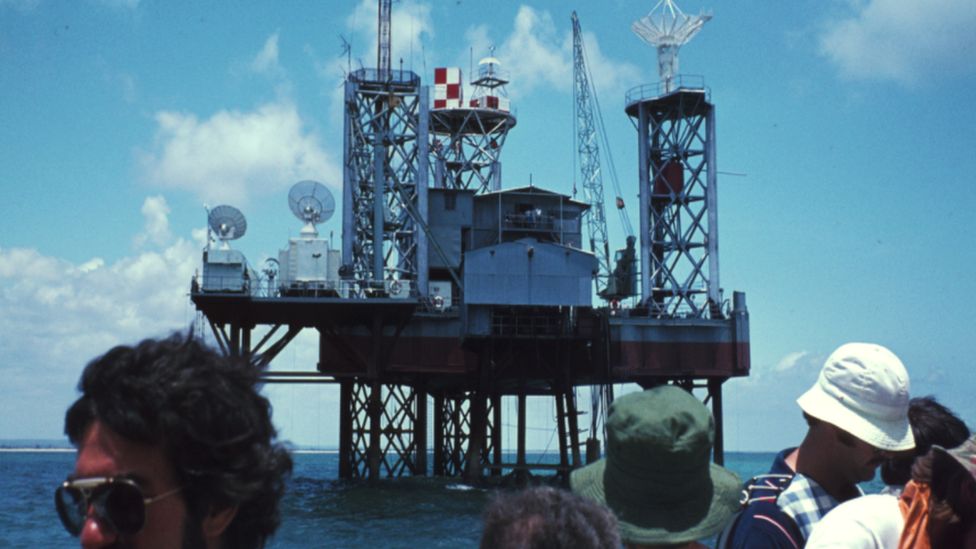
The history of the Italians in Malindi goes back to the opening of the Italian-run Broglio Space Centre off Kenya’s coast [32 kmfrom Malindi] in the Indian Ocean. [It started as a partnership between the Italian Space Research Commission and NASA, with 2 offshore launch sites made from old oil platforms, and a mainland communications station].
Broglio Space Centre Platform (Source: NASA on BBC website)
The first Italians to arrive in the town were engineers and scientists, who loved what they found. Word soon spread about Malindi’s miles of pristine beaches, abundance of seafood and good-natured inhabitants [colonization was always like that: good-natured inhabitants who could be fooled easily, and their lands grabbed away].
By the 1970s the community began to take shape, with many settling in Malindi and pursuing opportunities in the tourism industry.
They opened hotels, restaurants, built beach villas and became economically integral in the town.
… The town had its heyday in the 1980s and 1990s when tourism boomed and estimates suggest 4,000 Italians lived in the town and 30,000 visited annually.
But a shadier side to Malindi also emerged with allegations that the underage sex trade was rampant, as was the drugs trade and even whispers of the Italian mafia’s presence.
Still the tropical paradise with its hint of noir flourished until a slump began with Italy’s financial crash of 2008.
… But it is still a blissful place to relax and enjoy if you can visit, and while tucking into a delicious plate of crab linguine, I felt transported back in time if not place.
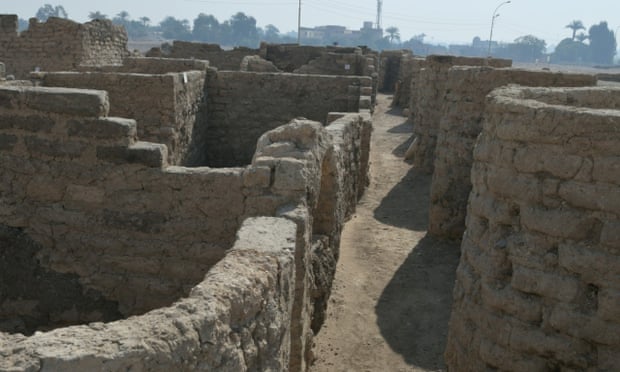
Archaeology experts have said discovery of Aten – called the ‘lost golden city’ – is the largest ancient city uncovered in Egypt. Photograph: Zahi Hawass Center for Egyptology/Reuters
Doing archaeology in Egypt is really a dream come true! Every day reveals new findings… it is amazing to witness the rediscoveries of this ancient African civilization… and each time as more artifacts are unearthed, we are in awe because current world civilizations seem so less advanced than the civilization of the Egyptian pharaohs! Today, in Egypt, the discovery of a 3,000 years old lost city was announced. This is not just any city, this is Aten; it dates back to the reign of Pharaoh Amenhotep III, one of Egypt’s most powerful pharaohs who ruled from 1391 to 1353 BC. Excerpts below are from the Guardian… Enjoy!
-=====
Archaeologists have hailed the discovery of what is believed to be the largest ancient city found in Egypt, buried under sand for millennia, which experts said was one of the most important finds since the unearthing of Tutankhamun’s tomb.
The famed Egyptologist Zahi Hawass announced the discovery of the “lost golden city”, saying the site was uncovered near Luxor, home of the Valley of the Kings.
“The Egyptian mission under Dr Zahi Hawass found the city that was lost under the sands,” the archeology team said. “The city is 3,000 years old, dates to the reign of Amenhotep III, and continued to be used by Tutankhamun and Ay.”
It called the find the largest ancient city, known as Aten, ever uncovered in Egypt.
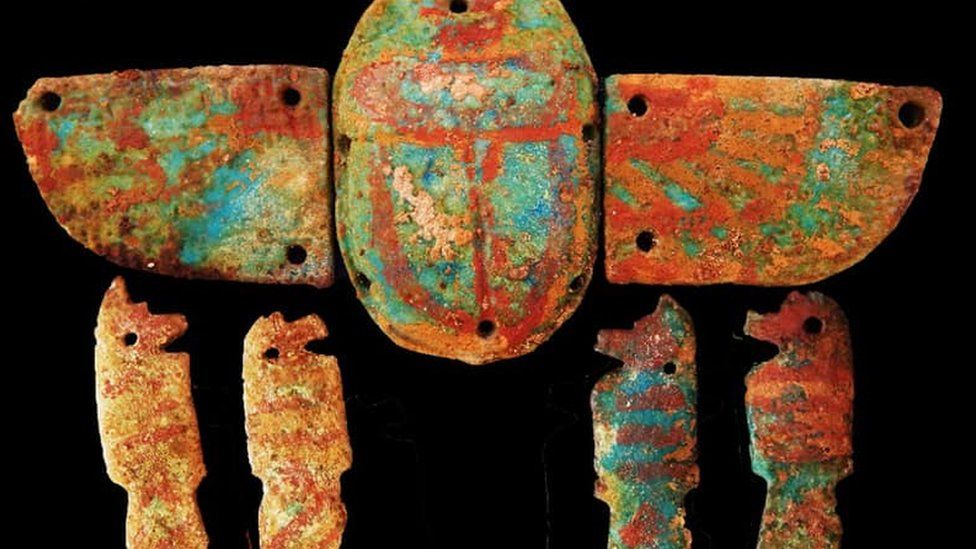
The archaeologists found a large number of decorative and ritual items, including scarabs and amulets. Photograph posted by Dr. Zahi Hawass on Facebook
Betsy Bryan, Professor of Egyptian art and archaeology at Johns Hopkins University, said the find was the “second most important archeological discovery since the tomb of Tutankhamun”, according to the team’s statement.
… Items of jewellery such as rings have been unearthed, along with coloured pottery vessels, scarab beetle amulets and mud bricks bearing the seals of Amenhotep III.
… “The archaeological layers have laid untouched for thousands of years, left by the ancient residents as if it were yesterday,” the team’s statement said.
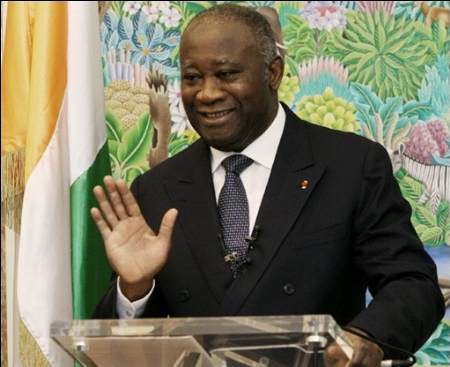
Last week, on March 31st, the International Criminal Court justice court appeals judges finally upheld the acquittal of former Ivory Coast president Laurent Gbagbo and his minister Charles Blé Goudé (How long shall they kill our prophets…?). They were acquitted 2 years ago in January 2019, but the prosecution stalled, keeping them in Europe, trying to find ways to overturn the decision, and blocking all their movements. Now the ICC judges upheld their acquittal, and technically Gbagbo and Blé Goudé should be free to go home to Ivory Coast! After this witch hunt which has lasted over 10 years, and his arrest and detention in the Hague, Laurent Gbagbo is now free to go home! Can you imagine? Did the ICC apologize for all the years of hurt? the tarnished image? And of course mainstream media, which yesterday published those images of Gbagbo and his wife Simone in their room surrounded by the rebels, now publish one line if at all anything! Unbelievable! They should be sued for playing such major roles in destroying countries, obliterating people’s images, and causing wars! I live you here with excerpts from an article from the BBC. All these tough years of claiming their innocence, all these years of constant support, and people’s prayers, dedication, love, and determination have born fruits. Truth always wins! It may take years… but it prevails! Now it is said that the government of Ouattara, the one installed with French war chars and cannons will try to have Gbagbo go through another trial once he lands in Cote d’Ivoire… Oh, he does not know that even then, like Thomas Sankara said, “La Patrie ou la mort, nous vaincrons!” We will keep fighting to the last drop! As Agostinho Neto said: “La luta continua e la victoria e certa!”
====
The International Criminal Court (ICC) has upheld the acquittal of Ivory Coast’s ex-President Laurent Gbagbo on charges of crimes against humanity.
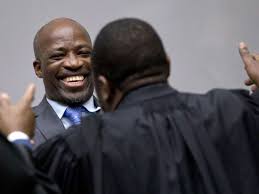
Charles Blé Goudé celebrating with his legal team on 01/15/2019 (SkyNews)
It paves the way for his return to Ivory Coast, where he remains an influential figure.
… The former president was in court alongside ally and former youth leader Charles Blé Goudé, who was accused of leading a militia backing him.
They were both acquitted in 2019, but the prosecution had appealed what was seen as the shock decision to clear them. It argued that there were procedural errors in how the original verdict was delivered and insisted that thousands of documents and 96 witnesses presented during the trial had proved their guilt beyond reasonable doubt.
But presiding Judge Chile Eboe-Osuji said: “The appeals chamber, by majority, has found no error that could have materially affected the decision of the trial chamber.
“The appeals chamber hereby revokes all remaining conditions on the release of Mr Gbagbo and Mr Blé Goudé as a result of this judgement.”
… Whenever a case collapses at the ICC, it damages the perception of the court as a credible tool of international justice, our reporter says.
The appeals judges agreed that the evidence in this case was extremely weak, raising questions about how this trial went as far as it did, she says. It is not the first case that has collapsed at the ICC.
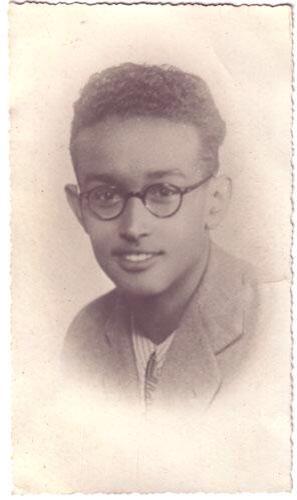
So Italy had a recent case of memory boost, remembering a Black man who gave his life for Italy in World War II. In Rome last month, the city council voted to name a future metro station in honor of an Italian-Somali man who was a member of the Italian resistance, Giorgio Marincola. Marincola was killed by Nazi troops at the age of 21, when they opened fire at a checkpoint on May 4th 1945, 2 days after Germany had officially surrendered in Italy. He was awarded posthumously the Italian medal of honor in 1953, Italy’s highest military honor. Not sure that it means anything [after all, the battles are deeper than that], but we are glad to see Italy recognize some of its forgotten African heroes.
The station, which is currently under construction [let’s hope they actually come through with this], was going to be called Amba Aradam-Ipponio – a reference to an Italian campaign in Ethiopia in 1936 when fascist forces brutally unleashed chemical weapons and committed war crimes at the infamous Battle of Amba Aradam. … The name change came after a campaign was launched in June, in the wake of Black Lives Matter protests around the world … Activists first placed a banner at the metro site stating that no station should be named after “oppression” and pushed for Marincola’s short, but remarkable life to be remembered.
[Marincola] is known as the “partigiano nero” or “black partisan” and was an active member of the resistance. In 1953 he was posthumously awarded Italy’s highest military honour, the Medaglia d’Oro al Valor Militare, in recognition of his efforts and the ultimate sacrifice he made.
Marincola was born in 1923 in Mahaday, a town on the Shebelle River, north of Mogadishu, in what was then known as Italian Somaliland. His mother, Ashkiro Hassan, was Somali and his father an Italian military officer called Giuseppe Marincola.
… At the time few Italian colonists acknowledged children born of their unions with Somali women [true of most Europeans in Africa in those days]. But Giuseppe Marincola bucked the trend and later brought his son and daughter, Isabella, to Italy to be raised by his family.
… Giorgio Marincola too was gifted, excelling at school in Rome and went on to enroll as a medical student. During his studies he came to be inspired by anti-fascist ideology. He decided to enlist in the resistance in 1943 – at a time his country of birth was still under Italian rule.
… He proved a brave fighter, was parachuted into enemy territory and was wounded. At one time he was captured by the SS, who wanted him to speak against the partisans on their radio station. On air he reportedly defied them, saying: “Homeland means freedom and justice for the peoples of the world. This is why I fight the oppressors.”
The broadcast was interrupted – and sounds of a beating could be heard. …
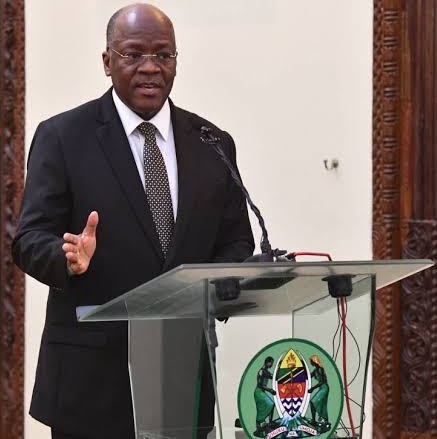
The former prime minister of Kenya, Raila Odinga, said of Dr. John Pombe Magufuli, “He was determined to put Tanzania ahead in the region and Africa through industrialisation. … His primary business was Tanzania. Outside Tanzania, his other business was Africa. He … embraced some of the founding President Mwalimu Julius Kambarage Nyerere’s ideals on patriotism, nationalism and self-reliance for his country. In about six-years, he went farther than Mwalimu Nyerere in trying to economically empower his people. While Mwalimu Nyerere embraced internationalism and had a broader view of the world and Tanzania’s place in it, Dr Magufuli was a super nationalist … Where Mwalimu Nyerere was a constant voice on the global stage, especially for Africa and the Third World, Dr Magulfuli reserved his voice and energy for Tanzania…. Dr Magufuli was, however, overly successful in transforming Tanzania in just about six years. He transformed Tanzania’s highways, ports, created Rapid Bus Transit to decongest Dar es Salaam and delivered SGR at a competitive rate, all because of a crackdown on corruption. Despite all these, Dr Magufuli’s … pushed hard the idea that success comes from hard work. In Tanzania today, people report to offices very early and they do not just sit there, they work. … May Dr Magufuli fare well in the next world.” [Raila Odinga, former Prime minister of Kenya in MarketWatch.com]
President John Pombe Magufuli has shown us, Africans, just like Thomas Sankara, that you do not need 20 or 40 years in power to make palpable improvement to the lives of Africans. Just look at what this man was able to achieve in 5 years! It is so reminiscent of Thomas Sankara‘s 4 years in power where he eradicated hunger, had roads and railways built by the local people, and influenced generations. So to all those African dinosaurs, the sellouts, or to anybody who applaud those treacherous creatures, please let them know that it is possible to get Africans out of poverty! All that is needed is visionary leaders who love their own… who love their fellow humans and not just their pockets! As always, we need to remember not to fall into the trap of democracy [Africans and the Trap of Democracy] laid out by the west, where democracy is a word used by the West against any government which does not abide by their will, and does not sell out to them…
Below are some of the quotes by the great man Dr. John Pombe Magufuli. May he rest in Power! Enjoy!
=====
As the 5th president of Tanzania, John Magufuli vowed, “My government will put emphasis on fighting corruption, job creation and industrialization.”
To fight against corruption he said, “The way to treat a boil is to squeeze it out, and I have made it my responsibility to do that. I know squeezing out a boil hurts but unfortunately, there are no two ways about it.“
Flag of Tanzania
Reflecting on his youth, as the son of a farmer, and on his knowledge of the people’s conditions, and need to make their lives better, Magufuli said, “Our home was grass thatched and like many boys I was assigned to herd cattle, as well as selling milk and fish to support my family, I know what it means to be poor. I will strive to help improve people’s welfare.“
As soon as he was elected, he divided his own salary by four, making him one of the lowest-paid African heads of state, cut public spending drastically, cancelled independence ceremonies as too costly, and began sweeping the streets of Dar es Salaam himself to set an example. As said earlier, this is reminiscent of what Thomas Sankara did in Burkina Faso.
Tanzania is the largest country in East Africa, and includes about 120 different African tribes. Believing in the unity of Tanzanians, Magufuli said, “It’s now time for us to unite and put our ideological differences aside, I will work hard for all Tanzanians regardless of their tribal, religious or ideological affiliations.”
John Magufuli was a doctor of chemistry, and had both taught chemistry and mathematics at the Sengerema Secondary School, before joining the Nyanza Cooperative Union Limited as an industrial chemist.With a PhD in Chemistry, he was among the top 5 most educated Presidents in Africa. He said, “You cannot talk of preserving the environment when the majority of the citizens are depending on charcoal or wood for most of their energy source;” there needs to be other ways, focusing first on getting them out of poverty.
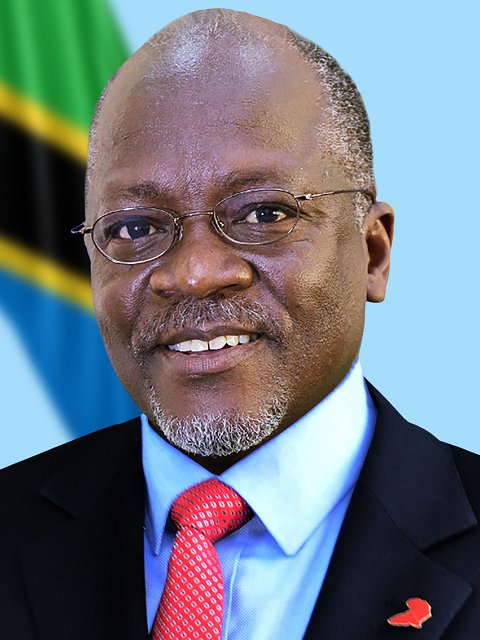
President John Pombe Magufuli of Tanzania
“African countries’ economic capacity is not the same as that of developed countries,” Magufuli told a televised meeting of top security organs. He singled out the World Bank, which has been offering new lending to nations on the continent to help them tackle the health crisis. “Instead of offering more loans to fight corona, they should forgive debts,” the president said [see… the west is always eager to give out loans at high rates, why not remove the unfair debt they have put on African countries? remember Thomas Sankara Speech on Debt and Unity?]. Tanzania spends 700 billion shillings ($303.03 million) every month to service its debts, with close to 200 billion shillings going to the World Bank, Magufuli said.
In 2020, after his re-election, he said, “As you are aware, elections have been a source of conflict in many countries, but we Tanzanians have safely passed this test. This is proof to the world that Tanzanians are peace-loving, and we have matured in our democracy.”
Dr John Magufuli was a remarkable economic leader, who understood that food security is a national security issue that needs the highest attention. He fought for his people, and loved them deeply. He was a nationalist!
I live you here with the speech by the Africant poet, Obert Dube. Enjoy!!!












 African Heritage