Queen Nefertari and Pharaoh Ramses II at the Queen’s temple at Abu Simbel
Love songs and poems are a part of every culture in the world… Love is a universal language. It does not have any barrier, race, class, and even time! It is Love… simple, overflowing, and boundless… Some of the world’s oldest love poems were found in Egypt written several millenia ago. Amazing how timeless they are! I chose the picture of Pharaoh Ramses II and Queen Nefertari as it is well-known that Ramses II deeply loved her and had a temple built in her honor at Abu Simbel .
For this Valentine Day, enjoy this Love poem from Ancient Egypt, found in Deir el-Medina, dated about 1300 BC. It is part of the Chester Beatty Papyri I. As you read it, savor it slowly, and stop for a moment to ponder as the lover sings of his sweetheart as the fairest of all, her skin as bright as a star, her hair as precious as the lapis lazuli stone, stone highly valued in antiquity, her arms surpassing gold, her legs parading her beauty, and when she steps outside she is as the sun so beautiful she catches everyone’s attention. I have placed two of the most popular translations next to each other. Enjoy!
Sister Without Peer My one, my soul without peer,
Most beautiful of all!
Rising like the morning star
At the start of happy year.
Shining bright, fair of skin,
Lovely the look of her eyes,
Sweet the speech of her lips,
She has not a word too much.
Upright neck, shining breast,
Hair true lapis lazuli;
Arms surpassing gold,
Fingers like lotus buds.
Heavy thighs, narrow waist,
Her legs parade her beauty;
With graceful steps
she treads the ground,
Captures my heart by her movements.
She causes all men’s necks
To turn about to see her;
Joy has he whom she embraces,
He is like the first of men!
When she steps outside
She seems like the Sun!
“She has no rival, there is no one like her.
She is the fairest of all.
She is like a star goddess arising
… at the beginning of a new year;
brilliantly white, shining skin;
Such beautiful eyes when she stares,
and sweet lips when she speaks;
she has not one phrase too many.
With a long neck and shining body
her hair of genuine lapis lazuli;
her arm more brilliant than gold;
Her fingers like lotus flowers,
ample behind, tight waist,
her thighs extend her beauty,
Shapely in stride
when she steps on the earth.
She has stolen my heart with her embrace,
She has made the neck of every man
turn round at the sight of her.
Whoever embraces her is happy,
he is like the head of lovers,
And she is seen going outside
like That Goddess, the One Goddess.”
ColonelAssimi Goïta,the president of Mali, recently addressed his people, the Malian people. I was moved by his humility, and depth. We should all aspire to do our part, and support our leaders, and more importantly remember that change starts with each one of us. If we want change, we each have to lend a hand, because it starts with us. We don’t have to wish for martyrs, but start one brick at a time. We are grateful forAssimi Goïtawho is trying to bring back dignity to the Malian people, and pray that he can reach his goal, this goal which is ours, and blesses the entire African continent. We pray for him, and countless Malians, and citizens who are standing up. This is a fight for our freedom, our humanity, our dignity… Enjoy! The original is onAfrik-plus.Translated to English by Dr. Y.,Afrolegends.com
=====
Flag of Mali
“I am a mortal, I am not perfect. I am aware of that. History will judge me one day, but in the meantime I just ask for your support. I did not choose this destiny. It imposed itself to me. God knows what He is doing.
I will go all the way but if I die before reaching our ideal, continue the project without me and lay the groundwork for change with my blood and my flesh.
Below is the colonial tax which is at the heart of Mali-France tensions today. It is part of The 11 Components of the French Colonial Tax in Africa which denies Africans the right to other military or economic partners without France’s approval. As stated before, France is angry that Mali has turned to Russia for help in regaining sovereignty over its territory to help fight against the jihadists whose presence have proliferated under the help of France and its buddies, the international community. The old colonial master wants to be the only one to decide the destiny of Malians in Mali… that era is over… Malians have the right to dignity! Malians, and Africans, have the right to choose the partners that can help them in their visions, a vision which seeks the well-being of their communities. Do you realize that France is now number 4 producer of gold in the world, when France does not have mines of gold on its soil? Mali produces upwards of 40 tons every year, and yet it is one of the world’s poorest countries on the globe! Mali’s production increased by 7%, with 65 tons produced, in 2019.Gold is worth much more than oil! So as you ponder why the prize of gold keeps going up, and people tell you about the economy… maybe it is simply because of tensions in Mali, and maybe you should also root for Mali’s independence from the colonial yoke.
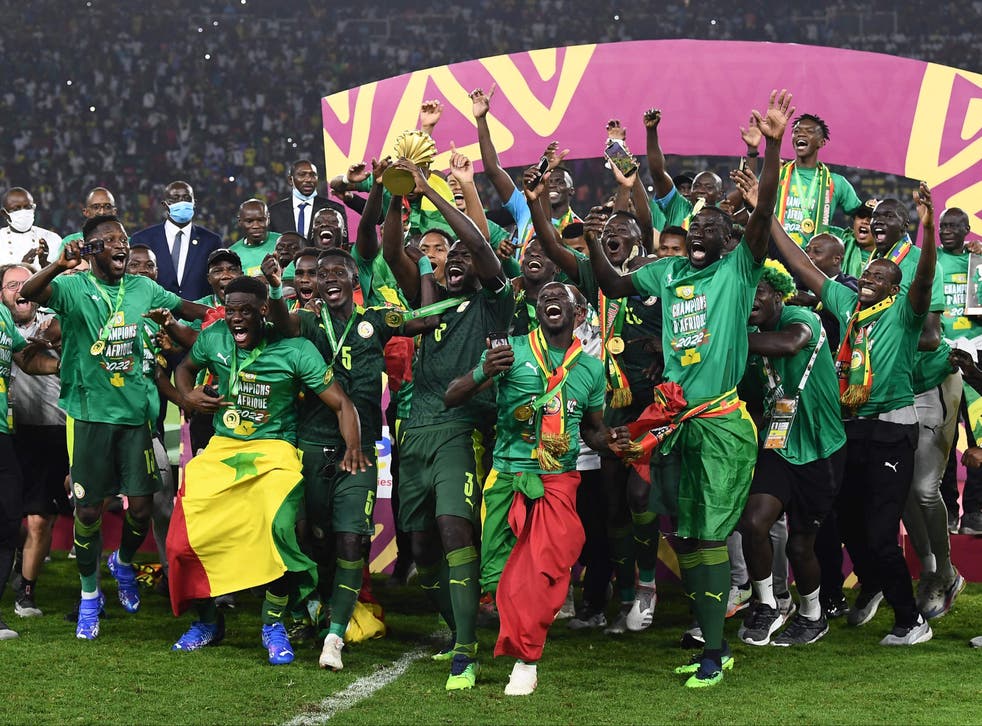
Senegal Lions of Teranga celebrate winning the AFCON 2021 (Independent.co.uk)
Yesterday February 6th, Senegal won the 2021 African Cup of Nations against the Pharaohs of Egypt to become the new champions. This was their first win in the history of the game. To be awarded the trophy after so many years of getting so close is a real joy. They came second at the last edition CAN 2019 missing the trophy against the Fennecs of Algeria. I am happy that with their Senegalese coach (not many African teams have African coaches these days), Senegal made us really proud.
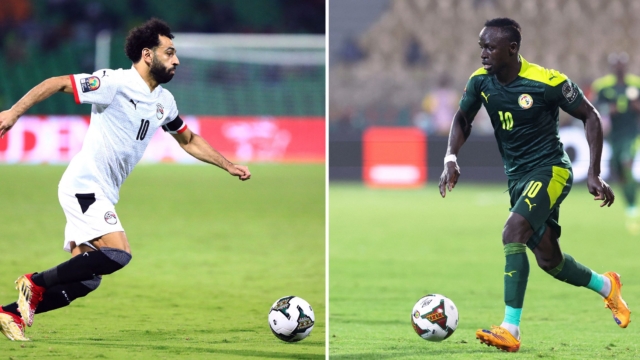
Egypt’s forward Mohamed Salah in Garoua (Left) on January 15, 2022; and Senegal’s forward Sadio Mane in Yaounde on February 2, 2022 (Right). (Photo by Daniel BELOUMOU OLOMO and Kenzo TRIBOUILLARD / AFP via Getty Images)
The game opposed some of the biggest football players in the world Sadio Mané of Senegal and Mohamed Salah of Egypt, both of Liverpool FC. Sadio Mané, scored the winning penalty in the shootout against Egypt, having seen a first-half spot-kick saved as Sunday’s game ended in 0-0 after extra time. “It’s the best day of my life and the best trophy of my life,” the 29-year-old Liverpool forward said. “I won the Champions League and some [other] trophies but this is the special one for me. This is more important for me. … I am happy for myself, my people and all of my family.” Mane credits his team-mates with giving him the strength to return in the shootout, where he sealed a 4-2 triumph. “When I missed the first penalty, it was a big blow for me,” he said. “But my team-mates came to me and said ‘Sadio, we lose together and we win together. … The trophy belongs to the whole Senegal team – everyone deserves it.”
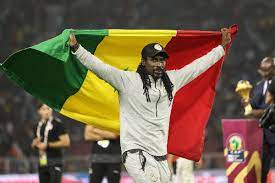
For Senegal’s coach Aliou Cissé, this marks a victory at his third attempt in the Nations’ Cup final. The 45-year-old captained the Teranga Lions when they finished as runners-up in 2002 – missing the decisive penalty in the shootout against Cameroon – and coached Senegal when they lost against Algeria in 2019. He dedicated the 2022 victory to his countrymen before his post-match press conference was interrupted by his squad for celebrations. … He said, “[this] really proves the mental strength of this generation. We are very happy, we dedicate this victory to the Senegalese people, because since independence until now we are running after this first star. … Today, we will also have a star on our shirt.”
As a result of their win, Senegal has declared Monday a national holiday to celebrate winning its first ever Africa Cup of Nations! It is also good to note that the Lions of Teranga of Senegal won against the Pharaohs of Egypt in the Stade Ahmadou Ahidjo in Cameroon. Many locals have claimed that the late Cameroonian President Ahidjo who is still buried in Senegal (story for another day), had been watching over the Senegalese team and blessing them, given that Senegal has been good to the previous president and his entire family.
Tensions are escalating between France and Mali as the French ambassador was expelled from Mali and given 72 hours on Monday to leave the country. How did we get here? In reality, Mali has been in disarray since Libya fell in 2011… and has never recovered since then (“Le Mali en miettes. A qui le tour?” de Chems Eddine Chitour – “Mali in pieces. Who is next?” by Chems Eddine Chitour). France came in to “offer” her support to fight the djihadists in the north of the country. Today, as a result, the country is split into pieces, countless Malians have died, and France is now world producer of gold… mind you that France does not have an ounce of gold on her territory, but rather has been pillaging the mines of Mali, disrupting the peace in the region, and getting the “International community” to support her efforts in the plundering of the golden Mali (Africa is funding Europe!). Remember that Emperor Kankan Musa of the Empire of Mali, which encompassed part of modern-day Mali, distributed so much gold during his pilgrimage to Mecca in 1324 that it took a decade for the Egyptian economy to recover.
Map of Mali with its capital Bamako
Mali has been in pieces… after the coup that got rid of France’s puppet IBK (Bye Bye IBK: Mali Coup), and the military coup that brought the Colonel Assimi Goita to power. Faced with 80% of its territory occupied by foreign forces and terrorists, and in order to regain the sovereignty of its lands, Mali has sought the partnership of Russia, which France has screamed against – remember The 11 Components of the French Colonial Tax in Africa which denies Africans the right to other military or economic partners without France’s approval? Well, France is angry that Mali has turned to Russia for help in regaining its territory… The time for us being doormats is over France… We have the right to our dignity! We have the right to choose the partners that can help us in our visions, a vision which seeks the well-being of our communities.
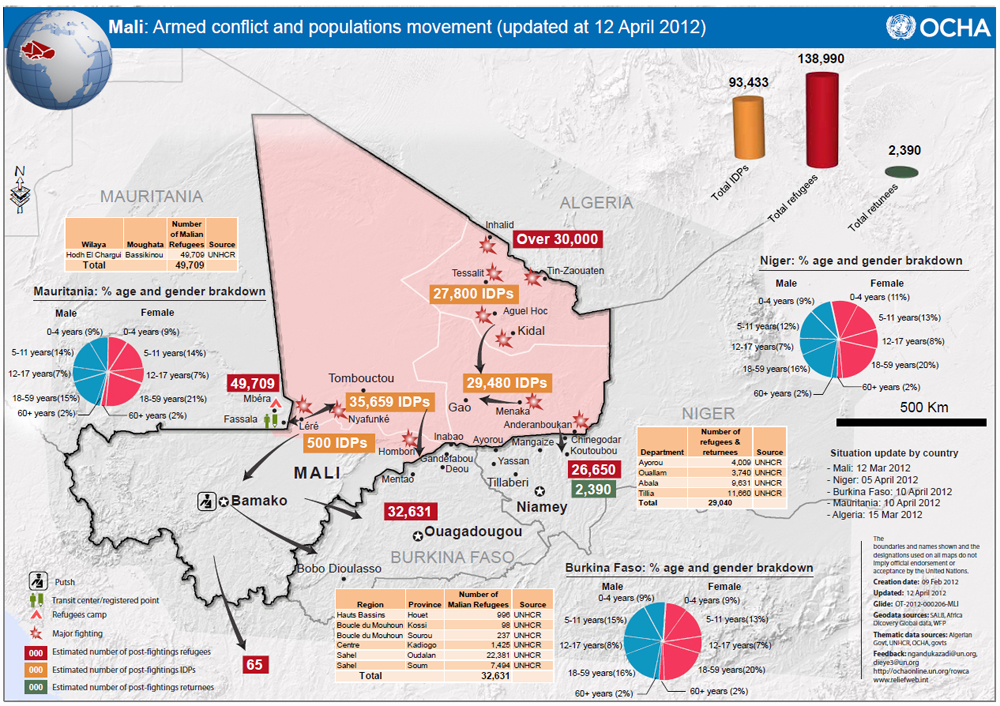
Mali conflict map
Just last week, France’s puppet organization that is ECOWAS (CEDEAO) placed unbelievable sanctions on Mali, closing borders, banking, etc… How can an African organization act in such a way against a sister country, if it is not serving the interest of the enemy?
I live you here with a more recent timeline published on Al-Jazeera. Bear in mind that it is not told from the eyes of a Malian or an African, so it is biased. For the full timeline, please go to Al-Jazeera.
====
Colonel Assimi Goita
On August 18, 2020, a group of Malian soldiers led by Colonel Assimi Goïta overthrew elected President Ibrahim Boubacar Keïta, who was facing angry protests over the government’s failure to stem the violence. The coup is seen as a blow to French President Emmanuel Macron, who had supported Keïta and sought to improve relations with former colonies in Africa.
On March 30, 2021, in a rare criticism of French forces in Mali, United Nations investigators accused the French military of being responsible for the killing of at least 19 civilians at a wedding party in central Mali in an air raid three months before. France denied the findings, saying its forces targeted an “armed terrorist group” and that it had “numerous reservations about the methodology used” in the UN investigation.
On May 25, Goïta pushed out a civilian-led government appointed to oversee a transition period, plunging the country into further uncertainty. He was named interim president on May 28.
In reaction to the power grab, France suspended its joint military operations with Malian forces on June 3 “awaiting guarantees” that civilians return to positions of power.
Conflict map of Mali with internally displaced populations (blog.amnestyusa.org)
On June 10, French President Emmanuel Macron announced a major “transformation” and drawdown of France’s military presence in the Sahel where about 5,100 soldiers – across Burkina Faso, Chad, Mali, Mauritania and Niger – operate under its Barkhane operation [no wonder France can afford to have 35-hour week for its workers, or even confine them forever… their riches come from Africa].
France decided on July 3 to resume its military operation in Mali, as well as its advisory missions.
On September 14, France warned Mali against a deal with Wagner as reports emerged the country’s military government was close to hiring 1,000 mercenaries.
A spokesperson for the Malian defence ministry said his country wanted to “diversify its relationships” on security grounds.
French flag
On October 5, Macron called on Mali’s military to restore state authority in large areas of the country. “It’s not the role of the French army to fill in for the ‘non-work’, if I may describe it, of the Malian state,” he told French media. …
Mali’s Prime Minister Choguel Kokalla Maiga said on October 8 that he had evidence that France was training “terrorist” groups operating in the country. Maiga said French troops had created an enclave in Kidal, a town in the desert region of northern Mali, and handed it over to a “terrorist group” known as Ansar al-Din, allegedly linked to al-Qaeda.
On December 15, French forces left the city of Timbuktu, marking the scaling down of France’s intervention in northern Mali which had started in 2013 when it helped beat back groups advancing towards Bamako.
France and more than a dozen countries condemned on December 24 the deployment of Wagner mercenaries [i.e. the international community = gang of thieves] – one of the first official acknowledgements by Western capitals of the stationing of fighters from the Russian firm. Mali’s government has denied this, saying the Russian troops are in the country as part of a bilateral agreement.
… On January 7, Russian soldiers were deployed to Timbuktu to train Malian forces at the base vacated earlier by French troops.
On January 9, the Economic Community of West African States (ECOWAS) imposed a trade embargo on Mali after the military government postponed elections for up to five years, despite promising to hold a vote by February [ECOWAS = puppet arm of France in Africa].
Two days later, on January 11,France, the United States and the European Union backed the West African bloc’s sanctions [of course… the United Nations of thieves]. With borders closed, the military government branded the sanctions an “extreme … and illegal embargo against our people” and organises mass protests. …
Denmark sent 105 military personnel to Mali on January 18 to join a European special forces mission, known as Takuba, that was set up to help Mali tackle armed groups [see… International Gang of Thieves]. It said its troops had deployed after a “clear invitation” from Mali.
On January 24, the Malian government called on Denmark to “immediately” withdraw its contingent of special forces deployed alongside French and international troops. Denmark’s withdrawal was a headache for France, which had staked much on “Europeanising” its Sahel intervention.
On January 27, French Foreign Minister Jean-Yves Le Drian lashed the [Mali] military transitional cabinet’s “irresponsible” decision, calling it “illegitimate”. And in remarks published on January 30 in the Journal du Dimanche newspaper, the French foreign minister accused the Wagner group of plundering Mali’s resources in exchange for protecting the military government [the pot calling the kettle black]. “Wagner uses the weakness of certain states to implant itself … to reinforce Russia’s influence in Africa,” Le Drian added.
But Mali’s Foreign Minister Abdoulaye Diop hit back saying France was not defending democracy and was angry only because “we have hurt their interests” [we have dared go against The 11 Components of the French Colonial Tax in Africa].
On January 31, Mali said it was expelling the French ambassador because of “hostile statements” by French officials.
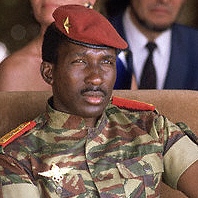
The trial to find Thomas Sankara‘s murderers (Who killed Thomas Sankara? The Trial starts in Burkina Faso) has been halted because of last week’s coup in Burkina Faso which saw the removal of president Roch Kaboré (2022 Burkinabé coup d’état). This adds to the fragility of the entire region, where the métropole (France) is impoverishing and destroying the countries it claims to be helping. As always, the ghostly/nonsensical organization that is ECOWAS (CEDEAO) with its nonsensical rules that only favor the old colonial powers came out with some ‘sanctions’. Below are excerpts from the article on ABC News.
====
Flag of Burkina Faso
OUAGADOUGOU, Burkina Faso — The long-awaited trial on the killing of Thomas Sankara, Burkina Faso’s influential leftist leader killed more than three decades ago, has been suspended as a result of the West African country’s recent coup.
The trial has been paused until the constitution is reestablished, a lawyer for the prosecution said Monday.
The suspension comes one week after a military junta overthrew President Roch Marc Christian Kaboré, suspended the constitution and dissolved the national assembly.
Prosper Farama, one of the lawyers for the Sankara family called the suspension a good thing that would respect everyone’s rights. “We have to be patient until the constitution is reestablished for things to be legal,” he said.
… Fourteen people are being charged for Sankara’s killing, including former President Blaise Compaore, who ousted Sankara in a 1987 coup. Compaore is charged with complicity, undermining state security and concealing corpses, according to military documents seen by The Associated Press. He’s being tried in absentia, as he has been in exile in Ivory Coast since he was toppled in 2014.
… “As young Sankarists, we are very worried about the suspension of the trial,” said Passamde Occean Sawadogo a singer and activist. “We remain vigilant so that nothing can jeoparidze the trial’,” he said.
As we saw from the description of a Bornu Maï (King) in the 17th century, the Bornu Empire was a prosperous empire with great kings.
Below is another description, this time of the Bornu Empire in 1582. Immediately, we notice the impressive size of the capital city most likely Ngazargamu, the respect given to the kings, who were treated just like the kings of Timbuktu. It is also good to note the level of education of these kings, as well as their relations with Libya and beyond, Turkey. Lastly, slaves were not traded here, but rather leather. Was this the source of the great Libyan leather?
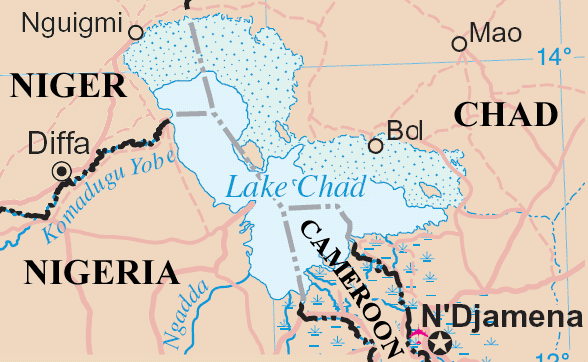
Then there is Borno on the edge of the Negro river (where there is a large lake formed by the said river [this is most likely the Yobe River also known as Komadugu Yobé River which flows into Lake Chad]). It is an immense city with a lot of traffic, having its own king who is treated with the same ceremonies, both by foreigners and by his own vassals, as those in use among the king of Tungubuto (Timbuktu). We kneel down on our knees, throwing sand on anyone’s head. He is served with great zeal by eunuchs and young girls whom they render sterile with certain potions.
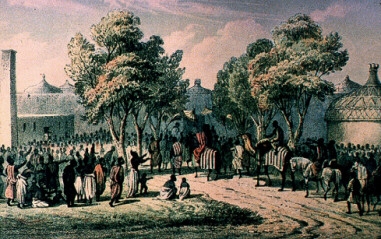
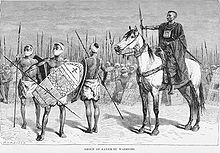
Group of Kanem-Bu warriors in the 1800s
In his correspondence, writing to foreign princes, he uses the Arabic language, as Giovanni di Vesti tells me, a very honorable person, and who was a slave to the son of a great count among the Turks. He himself saw a letter that the king of Borno wrote to the Pasha of Tripoli with great eloquence and art. This prince is so powerful that several times he has raised an army of hundred thousand men against the king of Cabi (Kebbi [in modern day Nigeria]). The blacks, it is said, regard him as an emperor, so great is his power. He owns a multitude of horses which Arabs bring from their country, and they make a great profit by selling them for at least a thousand or seven hundred crowns each. These horses do not stay alive for long, because when the sun enters the sign of Leo, many of them die every year from the extreme heat. Today many Turks arrive, seeking adventure, and many Moors from Barbary, who are their scholars. They are very well paid, because they are few in number, as it happens with all those blacks who are Muslims. And many merchants depart from there every year, carrying so much excellent quality leather that it seems extraordinary in Fizzan (Fezzan [in Libya]). Then they return with big quantities of horses, accompanying the caravans of black merchants.
Edition critique par Dierk Lange
Les Africains, vol. 3, Editions J.A., 1977, p. 57. Translated to English by Dr. Y., Afrolegends.com
We can retain without great risk of anachronism the detailed description that a Frenchman – probably a surgeon by the name of Girard held in slavery for a few years in Tripoli – gives in 1685 of the sovereign according to the testimonies he collected in this city.
It is in this case the grandson and fourth successor of Idris Alooma, designated under the name of “Mahi-Hagi-Hali”, that is Mai (Hajj) Ali b. Umar b. Idris, who had reigned, according to D. Lange, from 1639 to 1677.
Idris Alooma
“Those who have seen this prince agree that he is nice looking well-built, and of rich stature, but he is black : his ordinary clothes are a robe of white or blue linen, with long sleeves, very fine and untied : he wears the white turban like the Turks, and his face is always more than half covered, because the Bornu people are ashamed (take shame) to show their mouths, and which covers their face from the tip of the nose to the bottom of the chin.”
Chronology of the Bornu Kings from 1512 to 1671. – Extract from manuscript number 12220 (Nouvelles acquisitions. Bibliothèque Nationale, Paris) – Reproduced by le Bulletin de la Société de Géographie de Paris, 1849
It is good to note that, two centuries later, the European travelers who visited Bornu described the robe of the king in identical terms. Such permanence clearly indicates that this is not an occasional outfit, but one of the ritual and traditional insignia of power.
Les Africains, vol. 3, Editions J.A., 1977, p. 53. Translated to English by Dr. Y.,Afrolegends.com
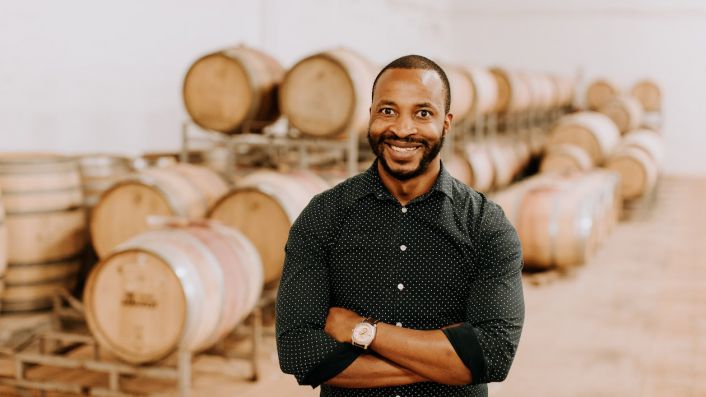
Tinashe Nyamudoka and barrels (Source: jancisrobinson.com)
Have you ever heard of Africans making it into the world of wine? I don’t mean South Africans who have a good history of wine-making, but other countries on the continent? Well, a while back, I had heard about an Ivorian making wines and actually having a vineyard, and now Zimbabweans. As a side story, one of my uncles was once a very pro-eminent wine-taster… I always wondered where he had acquired the taste (given that this is not a tradition for us), but he used to be called upon by the best wineries in France to taste and judge on the quality of their wines. The Guardian had a story about Tinashe Nyamudoka and a new generation of Zimbabweans getting into the wine business. Below are excerpts from that article. Enjoy!
====
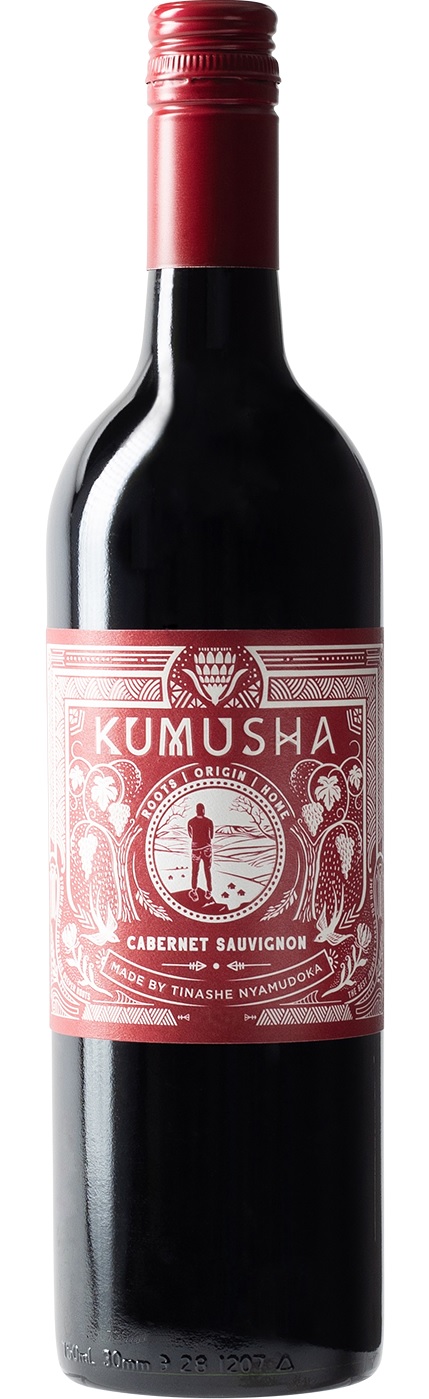
A bottle of Kumusha Wine, Cabernet Sauvignon
… When he left [Zimbabwe] in 2008, [Tinashe] Nyamudokahad never tasted wine. Now, he ranks among southern Africa’s top sommeliers and has his own wine label with international sales.
“We have a lot going against us as Zimbabweans, and you might think there is nothing good coming out of the country,” says the 36-year-old. “So, for me to be recognised as the [top] sommeliers in the world, being African and Zimbabwean, instils a sense of hope and pride.”
Nyamudoka began his career as a waiter in a Cape Town restaurant, where he learned about the different varieties and tastes of the wines his customers drank. He moved on to become a hotel wine waiter, working alongside some of the city’s leading sommeliers.
After studying his trade [he also has a certificate in wine business management from the University of Cape Town], he won the best wine steward award in a competition for luxury hotels in the Western Cape in 2013.
… His wine label, Kumusha – “home” or “roots” in Zimbabwe’s Shona language – has benefited from his celebrity, producing 200,000 bottles a year, up from 1,200 when it was launched four years ago. “People started embracing it,” he says.
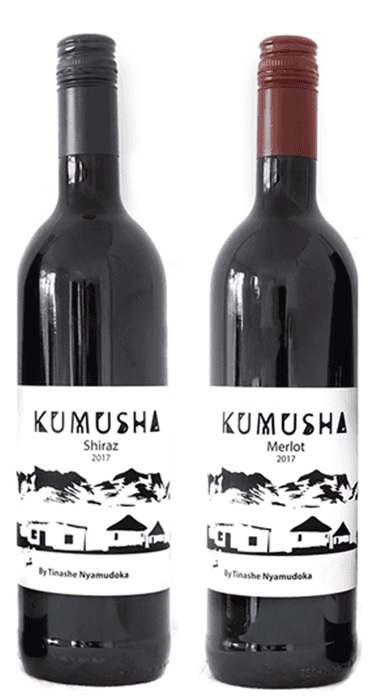
Kumusha wines, Shiraz and Merlot
… The eight Kumusha wines – three reds, four whites and a rosé – are all produced in South Africa. They are sold in the US, the Netherlands, Kenya and Zimbabwe – “my exciting market”, he says. This month, he is starting to export his wines to the UK.
“I started this brand from scratch with no aid or financial handouts. It has been pure grit, passion and dedication,” he says. “I want people to understand that you can make it without prejudice.”
…. “There’s been an emergence of black sommeliers in the world as the industry becomes more diverse. We see the hospitality offering in Zimbabwe improving and there will be a need for sommeliers.”


 If death marries me on the way to this ideal, do not mourn me.














 African Heritage