Once there was a dog, a goat and a donkey who wanted to travel to another country. So they got on the bus. The dog had ten birr (the main unit of currency in Ethiopia). The donkey had five birr, but the goat had no money.
The bus ticket cost five birr. But when the dog gave ten birr to the conductor, he didn’t get any change. Because the goat had no money, she tried to hide herself in the bus. But the donkey paid his five birr. When the bus arrived at its destination they all got off.
Une Chevre / A Goat
The dog always runs after the bus shouting, “Give me my five birr! My five birr!” The goat runs away from the bus, saying, “The conductor will ask me for my money.” But the donkey doesn’t move. He’s already paid his five birr and he feels quite safe and happy.
Diébédo Francis Kéré, an architect from Burkina Faso, has just won the prestigious Pritzker prize which some call the Nobel prize of Architecture. With this, Kéré is the first African to ever win such a prestigious award. He has held professorships at the Harvard Graduate School of Design, Yale School of Architecture and the Swiss Accademia di Architettura di Mendrisio. In 2017 he accepted the professorship for “Architectural Design and Participation” at TU München in Germany where he has been living since 1985.
Opera Village in Burkina Faso – Diébédo Francis Kéré’s work (Source: arquitecturaviva.com)
A lot of Kéré’s work is focused on the African continent: parliament buildings in Burkina Faso and Benin, schools and health center in Burkina Faso, and the National Park of Mali. He has also worked on projects in Germany, the United States, and Great Britain among which is the Serpentine Pavilion in London. Light is at the center of his designs because growing up in Burkina Faso, sometimes in the classroom, it was very hot from the weather (Burkina Faso has few rains due to the proximity to the Sahel) and from so many children all bunched together, but there was not much light inside; plenty sunlight outside, no light and too hot inside. Growing up Kéré thought that he could improve the designs and make the life of children in his village and beyond better.
Kéré Architecture is currently working on a new parliamentary building inspired by the palaver tree. It is, he told NPR, a West African symbol of consensus building, and he hopes the building will reflect a commitment both to tradition and democratic process. “Literally speaking, it is a tree under which people come together to make decisions, to celebrate,”…
Interior of the Serpentine Pavilion in London – Diébédo Francis Kéré (photo by Iwan Baan – Kerearchitecture.com)
He told the Pritzker prize that, “I grew up in a community where there was no kindergarten, but where community was your family. Everyone took care of you and the entire village was your playground. My days were filled with securing food and water, but also simply being together, talking together, building houses together. I remember the room where my grandmother would sit and tell stories with a little light, while we would huddle close to each other and her voice inside the room enclosed us, summoning us to come closer and form a safe place. This was my first sense of architecture.”
A while back, I told you aboutthe Mpemba effect, a physics effect demonstrated by a Tanzanian high school student in 1963, Erasto Mpemba, whereby hot water freezes faster than cold water. This is a ‘modern’ (after the 1960s) physics law made in Africa, by an African high schooler, and named after an African (history is full of cases of ‘intellectual’ misnaming i.e. naming the work of an African or others after a European).
Flag of Tanzania
More recently, scientists John Bechhoefer at Simon Fraser University in Canada, and colleagues, have experimentally demonstrated the Mpemba effect in reverse, also calledinverse Mpemba effect, where they observed that under specific conditions a cold particle will heat up faster than a warmer counterpart. The team used optical tweezers to create a tilted double-well potential that confined a colloidal particle, and then measured the particle’s response as a function of its initial temperature. The new measurements indicate the inverse Mpemba effect is much weaker than the conventional, forward effect. The work also experimentally corroborates some of the predicted mechanisms behind both the forward and the inverse effects. The findings were published in theProceedings of the National Academy of Sciencesin January.Excerpts below are fromPhysics Today; check out the full article which also goes into detail about Erasto Mpemba, and explains the effect in depth.Enjoy!
====
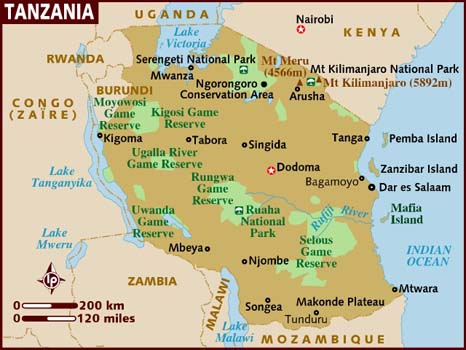
Map of Tanzania
In 1963, a 13-year-old Tanzanian student named Erasto Mpemba and his secondary school classmates were tasked with making ice cream. There was limited room in the freezers, and he found himself falling behind other students. His classmates were boiling milk for the treat, then letting the mixture cool before placing it in the freezer. To stay on track, Mpemba put his hot concoction straight into the freezer. Checking on the dessert some time later, he found it perfectly frozen, while his classmates’ remained liquid.
The idea of water freezing faster when it starts at a higher temperature was christened the Mpemba effect after he published the finding in 1969 with physicist Denis Osborne. …
Ice cream
… a decade ago, computational chemists simulated water molecules and observed the Mpemba effect despite the absence of the supposedly necessary mechanisms. Recently, researchers have also observed the effect in other liquids and magnetic alloys, which indicates that causes specific to water, like hydrogen bonds, cannot fully explain the effect. Further complicating the investigation of the Mpemba effect is that many water-based experiments involve a phase transition between liquid and ice, which is dependent on conditions like the container and environment; that makes measurements hard to obtain and extremely difficult to reproduce.
… Bechhoefer and his team used a simple and unambiguous definition to measure the inverse Mpemba effect: the time it takes a system that starts at one equilibrium temperature to reach another, higher temperature. By using a single colloidal particle, they avoided the unnecessary complications of phase transitions in water and other systems.
In their experiment, optical tweezers create a force and thus a potential in which the particle moves. The potential is a tilted double well, … . The particle can settle into two different local minima, the left or the right valley. The potential qualitatively mimics the states of supercooled water: One local minimum has a slightly higher free energy, representing liquid (left), and the other, representing solid ice (right), has a lower free energy because that state is favored.
… To get the same quality of results observed for the forward Mpemba effect, the team had to perform five times the number of trials—5000 rather than 1000—and they believe they know why. In the forward effect, particles fall quickly into one of the two potential wells. The fraction in the left and the fraction in the right, in general, differ from the fractions that should probabilistically be in each well in equilibrium, after the system has settled to its final temperature. That difference leads to a second, slower step, in which particles hop the barrier into the other well until the correct fractions are attained. If the barrier is tall, the process can be slow and create a sharp separation in time between the initial drop into the well and the hopping. When the Mpemba effect is working at its strongest, the hopping is minimal and the relaxation time to the final equilibrium temperature is short.
The coronavirus COVID-19 pandemic has caused a lot of upheavals around the world. Apparently, it was not all bad, as it has allowed for some gems to be uncovered and some local economies to focus on internal development vs being turned out to the outside. AfricaNews recently reported that the demand for African software developers has increased as a result of the pandemic. Below are excerpts from theAfricaNewsarticle. Will this trend keep up and help to counter the African Brain drain?
====
The demand for African computer software developers skyrocketed in 2021 due to the global economic crisis, and of course, Covid 19 also played a role, a new Google report reveals.
In the Africa Developer Ecosystem report, data was gathered from Kenya, Tanzania, Uganda, Rwanda, Algeria, Cameroon, Egypt, Ethiopia, Ghana, Ivory Coast, Kenya, Morocco, Mozambique, Nigeria, Senegal, South Africa and Tunisia.
In an interview with 1,600 software developers, Google discovered that 38% of African developers work for at least one company based outside of the continent.
“Across the continent, the pool of professional developers increased by 3.8% year on year. The total number of developers in Africa is now 716,000,” the survey discloses.
In what may seem like a confirmation to the findings by google, recent research, highlighting the dynamic and growing market for the continent’s technical talent over the last two years also showed that Four out of every ten African software developers now work for at least one company based outside of the continent, while five work for local start-ups.
A 22% rise in the use of the internet by small and medium-sized businesses in Africa, a record fundraising streak by local startups in 2021 and demand for remote tech workers in more mature markets are all factors attributed to the rising awareness of Africa’s software development talent.
“Increased global demand for remote tech talent, which was enhanced by the pandemic, created more remote employment opportunities for African developers,” said Google.
March 8th marks the International Women’s Day (IWD). Growing up, this was a day of celebration of the woman’s place in society, talks and conferences took place, school-age students wrote poems or offered flowers to their female teachers, in some cases parades took place, and much more. For IWD, President Thomas Sankara of Burkina Faso made it a day when the men participated in house chores, some would do the groceries for the day, thus getting more acquainted with the family needs, or take over some other chores; this made it so that the men where now aware of the demands and lives of their partners. More recently, the talk has been big on equal pay… yet when attending lectures where women talk about equal pay, few men are present… if real change is to take place, everybody needs to be a part of the conversation. There are probably a lot of men who would appreciate the extra income that their wives being paid equally would bring to the family, perhaps adding money to the children’s school fees, family travels, house repairs, medical bills, retirement funds, to name just a few. This needs to be a common goal. We cannot let the powers that be keep us divided over an issue such as equal pay, where women who work just as hard as men, and the same hours are paid less for the same job… Isn’t that absurd? IWD is not just another day on the calendar, but it is a day for everybody to acknowledge women, recognize their place as equal, and celebrate their contributions to society.
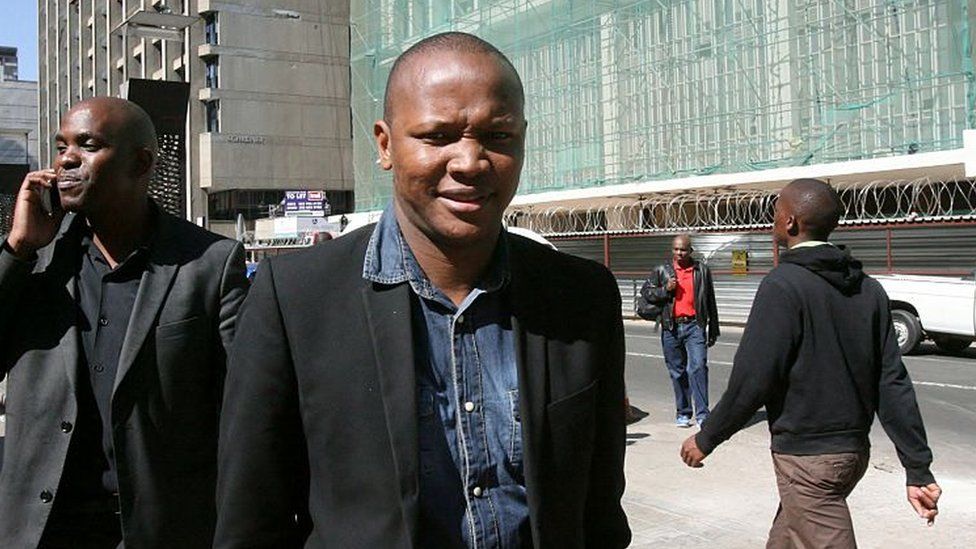
Nkosana Makate was pictured outside court in Johannesburg when the legal case began (Source: Getty Images/BBC)
In these days of exacerbated capitalism and companies shipping jobs oversees so as not to pay the locals fair salaries in the face of increasing cost of living, or people’s ideas stolen by big corporations without a single penny in return, it is refreshing to learn the story of Nkosana Makate. Nkosana Makate is a South African man who worked for Vodacom in South Africa and who is the mind behind the “Please Call Me” texting service, yet it took him 14 years to be remunerated for his invention. His story is one of perseverance when in the right, and endurance. How many would have given up? After almost 2 decades of fighting, Makate is now about to receive several millions of dollars in compensation for his idea. Excerpts below are from the BBC.
=====
South African Nkosana Makate’s 14-year court battle against a huge corporate opponent is testimony to the idea that it is sometimes worth fighting on, as he is now in line for a pay-out worth millions of dollars, writes the BBC’s Pumza Fihlani in Johannesburg.
… Two decades ago, he came up with the concept that went on to become Vodacom’s Please Call Me texting service, which allows customers to send a free message to another user on the same network requesting to be called back.
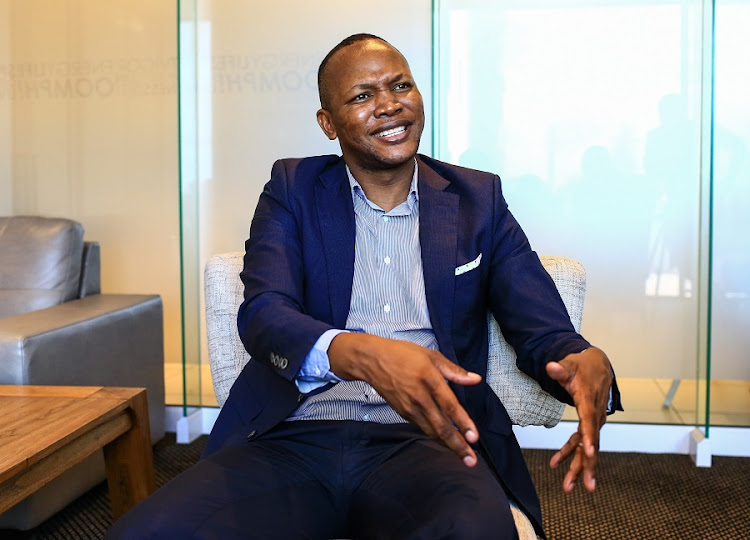
Nkosana Makate (Source: TimesLive.co.za)
… Twenty-two years ago Mr Makate was working as a trainee in Vodacom’s finance department.
“Rebecca [my wife] was a student at Fort Hare University and we were in a long-distance relationship. There’d be times where she’d want to call me but didn’t have airtime [credit to call].
“I thought: ‘Wouldn’t it be great if there was a way to initiate a call even when you didn’t have airtime?’ That’s how the idea came about,” he beamed, reliving the moment.
He entered into a verbal agreement with the company’s then director of product development and management, Philip Geissler, that he would get a share of the revenue generated by the product once it went to market.
At the time [in 2000] the firm even shared an internal newsletter praising him for the concept.
But something changed at some point and it is not clear why.
“Suddenly I was told that I’m being greedy for wanting a share of the profits from what I created,” said Mr Makate.
Instead of accepting the situation and deciding it was not worth taking on Vodacom, he went to court in 2008.
… His team of experts estimate that Vodacom made at least $4.7bn (£3.4bn) from Please Call Me and he has not seen a cent of those profits. Mr Makate has been asking for 15% of that.
At first, the company denied that their ex-employee had come up with the idea and then they said he was not due any financial benefits from it.
The case has gone through a number of courts
Eventually, in 2016, it ended up in the highest court, the Constitutional Court, which found in Mr Makate’s favour and ordered the two sides to negotiate remuneration.
The company offered a settlement of $3.1m saying it was “overly generous“, but he rejected it.
… “For me it’s about what is right, what is fair and it’s about justice. What they are doing is wrong and I cannot allow that,” he said …
… “I’m happy we persisted with the court review because we have now been vindicated,” he said.
Earlier this month, High Court judge Wendy Hughes said that Vodacom had gone against the Constitutional Court ruling and negotiated in bad faith.
Judge Hughes also said he [Makate] was entitled to a much bigger share of the revenue, which could run into the tens, if not hundreds, of millions of dollars.
… “… I will not give up,” he said, … He wants to make his children proud.
“I hope they know that daddy fought a clean good fight and that they learn to stand for something in life. I also hope they learn that nothing worthy comes easy.”
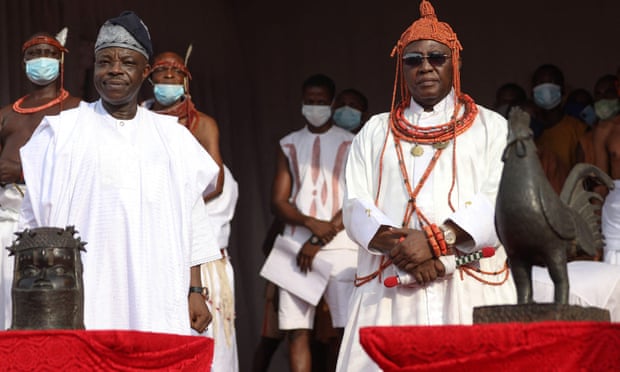
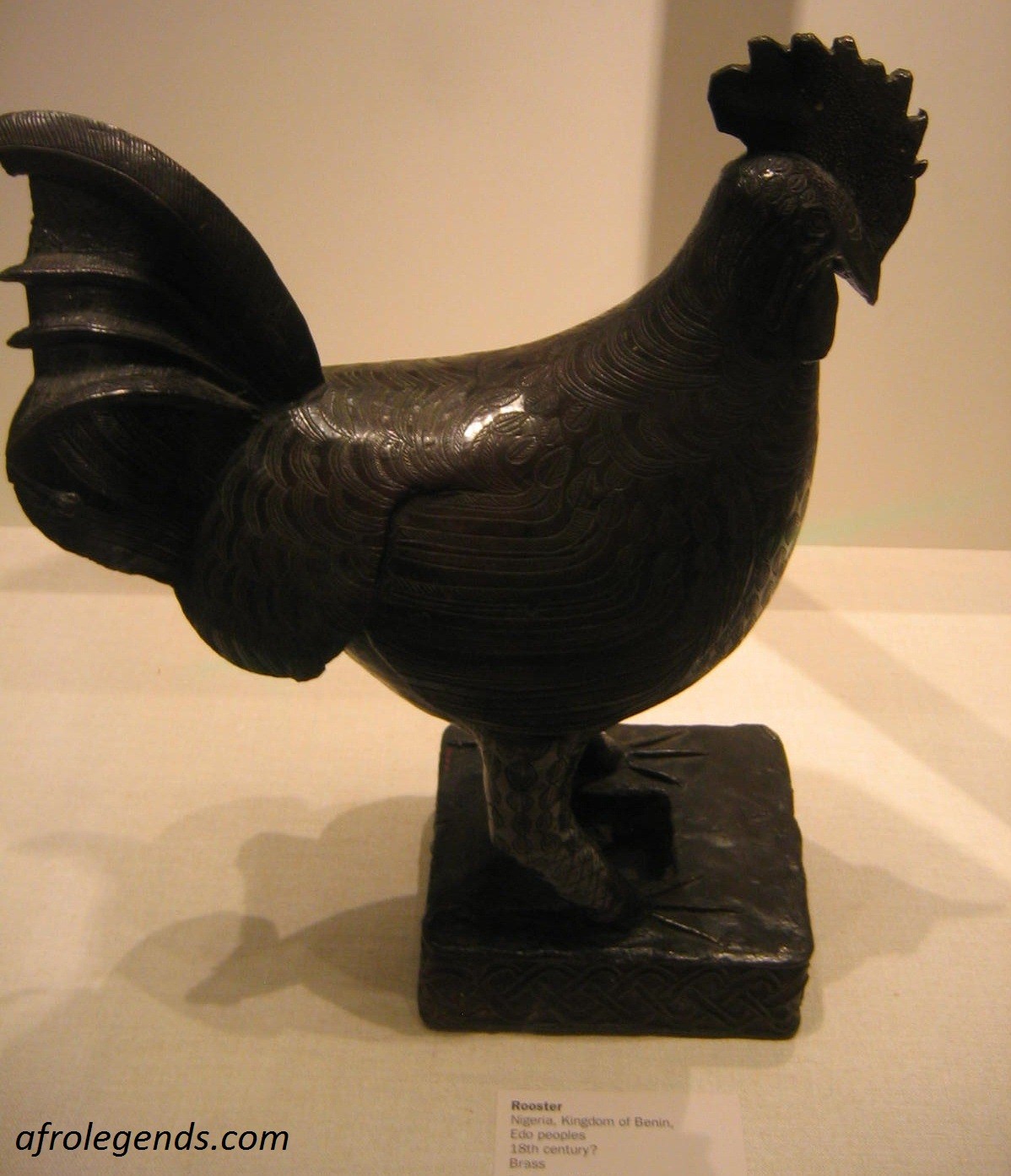
Return of cockerel sculpture and head of an Oba raises hopes that thousands more artefacts could be returned to their ancestral home. Photograph: Kola Sulaimon/AFP/Getty Images – The Guardian
It has been104 yearssinceBenin City: the Majestic City the British burnt to the groundwas looted and destroyed. Now, a century later, two of the numerous Bronze statues that were taken at the time, are being returned. Some may ask, who cares about 2 Bronze statues? These statues are not just a symbol of the craftsmanship of the Benin people, but they also symbolize the essence of the people. Back in those days, the statues were not used like they are by Europeans, to be placarded in museums, they had a symbolic, and some even had a spiritual or energetic importance. Below are excerpts from the article on the Guardian’s website.
=====
Two Benin bronzes were returned on Saturday [19 February 2022] to a traditional palace in Nigeria, more than a century after they were pillaged by British troops, raising hopes that thousands more artefacts could finally be returned to their ancestral home.
The artefacts, mostly in Europe, were stolen by explorers and colonisers from the once-mighty Benin Kingdom, now [part of] south-western Nigeria, and are among Africa’s most significant heritage objects. They were created as early as the 16th century onwards, according to the British Museum.
At a colourful ceremony to mark the return of a cockerel sculpture and head of an Oba or king, spokesperson Charles Edosonmwan for the Oba palace in Benin City noted that some of the bronzes were kept as far away as New Zealand, the United States and Japan.
Rooster from Benin Kingdom (18th century), exposed at the MET
The two artefacts were handed over to the Nigerian High Commission in October by the University of Aberdeen and Cambridge University’s Jesus College but had yet to return to their ancestral home.
“They are not just art but they are things that underline the significance of our spirituality,” Edosonmwan said in an interview on the sidelines of a ceremony attended by traditional leaders.
… About 90% of Africa’s cultural heritage is believed to be in Europe, French art historians estimate. Musée du quai Branly – Jacques Chirac in Paris alone holds about 70,000 African objects and London’s British Museumtens of thousands more.
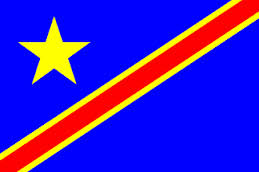
Belgium recently shared the inventory list of artifacts looted from the Democratic Republic of Congo (DRC) with the Congolese authorities. Are we supposed to applaud? In this day and age, what is an inventory list supposed to do? Is this a menu from which to choose what to ask for, and what not to? Are they hiding more: like giving you list A, while the real deal (list B) is kept in the vault? Does the inventory guarantee that all artifacts will be returned? Will the Royal Museum of Central Africa, with one of the largest collection of African artifacts in the world, graciously give back its collection, and lose the money from the million of visitors that come yearly? Moving forward, what will the ‘partnership’ between Belgium and Congo on this subject entail? The excerpt below is from Africa News.
=====
Belgian prime minister Alexander De Croo has submitted a complete inventory of Congolese works of art and artefacts [to DRC’s prime minister] which potentially could be returned to the former African colony.
… “I’m not really going to take this as repairing wounds, but I want to take it as a very voluntary act of having relationships today that are not only improved, but very much calmed down in comparison with our expectations“, said Congolese prime minister Jean-Michel Kyenge.
The inventory contains around 84 thousand objects divided in categories.
The Belgian prime minister hailed the moment as a step forward in building a partnership of trust between Belgium and the Democratic Republic of Congo.
“This program of restitution is an important element that shows the way we want to work together. It is a partnership between our two countries and a partnership of trust“, added Belgian prime minister, Alexander De Croo.
France just confirmed that it will withdraw its troops from Mali, 10 years after starting the fight against insurgency in the region. They will most likely go park their troops in neighboring countries like Niger, Burkina Faso, Mauritania? Who knows?… but we know that France has not spoken its last word… it is impossible for them to let go of the gold (after all, they are the world’s 4th producer of gold), uranium, diamonds, bauxite, of Mali just like that. Below are excerpts from an article from RFI.
====
French flag
France and its allies in its anti-jihadist operations in Mali have announced announced they will begin withdrawing troops after nearly a decade fighting a jihadist insurgency in the country.
“The political, operational and legal conditions are no longer met to effectively continue their current military engagement in the fight against terrorism in Mali,” [maybe France and its allies can no longer loot in peace] said a joint statement signed by France and European and African allies, announcing a “coordinated withdrawal” of French, European and Canadian forces. The decision applies to both the Barkhane counter-terrorism force in the Sahel and the 14-member European Takuba force that France had been trying to get off the ground.
France deployed troops against jihadists in Mali in 2013, but the insurgency was never fully put down [because the insurgents were funded by none other than…]. Some 2,400French soldiers are currently in the country as part of the Barkhane and Takuba operations. Relations between France and Mali have deteriorated after the military junta went back on an agreement to organize elections in February, and instead proposed holding on to power until 2025 [Let the Malian people decide their own destiny].
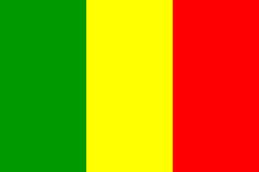
Flag of Mali
France and other countries have also accused Mali of using the services of the Wagner Russian mercenary group, which they say is incompatible with their mission [This is against rule #10 of the colonial tax France is imposing African countries, which state that no African country should have other military partners other than France unless authorized by France – The French Colonial Tax at the Heart of Mali-France Tensions].
… The countries [the allied forces] will continue “joint action against terrorism in the Sahel region, including in Niger and in the Gulf of Guinea” [oh, oh, Africa is in trouble!].
French President Emmanuel Macron said that Niger had agreed to host European forces fighting Islamist militants in the Sahel [does Niger really have a choice?… remember The 11 Components of the French Colonial Tax in Africa? plus the Niger president is a French puppet].
He also said the remaining forces would provide further assistance for countries in the Gulf of Guinea [let’s invent new troubles everywhere so we can loot in peace, and not pay a dime to the local populations]. “These states are increasingly exposed to efforts by terrorist groups to implant themselves in their territory,” Macron told a press conference in Paris Thursday, shortly before traveling to Brussels for a two-day EU-Africa summit.
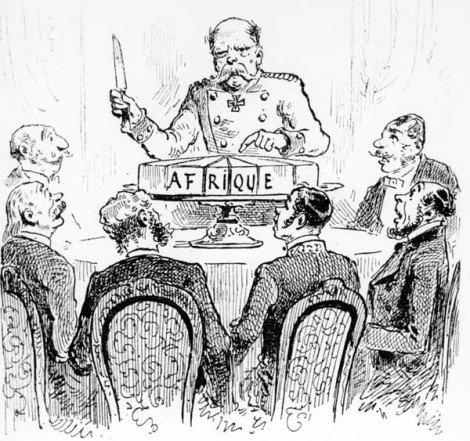
Le partage de l’Afrique a la Conference de Berlin de 1884
There are a total of 25,000 foreign troops currently deployed in the Sahel region, including the UN peacekeeping mission MINUSMA established in 2013 and an EU military training mission, the EUTM Mali, along with the Barkhane operation and the Takuba forces [Despite all these forces deployed, insurgencies still manage to flourish?… I wonder why? maybe because the insurgent is paid by … the ‘savior’?]. …









 The coronavirus COVID-19 pandemic has caused a lot of upheavals around the world. Apparently, it was not all bad, as it has allowed for some gems to be uncovered and some local economies to focus on internal development vs being turned out to the outside. AfricaNews recently reported that the demand for African software developers has increased as a result of the pandemic. Below are excerpts from the








 African Heritage