Once upon a time, there was a young man who was going to visit his fiancée. She received him with all honors and installed him in her hut in the middle of her bed. She hastened to present him with a calabash full of curdled milk. But custom dictates that one holds back when one is at one’s parents-in-law, and the stranger apologized for not being able to drink this good milk.
Despite his beloved’s insistence, he refused to take a single drop. The calabash was thus stored on the shelf and the conversation resumed even more vigorously.
A moment later, the girl went out for a few moments. Then, the stranger, who was tormented by the desire to taste this good milk, got up to take advantage of the absence of his beloved. But, in his haste, he knocks over the calabash, and the milk floods his boubou.
Stunned and crestfallen, he awaits his fiancée’s return. Fortunately, she does not return, but sends her little brother to bring back the calabash of milk stored on the shelf. The child enters the room and, seeing the confused man huddled in a corner, he understands what has happened. Heaving a sigh, he exclaimed:
– Ouch, I took the calabash, but it slipped from my hands and it fell over on the guest’s boubou!
The sister runs inside and burst into tears while apologizing to her guest for the clumsiness of her little brother.
Thus, the man was able to leave the village, not without keeping an excellent memory of the child who saved him from disgrace.
Contes Wolof du Baol, J. Copans and P. Couty, Ed. Karthala, 1988, p. 62. Translated to English by Dr. Y., Afrolegends.com
Today, education in Africa is Eurocentric, meaning that African history is rarely well-taught in African schools. In Francophone Africa, the school manuals are written by Frenchmen on the continent, or in France, so there is barely any emphasis on Africa. We learn about Europe, China, Japan, Napoleon, all the French dynasties, wars, etc, but very little about OUR history. Thus, most Africans grow up without knowing anything about the Ishango bone, the Blombos Cave, Lucy, the Lebombo bone, or the fact that Pythagoras or Thales theorems were actually written in Egypt by the scribe Ahmose over 1000 years before Pythagoras visited Africa; or even that C-sections were a normal part of African medicine for centuries while in Europe, women were still dying during pregnancies, or even that ancient Egyptians were black! There are countless examples showing that the falsification of African history has been ongoing for centuries, and that there is so much missing in African school manuals.
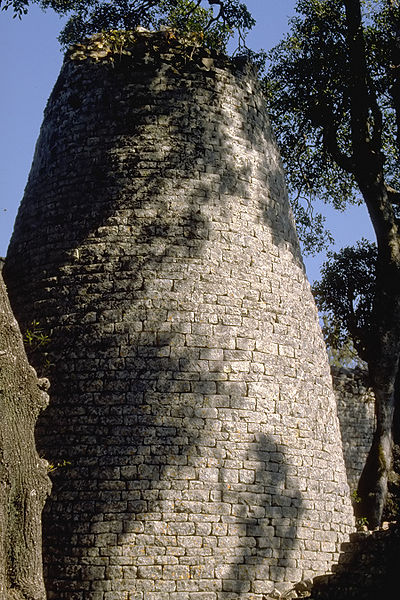
A Conical tower at Great Zimbabwe
Why is Nioussérê Kalala Omotunde’s work important for Africans? NKO’s work is fundamental because he, like some other illustrious Africans, worked tirelessly to restore Africa’s place in the world. However, his work was not just telling us Africans that we were once great, but more importantly focused on shaking the consciences of many: if my ancestor was great, if my ancestors built the great pyramids of Egypt, how can I, African today, believe that I am meant to live in tin shacks? If my ancestors were the great architects and metallurgists of Great Zimbabwe, why should I keep adopting the European materials for building when ours have lasted over centuries? how can I wait for foreign aid, when I have been blessed with fertile lands? How can I be eating wheat from Ukraine, when I could go back to ancient grains such as fonio, sorghum, millet which have always been a part of my diet for centuries (How Africa Copes with The War in Ukraine: Alternatives to Wheat – Ancient Grains?)? How can I import paper, when my ancestors developed the first support medium for writing (paper comes from papyrus)? How can I act like I do not know mathematics, when my ancestors where the amazing Egyptian mathematicians? How can I feel so lost in medicine or just focus on European medicine, when in Bunyoro kingdom, we had master gynecologists who could perform c-sections centuries before Europe? How can I be stuck with the FCFA when my ancestors invented currencies using silver? How can I, an African child, feel so small? How can I, an African child, focus only on misery, as opposed to what nature has given me? I need to raise my head, and see, and take the grain God has given me, and turn it into a tree!
I invite you to read some of his books, which can be found at: Anyjart.
“Si tu sais être comme le soleil, tu pourras raviver tous les soleils éteints autour de toi; mais ça ne passera pas que par des mots, il faut y associer ton coeur et des actes.”
“If you know how to be like the sun, you can revive all the extinguished suns around you; but it will not happen onlythrough words, it is necessary to associate your heart and deeds to it.“
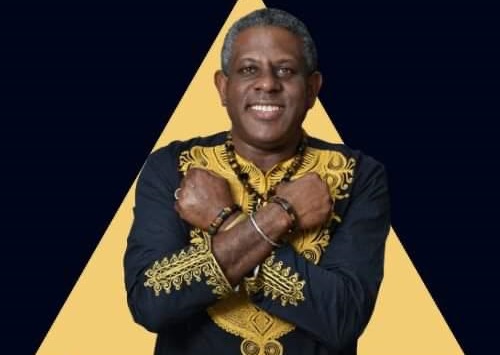
A great man has left us. Yesterday, the great teacher, researcher, Egyptologist, historian, and brother, Jean-Philippe Nioussérê Kalala Omotunde changed dimension. Kalala Omotunde was a bright light who worked tirelessly to teach us, Africans, about our true heritage. He was conscious that our souls and spirits had been so broken by colonization, slavery, wars, foreign invasions, and so many other ailments, that we had lost sight of who we truly were, descendants of the great pharaohs of Egypt, descendants of Mother Africa, the cradle of humanity and sciences.
Kalala was the founder of the Anyjart institute and satellite institutes in Canada, Guyana, Martinique, Haiti, and many more around the world. Via his institute, he worked tirelessly to empower Africans, and particularly the Black youth in the diaspora and beyond. His great work focused on the African classical humanities, and African mathematics and sciences. He was also Chargé de mission at UNESCO. He specialized in making the Black (wo) man whole again by teaching him about his history, his origin, his ancestors. You see… Africa has been under attack for centuries now, and along the way, her children have lost their conviction, the knowledge of their greatness, traditions, and have erred away from her by adopting other religions and even others’ distorted views of themselves.
Nioussere Kalala Omotunde
I have been a fan of his work for over a decade. I remember one time when we talked, I showed him the blog, and coincidentally the article of the day was, “How do We Continue the Fight when the Head has been Cut Off?” He made some comments and gave me pointers. In that conversation I learned so much: for instance, the picture of Amilcar Cabral pointed left, and Kalala told me that this was looking to the past, and when we have lost a leader, we need to look forward, and build for future generations. He embodied the article itself, working tirelessly to teach the next generations how to continue the battle through education. He had a strong presence, was so confident, and so generous in sharing his time and knowledge.Such a baobab! Such a dedication to Mother Africa… He was so welcoming, so selfless, always ready to help, addressing many with endearing words such as “mon très cher”, or “ma très chère”.His institute focused on teaching ancient hieroglyphs, the knowledge of African history, African mathematics and sciences, teaching the link between ancient Egypt (and beyond) and Africa today, and above all restoring the dignity of Africa. He focused on scientifically proving historical findings about Africa… he will often have at least 5 documents to prove the veracity of a claim he made; he was methodical. He had so many great projects!The geothermic project in Guadeloupe which he wanted to see extend to Africa, the Wakanda project, and countless others aimed at empowering Africans to be self-sufficient energetically, financially, agriculturally, technologically, and much more. I console myself in knowing that he has written so many books, and that we can all benefit from his teachings, and rise up as he wished.
Having been influenced by Cheikh Anta Diop, Nioussere Kalala Omotunde worked tirelessly to show the deep wealth of African cultures, and often shared the fact that the history of Black people in the Caribbeans did not start with slavery. So long brother… May your seeds bring lots of fruits. I will remember your contagious laughter, your big smile, your intelligence, and above all your teachings. I feel so privileged to have had a chance to know you, and receive some of your teachings. You always talked about African Renaissance. You showed us the way, now we have to carry on your light. May the Ancestors receive and cherish you.
When you hear the name Saint-Louis, what comes to mind? If you are thinking about the city with the Gateway arch, that city in the United States of America, St Louis,… then think again… today we will talk about the other Saint-Louis, the city located in Senegal, which used to be the capital of the French colony of Senegal from 1673 to 1902. You heard right… so Saint-Louis in Senegal is actually much older than the American St Louis.
View of the Saint-Louis Fort from the sea, from “L’Afrique ou histoire, moeurs, usages et coutumes des Africains”, by René Claude Geoffroy de Villeneuve, 1814
The city of Saint-Louis is the capital of Senegal’s Saint-Louis Region, and is located in the northwest of the country, near the mouth of the Senegal River, 320 km from the capital Dakar, on the border with Mauritania. The city was named after Louis IX, a 13th century king of France, and also in honor of Louis XIV who was the monarch at the time of the island’s settlement by France in 1659. It was the first city founded by Europeans in West Africa; before then, there were Portuguese, Dutch, English traders in the area, but they had not yet ‘founded’ cities. The city was originally known as Saint Louis of the Fort (St-Louis-du-Fort) after its fort. At least 200 years prior to the European arrival in the area, the site was an Wolof settlement known to locals as Ndar or N’dar which is Wolof for island. With the arrival of Europeans, the city became an important trade center for gold, gum Arabic, ivory, and slaves in Africa.
Downtown Saint-Louis, Rue Lebon, 1900
Nicknamed the “African Venice,” it is no surprise that Saint-Louis acquired the status of UNESCO World Heritage Site in 2000. Since then, the city has been working on renovation of ancient buildings, transforming some of the warehouses into hotels and restaurants. The city still has a lot of houses from the colonial era. It is divided into three parts: N’Dar’s island (the historical part of the city) which is connected with a bridge to the fishing village in the peninsula Guet N’Dar (the
View of Saint-louis showing its different neighborhoods (Source: Baobabtourisme.com)
Langue de Barbarie) and to the continental part with another bridge. The heart of the old colonial city is located on a narrow island which is a little more than 2 km (1.2 mi) long but only about 400 m (1,300 ft) wide. The island lies in the Senegal River. It is 25 km (16 mi) north of its mouth, but is only separated from the Atlantic Ocean to its west by the Langue de Barbarie, a 300 m (980 ft) wide sand spit. The Langue de Barbarie is the location of the seaside neighborhoods Ndar Toute and Guet Ndar. On the mainland, the east bank of the river is the site of Sor, an older settlement now considered a suburb of Saint-Louis. It is nearly surrounded by tidal marshes. Three characteristics give Saint-Louis its distinctive geographic appearance: the Sahel, the marshes, and the Langue de Barbarie.
A Signare or Negresse of quality from the Island of Saint Louis in Senegal, accompanied by her slave, Illustration from Costumes civils de tous les peuples connus, Paris, 1788, by Jacques Grasset de Saint-Sauveur
One cannot talk of Saint Louis without mentioning the Signares. Deriving from the Portuguese Senhora, Signares were the women of mixed descent, French/Senegalese, also known as Métis, who formed a class of entrepreneurs women who managed to gain some assets, status and power in the hierarchies of the Atlantic slave trade. They were important in the economic, cultural and social life of the city. They created a distinctive urban culture characterized by public displays of elegance, refined entertainment and popular festivities. There are still families descending from these women entrepreneurs of the 18th and 19th centuries.
Some big attractions apart from the city itself include the National Park Langue de Barbarie which is in the southern tip of the peninsula, and covers a total surface of 2000 hectares, and the Djoudj National Bird Sanctuary which is the third largest bird sanctuary in the world, with species emigrating there from Europe, Asia, and East Africa.
If you are ever in Senegal and would like to head north of Dakar, please take the time to visit Saint-Louis, and bathe in the mix of old colonial French style and the teranga (hospitality) so well known to Senegalese people. To learn more about Saint-Louis, check out: Saint-Louis du Senegal, UNESCO World Heritage Site, and my favorite on Spirited Pursuit.
Last year, the Thieboudienne entered into the UNESCO Intangible Cultural Heritage list. Anybody invited to a Senegalese home, or country, cannot leave without a taste of Senegal national dish: the Thieboudienne. In the Wolof language, Thieboudienne or Ceebu Jën in Wolof literally translates to ‘the rice of fish’, ceeb (rice) and jën (fish).
Thieboudienne is a dish that originated in the fishing communities on the Island of Saint-Louis in Senegal in the 19th century. The story has it that a cook by the name of Penda Mbaye who was working in the colonial governor’s mansion (Saint Louis was the capital of the French colony of Senegal from 1673 to 1902) substituted broken rice for barley; barley was more prominent and local but in short supply at the time, while the broken rice was an introduction from Vietnam by French merchants in Senegal (side note: do you see how breaking the local market is done?).
Although recipes vary from one region to the next, the dish is typically made with fresh fish (grouper or snapper usually), broken rice, dried fish, mollusc and seasonal vegetables such as onions, parsley, garlic, chilli pepper, tomatoes, carrots, eggplant, white cabbage, cassava, sweet potato, okra and bay leaf. As one can imagine, the quality of the fish and the choice of vegetables are determined by the importance of the event or the degree of affection one has for the guest. Like many traditional dishes, the recipe and techniques are passed down from mother to daughter, from generation to generation. Senegalese are known to eat together, so the ceebu jën is served on a large platter, and eaten with hands. It is associated with the Senegalese teranga or hospitality. Today, there are variations thieb ganaar (thieb with chicken) or thieb yappa (thieb with meat). It is said that the Gullah red rice dish from the Gullah people of the south of the United States may actually have derived from the thieboudienne, suggesting that enslaved Africans took their culinary expertise to the Americas, which is a no-brainer.
If you visit Senegal, or if you ever go to a Senegalese restaurant, try the national dish Thieboudienne, which is now on the UNESCO list of Intangible Cultural Heritage. Enjoy!
On October 11, 2022, the Smithsonian museum returned 29 Benin Bronzes to the National Commission for Museums and Monuments in Nigeria. This was done in a ceremony at the National Museum of African Art, and held in conjunction with the National Gallery of Art. The bronzes, which were part of the Smithsonian museum’s collection, were stolen from Nigeria during the 1897 British raid on Benin City (Benin City: the Majestic City the British burnt to the ground). The return of these Benin Bronzes is the first return under the Smithsonian’s new ethical returns policy, policy which authorizes Smithsonian museums to return collections to the community of origin based on ethical considerations, such as the manner and circumstances in which the items were originally acquired. In my eyes, this Smithsonian ethical returns policy sounds more like the thief finding lexicon and grammar to explain its theft and the reason why it is hard for him to return the loot, or rather the reason why he needs to hold onto the loot. As always, the question remains: why now?Are the Western museums really going to deplete their museums from attractions that generate millions of dollars yearly? And then the even bigger question: how many Benin Bronzesare there, and should we applaud the return of 1 here, 2 there, or 29 here?
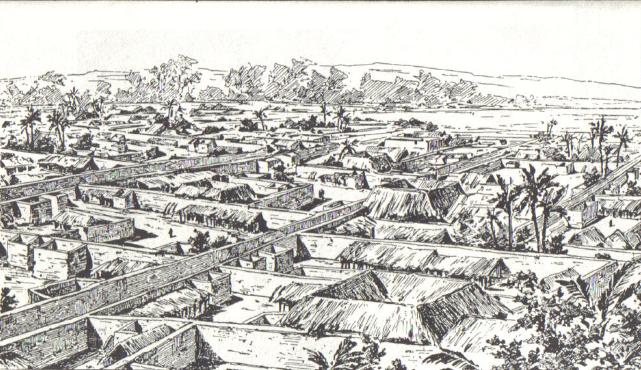
Benin City in 1897
As a recap, on February 1897, an expeditionary force of 1,200 British soldiers and African auxiliaries, known as the Punitive expedition of 1897, captured, burned, and looted the city of Benin, bringing an end to the West African Kingdom of Benin. During the conquering and burning of the city, most of the country’s treasured art, over 3,000 pieces of art work, including the Benin Bronzes, were either destroyed, looted or dispersed; see Benin City: the Majestic City the British burnt to the ground.
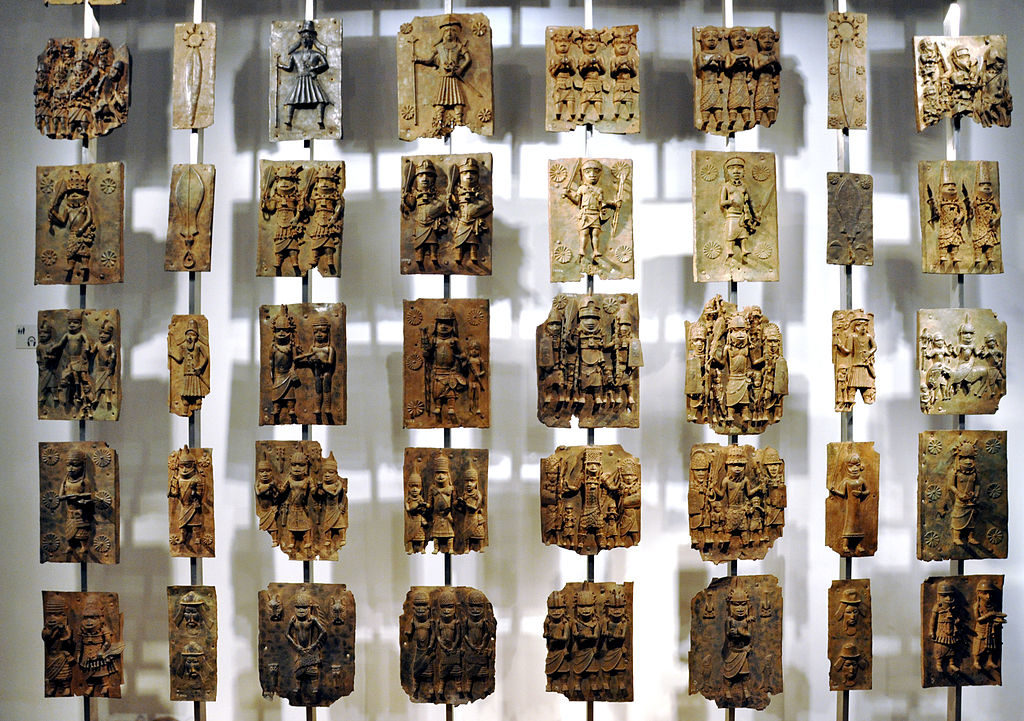
Exposed Benin Bronzes at the British Museum
So, according to C. Huera, 2,400 of Benin artworks including Bronzes, ivories, and more, are held in museums around the world, even though over 3000 were carried back to Europe in 1897. Of those, only 50 are in Nigeria. Today, there are over 900 objects from the historic Kingdom of Benin in the British Museum‘s collection alone. Around 1950-1951, the British Museum sold, exchanged, donated 26 to the Colony and Protectorate of Nigeria (25) and the government of the Gold Coast (1) to be in their countries’ museums; it was said at the time that these were duplicates of originals still held at the British Museum (which was denied… but who can really confirm? after all, in the 1950s these countries were colonies of the Queen, did it make sense to return originals to mere colonies?). I wonder how many today are part of the Smithsonian Museum, or the Louvre, or the… the list is so long. In view of this, the return of 1 or 2, or even 29 Benin Bronzes, although laudable, can be seen as a token gesture, more than anything else. Plus, after 125 years spent outside of Benin City, who can really tell if the returned Benin Bronzes are the real ones? Also, are the returned Benin Bronzes the major ones, or part of the backup, you know the ones that never get exposed? Lastly, I hope the Benin people, and the people of Nigeria as a whole, have put in place great security systems and a loyal patriotic circle of trust so that the returned Benin Bronzes will never again leave the homeland!
















 African Heritage