The coup d’etat which just happened a little over 2 weeks ago in Burkina Faso on September 30, 2022, marks the need for Burkinabe and Africans in general to be in charge of their own destinies. We have the land, we have the resources, we should be in charge of our own destiny. We can no longer be ‘partners’ (more like slaves) to a master (France and the West) which takes all our resources while leaving us dirt poor. We deserve dignity, and are going to reclaim our territories, in the case of Burkina Faso or Mali, territories stolen by terrorists armed by foreign powers; we are going to reclaim our resources, and more importantly reclaim our lives, and our futures. As we mark the35th anniversarysince the murder of Thomas Sankara, president of the Faso, his widow Mariam Sankara gave a speech which can be found in its entirety onThomasSankara.net. I have translated parts of it. Enjoy!
Once again, I would like to thank you all for your support before and during this first part of the trial. My thanks go to the family lawyers, to the organizers of the “fight against impunity, justice for Thomas Sankara” campaign, to militant Africa in general, to the associations of Burkina, to the Diaspora, to the people of Burkina Faso and to the friends from Burkina Faso.
However, we must know that our struggle is not over. …
.
Map of Burkina Faso
.. Burkina, as we all know, is going through a serious period in its history due to the destabilization imposed on it by terrorists supported by shadow forces. These forces want to wipe our country off the map of the world. This project is unacceptable.
We must all opt for the support of our security forces, the families of the victims and those displaced by war, who number in the thousands.
Admittedly, we must rely on our own strengths, but it is imperative that we call on honest and credible partners, if necessary.
May Burkinabè patriotism serve as a compass for the final victory against terrorism, for social cohesion and for the prosperity of our country.
Tapiwa Guzha, founder of Tapi Tapi (Source: sossegodaflora.blogspot.com)
Can you imagine having Egusi ice cream? or dried fish or edible clay or caterpillar or Chin Chin ice cream? … well… think no further! In2020, Zimbabwean postdoctoral studentTapiwa Guzhawho emigrated to South Africa for studies, had the idea of creating an ice cream parlor that represented African foods, flavors, and cultures. He thought of sharing his love of science, his specialty being plant biotechnology, to educate others with flavors from the continent. Thus was bornTapi Tapi, which means sweet sweet in the Shona language of Zimbabwe. Guzha mixed in typical traditional African flavors from all over the continent into his ice cream. To date, he has made over900different flavors from some of the most amazing African spices, nuts, seeds, fruits, flowers, clay, and even caterpillar. Tapi Tapi‘s sugar cones are made with millet, cassava, sorghum, maize, and plantain flour.. Enjoy, and if you are ever in Cape Town, don’t be shy… go and try out these amazing African flavors! Excerpts below are fromthe Guardian! Please also check out this very good article fromTravelEssenceMag, and another fromCNN.
======
Baobab ice cream (Source: Tapi Tapi)
Caterpillars, dried fish and clay are not what you would expect to find in ice-cream, but one Cape Town cafe with a mission to celebrate African foods and culture has used all three as ingredients in its frozen desserts.
“Handcrafted, authentic African ice-cream,” reads a sign at the entrance to Tapi Tapi. Inside, the counter is filled with ice-creams in various shades of beige and brown. They look underwhelming, but the blackboard listing the flavours suggests differently.
Tshego Kale, a 22-year-old student and part-time worker in the cafe, explains the menu. “First up is prekese and kei-apple jam. Prekese is a spice from west Africa, sometimes used in soups,” she says. “Kei apple is a sour fruit, but the ice-cream is sweet with a bitterness coming through.” Rooibos, fermented pineapple and lime is next: “It’s sweet, not as dense; good for hot days.”
There are three ice-creams containing chin chin – a fried snack from west Africa. One is paired with African bird’s eye chilli, and has “a kick that comes towards the end”. Another one features clay as the second ingredient: “It has an earthy flavour, very mellow and smooth with a biscuity texture.”
Egusi, a combination of seeds used in west African cuisine, is mixed with pumpkin, cinnamon and nutmeg in another ice-cream. “People from overseas have said this one tastes like Christmas,” says Kale.
Rooibos
Tapi Tapi and its African ice-cream is the brainchild of Tapiwa Guzha, who first came to Cape Town as a student from Zimbabwe. In the two years since it opened, he has created about 900 flavours.
Each tub he makes is unique and never repeated. His aim is to use ice-cream as a vehicle for educating and inspiring people about African flavours. When making a new flavour, Guzha thinks of an ingredient and what he wants to achieve by using it.
He explains: “What point am I trying to make by creating that flavour? Am I trying to showcase something new that people don’t know about? Am I trying to teach people about a cooking technique that turns out certain dishes or flavours? Or am I looking at a cultural icon?”
The idea for Tapi Tapi came in 2018, when Guzha was doing post-doctoral research in plant biotechnology but wanted a change. “I was looking for ways of communicating about science without having to rely on the scientific process – journal publishing, conferences and keeping knowledge in academic spaces,” he says.
Guzha had been making ice-cream for 10 years with dry ice that was delivered to his research labs, after seeing how it was done on a cookery show. One day, it dawned on him that he had never made a specifically African ice-cream. “I realised there was something faulty in the system. The moment you taste a flavour that connects you to home, your culture, your land – it’s a different experience.”
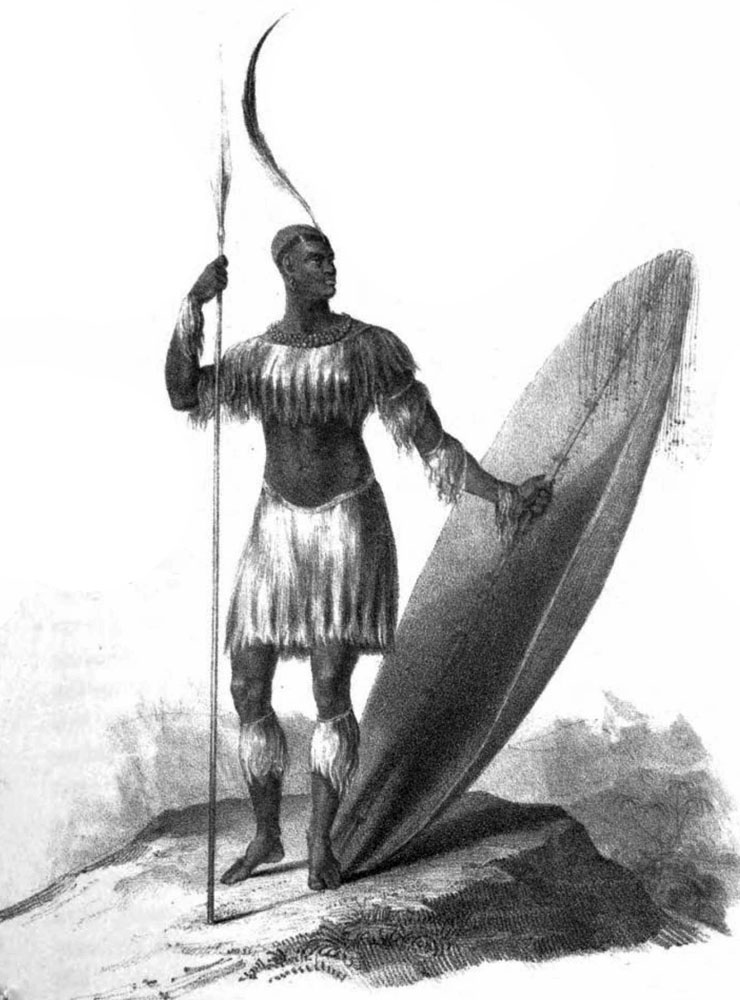
Sketch of King Shaka from 1824 (found in Nathaniel Isaacs’ book ‘Travels and Adventures in Eastern Africa,’ published in 1836)
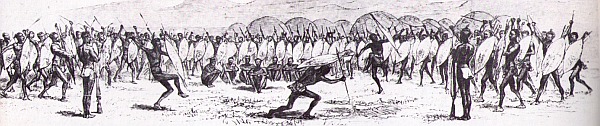
Below is a description of King Shaka’s warriors. King Shaka is known for the military and social innovations he brought to the Zulu people unifying them into a formidable empire admired by some, and feared by others. What stands out is the great discipline of his warriors. The Zulu army or Zulu impi was the most powerful war machine the British ever faced in Southern Africa. The Zulu combat strategy was perfected by King Shaka himself, who added great organization and discipline to the traditional qualities of courage and mobility cultivated within African armies. During the battle, the Zulu army would organize itself as an arc facing the adversary. This arrangement was known as the “bull horn” formation. At the center (known as the chest in Zulu) were found the most seasoned regiments; on the wings (or horns) were found the regiments of younger warriors. The latter used their speed and agility to outflank the enemy by attacking him on the flanks while trying to encircle him, while the chest warriors engaged him in the front. Behind the chest, and with their back turned so as to keep their calm, were the veteran regiments (also known as the kidneys) who will wait as reserves, intervening only to switch the battle to victory. Every man knew his place, moves, and maneuvers with extreme precision. Shaka’s methods reached their high point during the Zulu victory at Isandhlwana against the British forces in 1879.
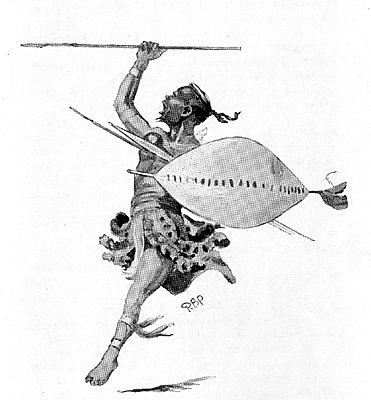
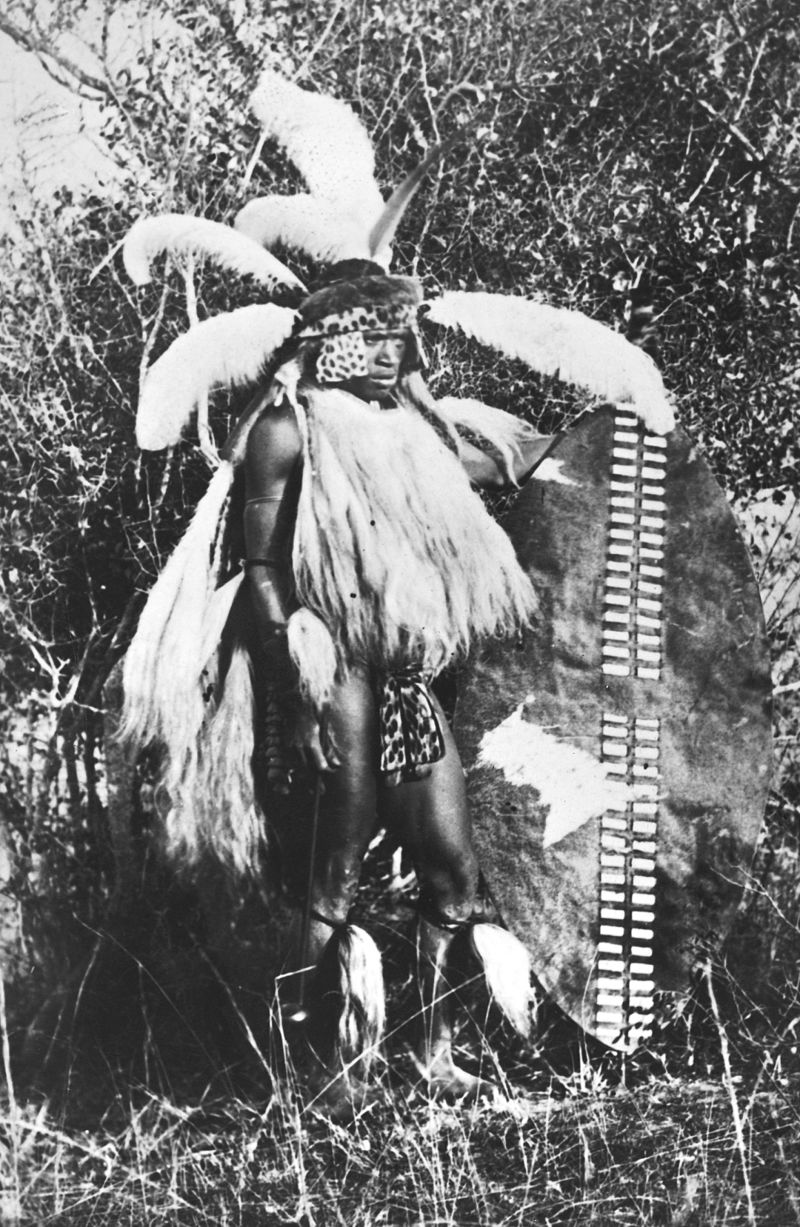
Zulu warrior in 1913
Although Isaacs’ account below of his visit to Shaka’s palace is a biased view from a European who saw everything African, Black, as inferior, it is still good to note the number, the order of the troops, the strength of the king (who was not just complacent, but an active member of his troops), and much more. This also gives a better idea of the dressing of the warriors and girls, as well as the living structure in the kraal. This account can be found in N. Isaacs, Travels and Adventures in Eastern Africa volume 1.
=====
Reception of the Zulus for Chaka from Isaacs’s book Travels and Adventures in Eastern Africa. Descriptive of the Zulus, their manners, customs, with a sketch of Natal.
This morning three regiments of boys arrived to be reviewed. There appeared to be nearly 6000, all having black shields. The respective corps were distinguished by the shape and ornament of their caps. One regiment had them in the shape of Malay hats, with a peak on the crown about six inches high, and a bunch of feathers at the top. Another wore a turban made of otter-skin, having a crane’s feather or two on each side ; and the third wore small bunches of feathers over the whole head, made fast by means of small ties. Thus accoutred and distinguished, they entered the gate, ran up the kraal, halted in front of the palace, and saluted the king.
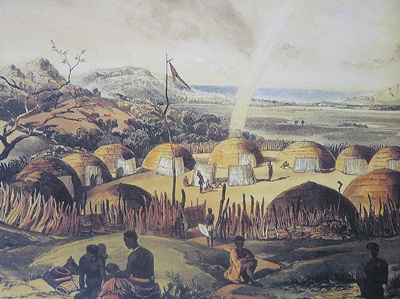
Zulu kraal near Umlazi in Natal 1849
One boy stepped in front and made a long harangue. When the orator had concluded, the whole of his comrades first shouted, and then commenced running over the kraal, trying to excel each other in feats of agility and gesture, regardless of order, regularity, or discipline. After this exhibition, which lasted three hours, a regiment of men arrived with white shields, having on them one or two black spots in the center; they saluted Shaka, then retired to put away their shields, and assembled again in one body to dance. They formed a half circle; the men in the center and the boys at the two extremities. The king placed himself in the middle of the space within the circle, and about 1500 girls stood opposite to the men three deep, in a straight line, and with great regularity. His majesty then commenced dancing, the warriors followed, and the girls kept time by singing, clapping their hands, and raising their bodies on their toes. The strange attitudes of the men exceeded anything I had seen before.
Zulu warrior in full regalia 1860: carrying the large isihlangu war shield. The upper body is covered in cow tails, the kilt is of spotted cat, genet or civet skin and the shins are decorated with cowtails. The elaborate headdress consists of a browband and face-framing flaps of leopard skin with another band of otter skin above. There are multiple ostrich feather plumes and a single upright crane’s feather.
The king was remarkable for his unequaled activity, and the surprising muscular powers he exhibited. He was decorated with a profusion of green and yellow glass beads. The girls had their share of ornaments, in addition too they had each of them four brass bangles round their necks, which kept them in an erect posture, and rendered them as immovable as the neck of a statue. This ceremony was performed with considerable regularity, from the king- giving, as it were, the time for every motion. Wherever he cast his eye, there was the greatest effort made, and nothing could exceed the exertion of the whole until sunset, when Shaka, accompanied by his girls, retired within the palace, and the warriors to their respective huts. Many, however, first went to the river and performed their evening ablutions.
Colonel Abdoulaye Maiga speaking at the UN General Assembly (Source: DW – South Africa)
I have listened to the Malian Prime Minister’s speech at the UN again and again. Colonel Abdoulaye Maïga stated quite a few things which are not only worth restating, but also mark the beginning of a new era for relationships with Africa. For me the clear message was that, faced with the West’s insults, defamations, and aggressions, we will no longer respond with fear, we will stand up and respond in kind; we deserve respect and will be treated as such! France, the west, uses Africa to become 4th world gold producer (without a single mine), yet France walks on Africans, and insult us… the era when our backs were broken, and we held back how we felt by fear of retaliations, or by fear of the master, that era is long gone! We will respond in kind. We are human beings too, we are proud sons and descendants of long generations of great kings, we deserve respect, and we will fight to be treated respectfully. Abdoulaye Maïga honored Malians, and Africans as whole; he said openly what we have all been feeling in the depth of our bellies.
In his speech, Maïga called France’s government, a junta, which by the way is how the French government has been referring to the Malian government… but I ask you, is it not what France’s troops and allies have been doing in Mali? in the DRC? in Libya? That is nothing new for France’s behavior (and the West) in Africa. Isn’t neighboring Ivory Coast a recent example? He added, “The French junta has damaged universal values and betrayed its long tradition of humanistic thought,” … [Paris has acted] “in service of obscurantism” and engaged in “neocolonial, condescending, paternalistic and revanchist” politics.
“Move on from the colonial past and hear the anger, the frustration, the rejection that is coming up from the African cities and countryside, and understand that this movement is inexorable,” Maïga said, addressing France.
“Your intimidations and subversive actions have only swelled the ranks of Africans concerned with preserving their dignity,” he said. Why, because Africans have all had enough! How can anybody understand that Africa is funding Europe! up to 500 billion Euros per year goes to France through the FCFA, and yet France leaves abject poverty in its wake? and then France (and the West) treats Africa with the greatest condescension? We are not looking for love in these relationships… we just want what is owed us, respect and dignity!
Last week, Mali new interim Prime minister Abdoulaye Maïga gave a speech at the United Nations’ Tribune. It was an amazing speech detailing Mali’s battle for its freedom and its struggle against France and its commies. Excerpts below are fromAl-Jazeera.
=====
Abdoulaye Maiga lashes out at the former colonial ruler, the UN as he praised the ‘exemplary’ cooperation with Russia.
Mali’s military-appointed prime minister has lashed out at France and the United Nations in a grievance-filled address over his nation’s deteriorating security situation while praising the “exemplary” cooperation with Russia.
Map of Mali with its capital Bamako
Addressing the 77th session of the UN General Assembly on Saturday, Abdoulaye Maiga slammed what he called France’s “unilateral decision” to relocate its remaining troops to neighbouring Niger amid deteriorating relations with Mali’s two-time coup leader Assimi Goita.
… “Move on from the colonial past and hear the anger, the frustration, the rejection that is coming up from the African cities and countryside, and understand that this movement is inexorable,” Maiga, who was appointed prime minister last month, said.
“Your intimidations and subversive actions have only swelled the ranks of Africans concerned with preserving their dignity,” he added.
The Malian prime minister also offered a grim assessment of the UN peacekeeping mission, known as MINUSMA, while openly praising the “exemplary and fruitful cooperation between Mali and Russia” and the influence of mercenaries from the Wagner Group.
… “We must recognise that nearly 10 years after its establishment, the objectives for which MINUSMA was deployed in Mali have not been achieved,” Maiga said. “This is despite numerous Security Council resolutions.”
Sketch of King Shaka from 1824 (found in Nathan Isaacs’ book ‘Travels and Adventures in Eastern Africa,’ published in 1836)
To celebrate South Africa’s Heritage Day which used to be known as ‘Shaka Day‘ before 1996, we share with you this beautiful praise for the great king. KwaZulu (“Place of the Zulu” in Zulu)-Natal is an important province of South Africa, and the birthplace of the Zulu kingdom. It is the second-most populous province in South Africa, after Gauteng, and the land of the Zulu people. Before 1996, 24September was known as Shaka Day, in commemoration of the Zulu King, Shaka, on the presumed date of his death in 1828. Shaka kaSenzangakhona (Shaka, son of Senzangakhona) was the Zulu King who played an important role in uniting disparate Zulu clans into a cohesive nation; he is known as the founder of the Zulu Empire. . Each year people gather at King Shaka’s grave to honor him on this day.
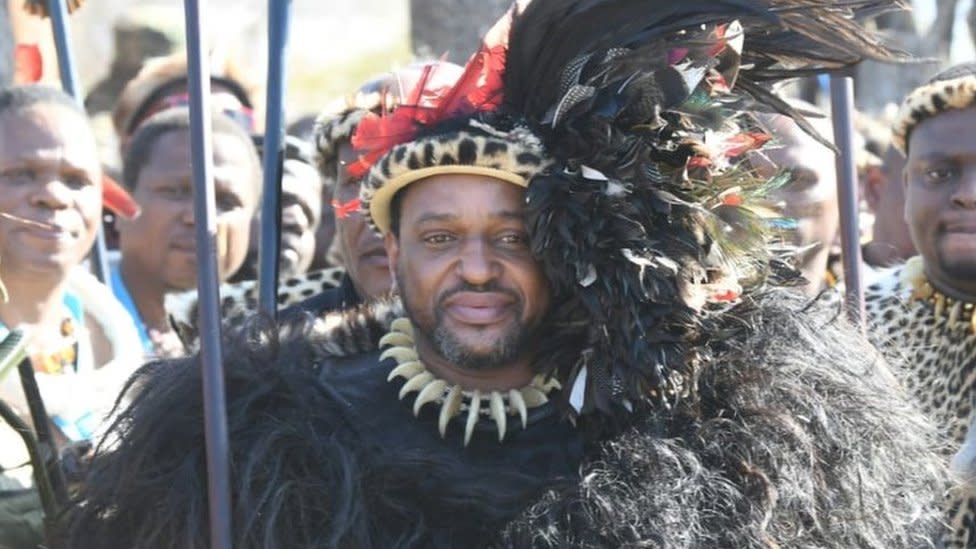
King Misuzulu ka Zwelithini (Source: yahoo news)
King Shaka was murdered by his two half-brothers Dingane and Mhlangana at kwaDukuza in 1828—one date given is September 24. Dingane assumed the throne after the assassination. Thus, September 24 is known as Shaka Day, and nowadays has become ‘Heritage Day’. This year’s celebration will mark the official public coronation of the new Zulu King, Misuzulu Siqonbile ka Zwelithini, who inherited from his father, King Goodwill Zwelithini ka Bhekuzulu (Traditional Coronation of a New Zulu King).
Shaka Zulu
He is Shaka the unshakeable, Thunderer-while-sitting, son of Menzi He is the bird that preys on other birds, The battle-axe that excels over other battle-axes in sharpness, He is the long-strided pursuer, son of Ndaba, Who pursued the sun and the moon. He is the great hubbub like the rocks of Nkandla Where elephants take shelter When the heavens frown…
Traditional Zulu praise song, English translation by Ezekiel Mphahlele
Sketch of King Shaka from 1824 (found in Nathaniel Isaacs’ book ‘Travels and Adventures in Eastern Africa,’ published in 1836)
King Shaka, Shaka kaSenzangakhona (Shaka son of Senzangakhona), or Shaka Zulu, is known today as the founder of theZulu EmpireorZululand. He ruled from1816to1828, and was one of the most influentialmonarchs of the Zulu, responsible for re-organizing the Zulu military into a formidable force via a series of wide-reaching and influential reforms; thus he was responsible for uniting small Zulu clans to form an impressive Empire which was a real threat to European advances in the region. Shaka was a master military strategist who revolutionized the Zulu military by dividing his army into components, sometimes on the basis of age and fighting strength. For example, he tasked young boys, perhaps in their early teens, with transporting military supplies. This allowed his fighting machine to move very quickly during raids or conquests. When Shaka first became king, the Zulu were a cluster of tribes of less than 2000 people; by the end of his reign, the population was 250,000people, an impressive growth for a 12-year reign.
Nathaniel Isaacs, a British explorer met King Shaka. Below is a portrait he made of King Shaka found in N. Isaacs, Travels and Adventures in Eastern Africa Vol I, 1836.
=====
Reception of the Zulus for Chaka from Isaacs’s book Travels and Adventures in Eastern Africa. Descriptive of the Zulus, their manners, customs, with a sketch of Natal.
“In the evening, at the request of the king, we joined in their amusements, and could not … avoid singing: we commenced with ‘God save the King.’ On our explaining its literal meaning, Chaka was highly pleased; in fact, there was nothing but good humour to be observed in the countenances of every one present. The party broke up at a late hour; and, as is usual, in the morning we paid the king an early visit. We now expressed a wish to see him in his war dress; he immediately retired, and in a short time returned attired: his dress consists of monkeys’ skins, in three folds from his waist to the knee, from which two white cows’ tails are suspended, as well as from each arm; round his head is a neat band of fur stuffed, in front of which is placed a tall feather, and on each side a variegated plume. He advanced with his shield, an oval about four feet in length, and an umconto, or spear, when his warriors commenced a war song, and he began his maneuvres. Chaka is about thirty-eight years of age, upwards of six feet in height, and well proportioned: he is allowed to be the best pedestrian in his country, and, in fact, during his wonderful exercises this day he exhibited the most astonishing activity.”
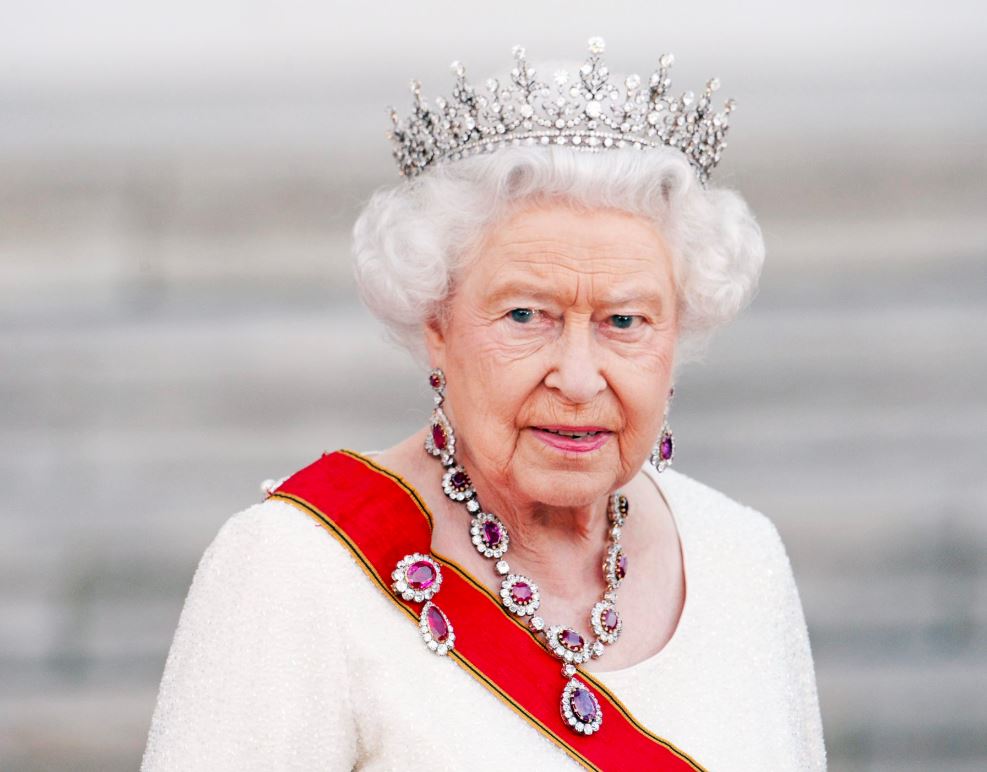
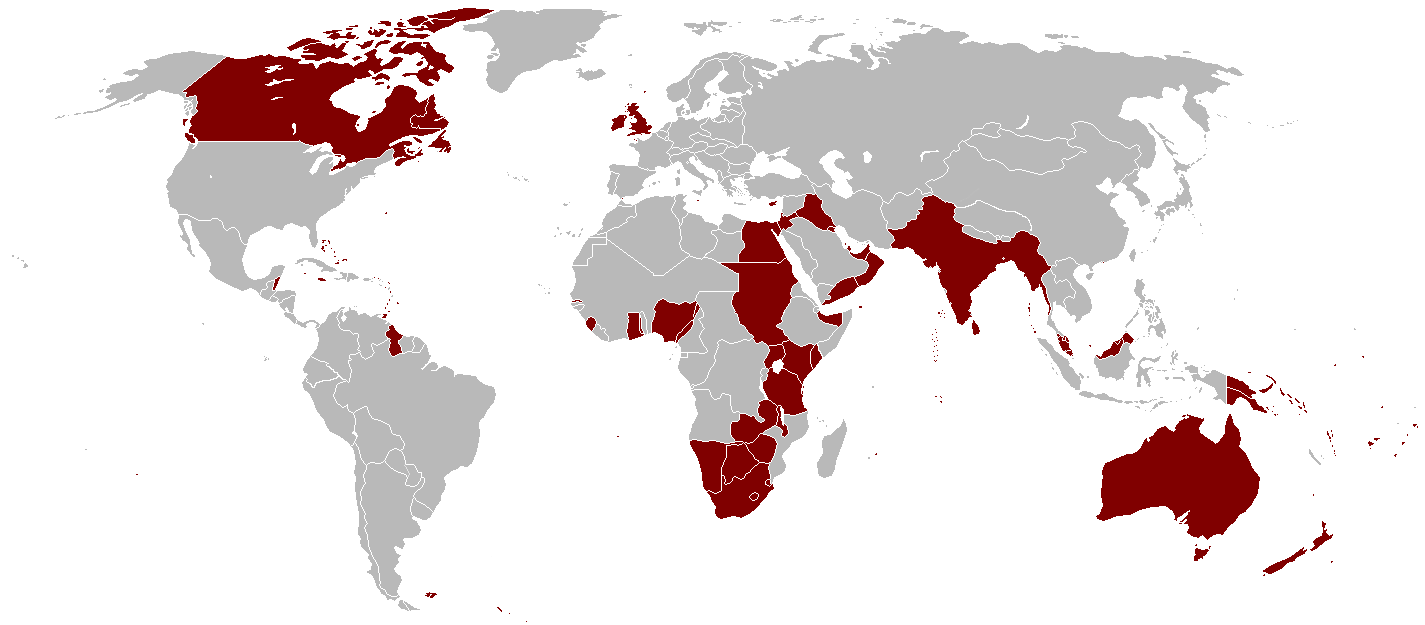
Queen Elizabeth II’s reign started in 1952, at the tail end of the ‘colonization’ era, leading into the independence or decolonization of former British colonies, and then the new era of neo-colonization. The 1960s and 1970s saw an acceleration in the decolonization of Africa and the Caribbeans. More than 20 countries gained independence from Britain as part of a planned transition to ‘self’-government. Newspapers would give the polished version, but it is clear that under her reign, major events rocked nations and particularly the third-world, as we, ‘not the West’ used to be called. She started her reign while in Kenya (i.e. learnt of the passing of her father while in visit of Kenya, and that she was to become queen). She inherited a vast empire spanning the African continent upon becoming Queen, her reign saw all 14 African British colonies gain their independence, starting with Ghana in 1957. And yet the Queen managed to maintain warm relations with them, partly through the creation of the successor organisation to the empire, the Commonwealth. One could argue that the relationship between the British monarchy and post-colonial Africa was a complicated one.
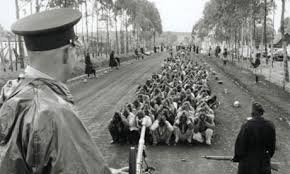
In a prison camp in Kenya during the Mau Mau rebellion (Source:The Guardian)
Who can forget the Mau-Mau massacre in Kenya by British forces (The British Government apologizes for Mau Mau atrocities)? Or then Southern Rhodesia (now Zimbabwe)? or Sudan? or the wars of independence in different parts of Africa?
The president of Kenya where her journey as Queen started, Uhuru Kenyatta of Kenya, mourned her passing in a statement, describing her as “a towering icon of selfless service to humanity and a key figurehead of not only the United Kingdom and the Commonwealth of Nations where Kenya is a distinguished member but the entire world“.
The traitor Mnangagwa, even though the Queen granted knighthood to President Robert Mugabe to later revoke it, and the relations between Zimbabwe and Great Britain were bad for many years, was quick to tweet that his “deepest condolences” were with the Royal Family and “the people of the United Kingdom, and the Commonwealth“. Zimbabwe held some services.
President Cyril Ramaphosa of South Africa has, on behalf of the government and people of South Africa, expressed his profound and sincere condolences to King Charles III on the passing of Queen Elizabeth II, saying, “Her Majesty was an extraordinary and world-renowned public figure who lived a remarkable life. Her life and legacy will be fondly remembered by many around the world. The Queen’s commitment and dedication during her 70 years on the throne remains a noble and virtuous example to the entire world.”
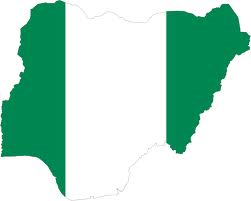
Flag and map of Nigeria
The leader of Nigeria, the biggest of Britain’s former colonies in Africa, President Muhammadu Buhari wrote a long tribute to her on Twitter, saying “The story of modern Nigeria will never be complete without a chapter on Queen Elizabeth ll, a towering global personality and an outstanding leader. She dedicated her life to making her nation, the Commonwealth and the entire world a better place.”
However, the younger generation of African leaders, and leaders around the world are saying they cannot mourn the passing of the Queen of England.
Uju Anya, a linguistics professor at Carnegie Mellon University on Thursday described the late queen as the monarch of a “thieving raping genocidal empire” in a series of tweets. “I heard the chief monarch of thieving raping genocidal empire is finally dying. May her pain be excruciating,” Anya said. Referring to Great Britain’s conquest of Nigeria in the 19th and 20th century, she added, “If anyone expects me to express anything but disdain for the monarch who supervised a government that sponsored the genocide that massacred and displaced half my family and the consequences of which those alive today are still trying to overcome, you can keep wishing upon a star.”
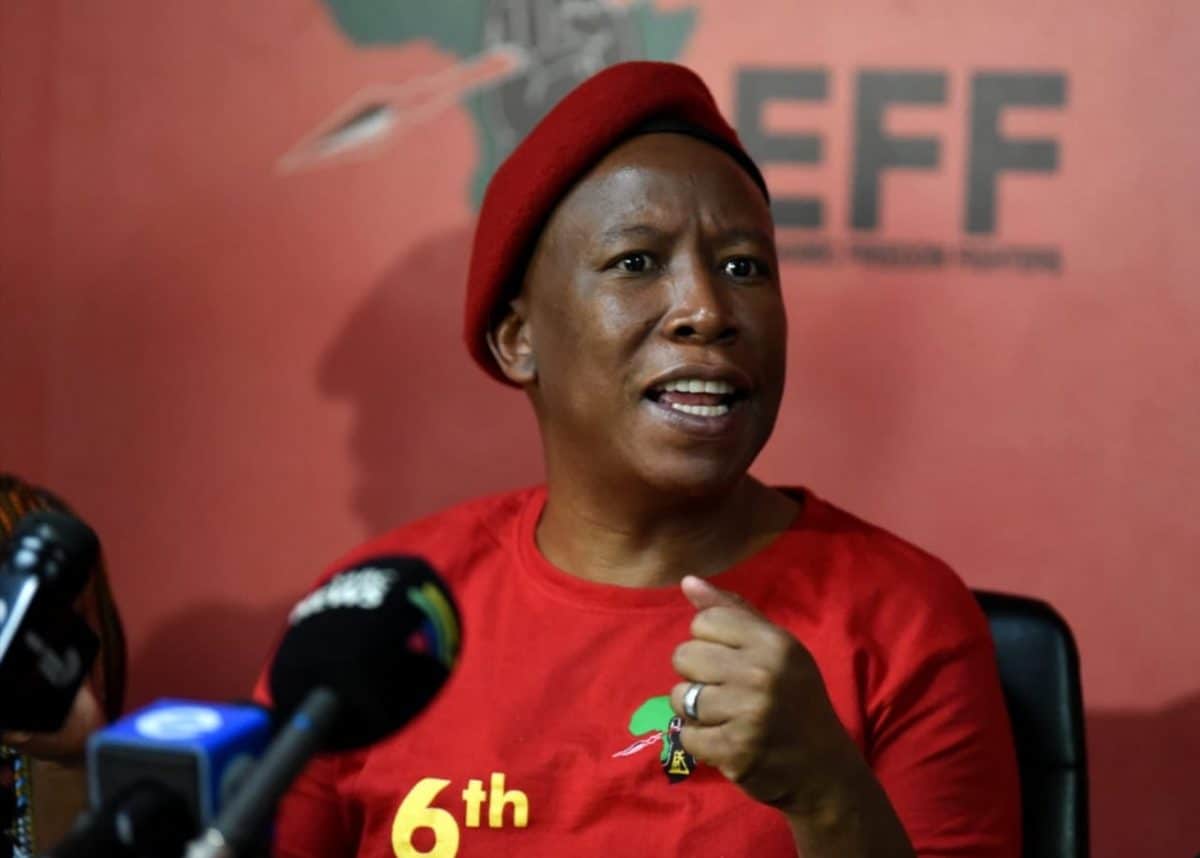
Julius Malema, Leader of the Economic Freedom Fighters (Source: TheSouthAfrican.com)
Julius Malema, of the South African Economic Freedom Fighters (EFF), South Africa’s third-biggest political party, criticized the queen, who ascended to the throne in 1952, for reigning for 70 years as a head of an institution “built up, sustained, and living off a brutal legacy of dehumanization of millions of people across the world.”
Malema added “We do not mourn the death of Elizabeth, because to us her death is a reminder of a very tragic period in this country and Africa’s history,” …
“Britain, under the leadership of the royal family, took over control of this territory that would become South Africa in 1795 from Batavian control, and took permanent control of the territory in 1806.
“From that moment onwards, native people of this land have never known peace, nor have they ever enjoyed the fruits of the riches of this land, riches which were and still are utilized for the enrichment of the British royal family and those who look like them.” … the royal family’s leadership “has been one of pain and suffering, of death and dispossession, and of dehumanization of African people“.
“During her [Elizabeth II’s] 70-year reign as Queen, she never once acknowledged the atrocities that her family inflicted on native people that Britain invaded across the world. She willingly benefited from the wealth that was attained from the exploitation and murder of millions of people across the world.
“The British Royal family stands on the shoulders of millions of slaves who were shipped away from the continent to serve the interests of racist white capital accumulation, at the center of which lies the British royal family. If there is really life and justice after death, may Elizabeth and her ancestors get what they deserve,” the statement concluded.
The atmosphere I would say then is nuanced in Africa, some, particularly the heads of states mourn, while the younger generations cannot be bothered to mourn the life of a monarch whose reign caused a lot of pain, suffering, and dehumanization to millions.











 African Heritage