GoodBye to a Courageous Leader : Ni John Fru Ndi and Ushering the Multi-Party Era in Cameroon

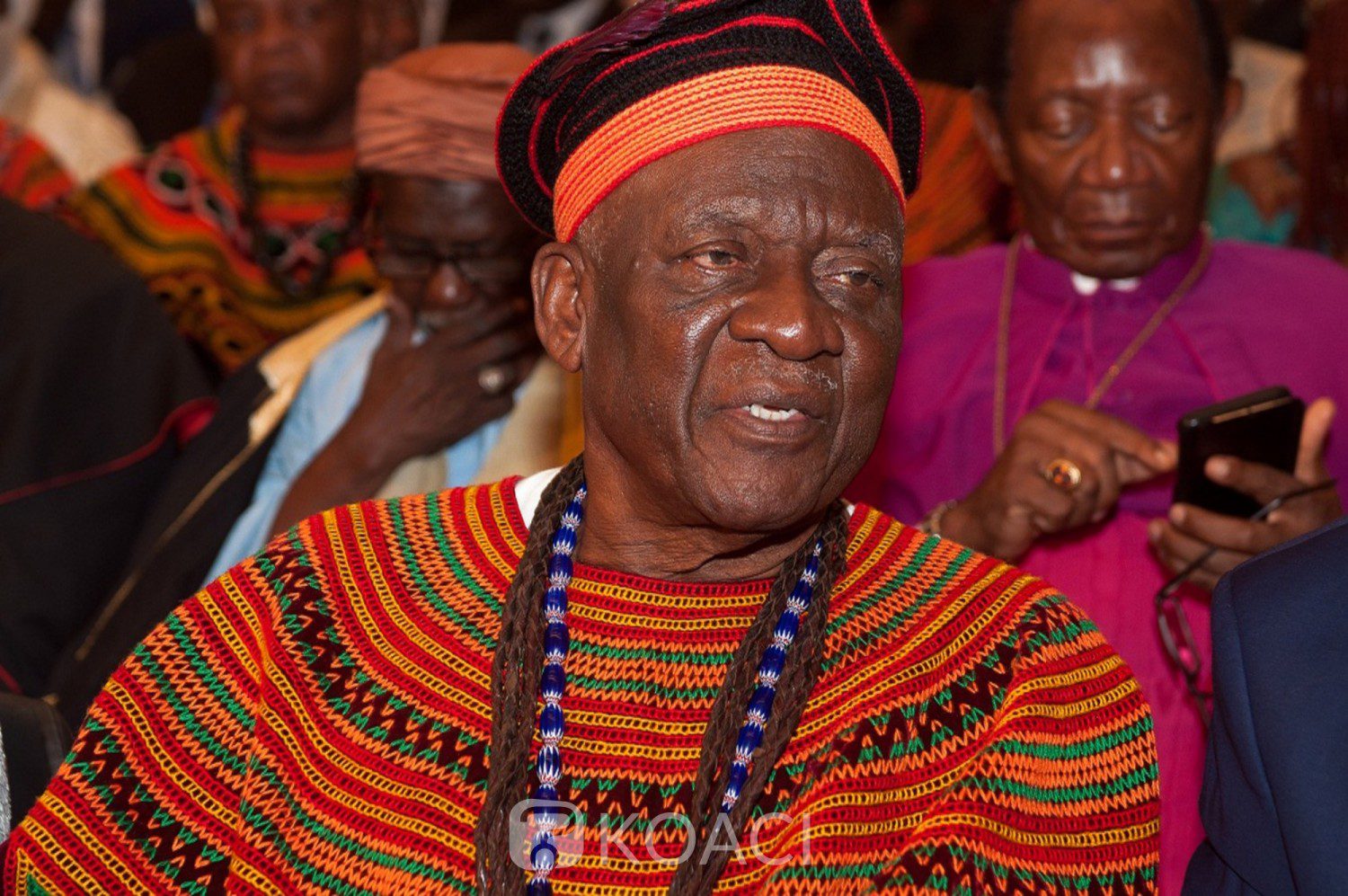
John Fru Ndi (Source: NewsduCamer.com)

Ni John Fru Ndi, the major political opponent to the current president of Cameroon for almost 3 decades has passed away. Affectionately called “The Chairman,” John Fru Ndi came up at the twilight of the National Conference in Cameroon with the creation of the Social Democratic Front (SDF) in 1990. Over the years, his party came to symbolize hope in a place where there had been no ‘real’ leadership change in over 30 years. His party was seen as the main opposition party to the government for over 2 decades. He was unavoidable in the political arena, and ran for president several times. He came close to winning in the October 1992 presidential election, but through some constitutional gymnastics and some play by the Supreme court (always) his win was pulverized and given to the governing party. The Supreme Court judge who heard his petition alleging fraud, said his “hands were tied” – and let the official results granting victory to incumbent Paul Biya, with 40% of the vote, stand. This caused great upset among SDF supporters and Fru Ndi was placed under house arrest for three months in his home in Bamenda, and a state of emergency was declared in the country. Later, Fru Ndi was nonetheless invited with his wife to the inauguration of US President Bill Clinton in January 1993.
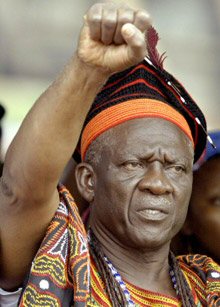
Ni John Fru Ndi (Source: Bonaberi.com)

Like everyone back then, Fru Ndi began his political career in the 1980s as a member of Biya’s Cameroon People’s Democratic Movement (RDPC). Through the years, he grew frustrated with the one-party system. In 1990, during the years of the National Conference when Cameroon officially ended the one-party rule, he formed the opposition party the Social Democratic Front (SDF). Although he hailed from the Northwest province of Cameroon (English speaking area of Cameroon), he strove to represent all Cameroonians, and aspired for the unity of the entire country seeking a federally unified Cameroon. He addressed the masses in pidgin English. Soon, SDF came to stand for “Suffer don finish” – where with his arrival in power, his party would usher the end to suffering. At political rallies, he would raise his fist to shout “SDF” to the crowd, who would chant back en masse: “Power to the people!” This call and response was repeated until the third time when they would roar back: “Power to the people and equal opportunities!” The masses were galvanized; for many Cameroonians who had been muzzled for far too long under the one-party frame, this was the opportunity to exercise their civic duties and participate in the political life of their country. They saw in Fru Ndi the alternative to the stuck-up politics. Their efforts were repressed by the governing party; the early 1990s were the years of strikes, street protests, “zero-deaths,” and more.
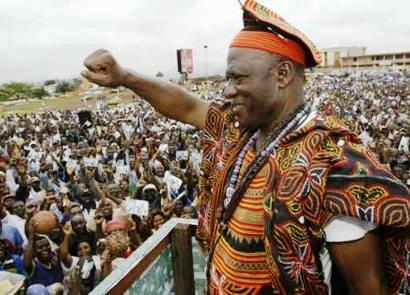
John Fru Ndi addressing the masses in Bamenda (Source: Cameroonpostline.com)

In recent years, Fru Ndi was not a supporter of the secessionist rebellion in Anglophone Cameroon that has claimed tens of thousands of lives and displaced countless people over the last six years. He was even kidnapped twice and beaten up by militants of the secessionist group in 2019, and part of his house was burnt down. The  secessionists were angered by what they saw as his betrayal for not supporting their demand for an independent state of Ambazonia, as they call Cameroon’s two English-speaking areas – the Northwest and Southwest regions. This forced him to sadly relocate from his beloved Bamenda to the capital Yaounde. He was very proud of his origins and rarely was seen wearing anything but atogho, traditional Bamileke clothing from the Northwest region, or Boubou: A Traditional African Garment.

Flag of Cameroon

Many claim that he should have united the opposition behind one leader against the government, as he had failed to get the coalition formed by the opposition to agree to field a single candidate to take on Mr Biya; or that he had been corrupted by the governing party.  Fru Ndi may have made mistakes, but at some point he represented the hopes of millions, hopes for a different future, a different alternative; and he had the courage to stand up and create a party who united people from all levels of the society, ushering the era of multi-party in Cameroon which was often paved with thorns. He has left a major imprint in Cameroon’s politics.

Below are some tributes from AfricaNews,

I salute the memory of a singular, charismatic and courageous leader,” said current opposition leader Maurice Kamto who ran for president in 2018.

The story of the return to multi-party politics in Cameroon cannot be written without [Fru Ndi’s] name in bold gold,” said politician Akere Muna, who ran for president in 2018. “His life is a lesson to the fact that leadership is about serving and not about being served,” he said.

Ni John Fru Ndi for the SDF (Social Democratic Front, editor’s note) was the guide, that is to say, the man who traced the furrow along which we walk, the man who against all odds imposed the return to a multi-party system in Cameroon on 26 May 1990 and with it a set of individual and collective freedoms granted to the entire Cameroonian people” Marcel Tadjeu , Chairman of the Douala 5 SDF electoral constituency told AfricaNews correspondent.

Read also articles on the BBC, ABC, and AfricaNews.

So Long to Ghanaian Writer Trailblazer Ama Ata Aidoo

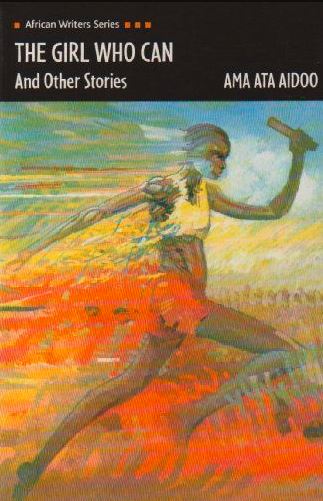
The Girl Who Can and Other Stories by Ama Ata Aidoo

It’s not easy.’

She was superb. The words rolled off her tongue like pips from oranges or cherries: articles thrown away with wistful abandon, to be forgotten utterly or later, maybe, searched for, and used.

She was great: an advocate who could stand her ground with the best of them. A lawyer who knew how to get all to see her point. Their lordships would have been wowed.” Her Hair Politics, p. 1, The Girl Who Can and Other Stories, by Ama Ata Aidoo, Heinemann 1997.

Above is an extract from the short story Her Hair Politics by Ghanaian trailblazer Ama Ata Aidoo, from the book The Girl Who Can which graces my library. Who was Ama Ata Aidoo?

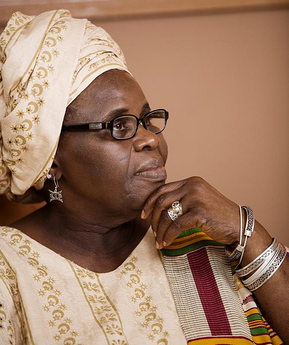
Ama Ata Aidoo (Source: W4.org)

Ama Ata Aidoo was the first published female African dramatist with her play The Dilemma of a Ghost published in 1965. She was a Ghanaian author, poet, playwright, who served in the government of Jerry Rawlings as Secretary for Education from 1982 to 1983. As the daughter of Nana Yaw Fama, chief of Abeadzi Kyiakor, she hailed from a royal family of the Fante ethnic group of southern Ghana. Her grandfather was murdered by neocolonialists, event which influenced her father in putting a huge emphasis on education and the learning of history and current events. In 1992, she won the Commonwealth Writers’ Prize for her novel Changes. In 2000, she established the Mbaasem Foundation in Accra, Ghana, to promote and support the work of African women writers. She taught at different universities in Zimbabwe, and the United States.

Ghanaian author Ama Ata Aidoo (Source: Africancelebs.com)

Writer Ama Ata Aidoo belongs to the generation of African women writers who dared to speak up loud and clear about African women issues at a time when it was not common. Like Mariama Ba, Buchi Emecheta, Flora Nwapa, Aidoo led the way and broke barriers for the current generation of African writersIn a 2014 interview with Zeinab Badawi of BBC, she said “People sometimes question me, for instance, why are your women so strong? And I say, that is the only woman I know.” This is what made Aidoo’s work touch millions because she portrayed the true African woman that we all know. So long Champion Aidoo, rest assured that you have influenced millions, and many are now following in your footsteps! 

To learn more, please check out the articles on The Conversation by Rose Sackeyfio, BBC, and the Guardian. President Nana Akufo-Addo of Ghana said, “Through her work, she made a tremendous contribution to the development of our country and continent, and expressed so many of our feelings about our fate as Ghanaians, and, indeed as Africans.” As you read back the extract at the top, doesn’t it remind you of Ama Ata Aidoo herself, the writer who advocate for women’s rights… the lordships were definitely wowed!

Proverbe Yoruba sur Dieu, le seul pouvoir / Yoruba Proverb on God, the Only Power

A millennial tree

Personne ne peut déraciner l’arbre que Dieu a planté (Proverbe Yoruba – Nigeria, Benin).

No one can uproot the tree which God has planted (Yoruba proverb – Nigeria, Benin).

Description of Emperor Tewodros II after He was Crowned

Emperor Tewodros II

When Emperor Tewodros II was crowned King, the British Consul Walter Plowden who knew well the political events of Ethiopia during the 1850s and had foretold the rising star of Kassa, the Emperor’s birth name, the freelance warrior from Qwara, described him as such:

The King Theodorus is young in years, vigorous in all manly exercises, of a striking countenance, peculiarly polite and engaging when pleased, and mostly displaying great tact and delicacy. He is persuaded that he is destined to restore the glories of the Ethiopian Empire and to achieve great conquests: of untiring energy, both mental and bodily, his personal and moral daring is boundless… When aroused his wrath is terrible, and all tremble; but at all moments he possesses a perfect self-control. Indefatigable in business, he takes little repose night or day: his ideas and language are clear and precise; hesitation is not known to him; and has no counsellors or go-between. He is fond of splendour, and received in state even on a campaign. He is unsparing in punishment — necessary in a wilderness as Abyssinia (at that time). He salutes his meanest (poor) subjects with courtesy, is sincerely though often mistakenly religious, and will acknowledge a fault committed to his poorest follower in a moment of compassion with sincerity and grace. He is generous to excess, and free from all cupidity, regarding nothing with pleasure or desire but munitions of war for his soldiers. He has exercised the utmost clemency towards the vanquished, treating them more like friends than enemies. His faith is signal: without Christ I am nothing.”

Proverbe Ethiopien / Ethiopian Proverb

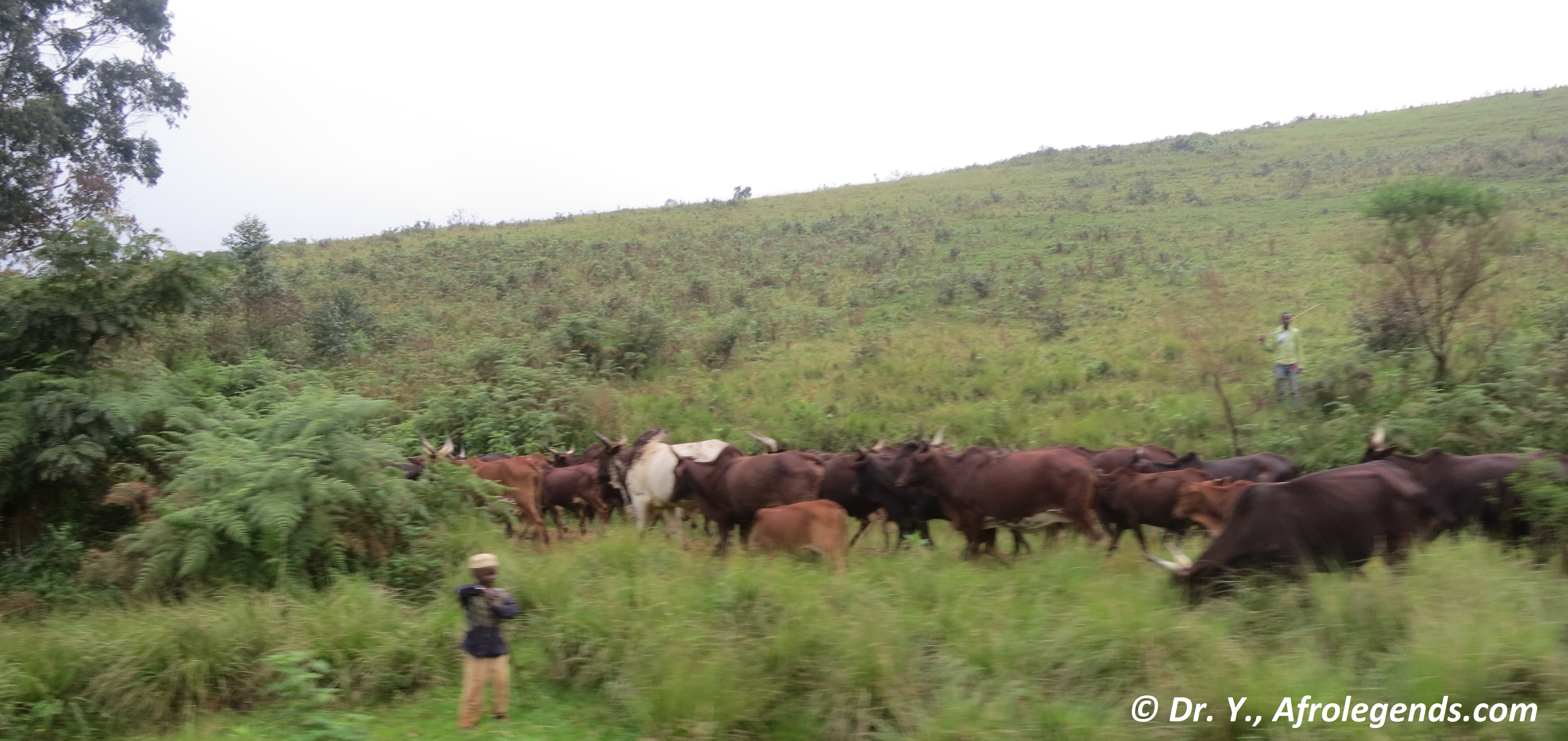
Un berger et ses vaches / A shepherd and his herd of cows

Quand le berger rentre à la maison en paix, le lait est doux (proverbe Ethiopien – Ethiopie).

When the shepherd comes home in peace, the milk is sweet (Ethiopian proverb – Ethiopia).

Description of What Happened to Tewodros II’s Body at Maqdala 1868

From this scene I strolled away to the northern gate, to where the dead body of the late Master of Magdala lay, on his canvas stretcher. I found a mob of officers and men, rudely jostling each other in the endeavour to get possession of a small piece of Theodore’s blood-stained shirt.

No guard was placed over the body until it was naked, nor was the slightest respect shown it. Extended on its hammock, it lay subjected to the taunts and jests of the brutal-minded. An officer, seeing it in this condition, informed Sir Robert Napier of the fact, who at once gave orders that it should be dressed and prepared for interment on the morrow.—Henry M. Stanley [Henry M. Stanley, Magdala: The Story of the Abyssinian Campaign, 1866-67.  Being the Second Part of the Original Volume Entitled “Coomassie and Magdala”, Leopold Classic Library,1896, p. 156.]

UK rejects Calls to Return Ethiopian Prince’s Remains

Prince Alemayehu, son of Emperor Tewodros II, as photographed in 1868 by Julia Cameron

This is a heartbreaking news. Last week, Buckingham Palace, and the UK government refused to return the remains of Prince Alemayehu, son of Emperor Tewodros II, to Ethiopia. Prince Alemayehu’s remains are still in Great Britain 150 years after his death. How preposterous is this! Few years ago, when the Ethiopian government asked, the British said that they could not identify his bones (Ethiopians urge Britain to return bones of ‘stolen’ prince after 150 years). Today, Ethiopians thought that now that there is a new occupant in Buckingham Palace, King Charles III, Prince Alemayehu’s remains will finally return home. However, Buckingham Palace said that returning his remains will not be possible, as it will disturb the resting place of several others in the vicinity. From not being able to identify his bones a few years ago (when in this day and age the remains of King Richard III of England have been identified 500 years after his death), to disturbing others buried there, it makes us wonder if they ever even took the time to look. These are the same people who only returned the hair of Emperor Tewodros II only in 2019. It is so painful to hear… it feels like part of Emperor Tewodros II is still stuck in England. As one looks at pictures of the young orphaned prince who arrived in the UK at the age of 7, and who died at the age of 18, there is so much pain in his face.

Below are snippets of the article; for the full version, go to the BBC.

=====

Emperor Tewodros II

Buckingham Palace has declined a request to return the remains of an Ethiopian prince who came to be buried at Windsor Castle in the 19th Century.

Prince Alemayehu was taken to the UK aged just seven and arrived an orphan after his mother died on the journey. Queen Victoria then took an interest in him and arranged for his education – and ultimately his burial when he died aged just 18.

But his family wants his remains to be sent back to Ethiopia. We want his remains back as a family and as Ethiopians because that is not the country he was born in,” one of the royal descendants Fasil Minas told the BBC. It was not right” for him to be buried in the UK, he added.

… in a statement sent to the BBC, a Buckingham Palace spokesperson said removing his remains could affect others buried in the catacombs of St George’s Chapel in Windsor Castle. It is very unlikely that it would be possible to exhume the remains without disturbing the resting place of a substantial number of others in the vicinity,” the palace said. The statement added that the authorities at the chapel were sensitive to the need to honour Prince Alemayehu’s memory, but that they also had “the responsibility to preserve the dignity of the departed“.

How Prince Alemayehu ended up in the UK at such a young age was the result of imperial action and the failure of diplomacy. In 1862, in an effort to strengthen his empire, the prince’s father Emperor Tewodros II sought an alliance with the UK, but his letters making his case did not get a response from Queen Victoria. Angered by the silence and taking matters into his own hands, the emperor held some Europeans, among them the British consul, hostage. This precipitated a huge military expedition, involving some 13,000 British and Indian troops, to rescue them [no diplomacy, always force and violence].  

British Camp at Zoola, Abyssinia expedition 1868-9 (Source: Victoria and Albert Museum, London)

The force also included an official from the British Museum. In April 1868 they laid siege to Tewodros’ mountain fortress at Maqdala in northern Ethiopia, and in a matter of hours overwhelmed the defences. The emperor decided he would rather take his own life than be a prisoner of the British, an action that turned him into a heroic figure among his people. 

Departure of the British expeditionary forces from Maqdala with the loot – Illustrated London News 1868

After the battle, the British plundered thousands of cultural and religious artefacts. These included gold crowns, manuscripts, necklaces and dresses. Historians say dozens of elephants and hundreds of mules were needed to cart away the treasures, which are today scattered across European museums and libraries, as well as in private collections. [In the case of Maqdala in 1868, it is said that 15 elephants and 200 mules were needed to cart away all the loot from Maqdala. British forces looted the place with no restrain].

The British also took away Prince Alemayehu and his mother, Empress Tiruwork Wube. [The loot was not enough… the young prince and the Empress too].

Proverbe Yoruba sur la générosité / Yoruba Proverb on Generosity

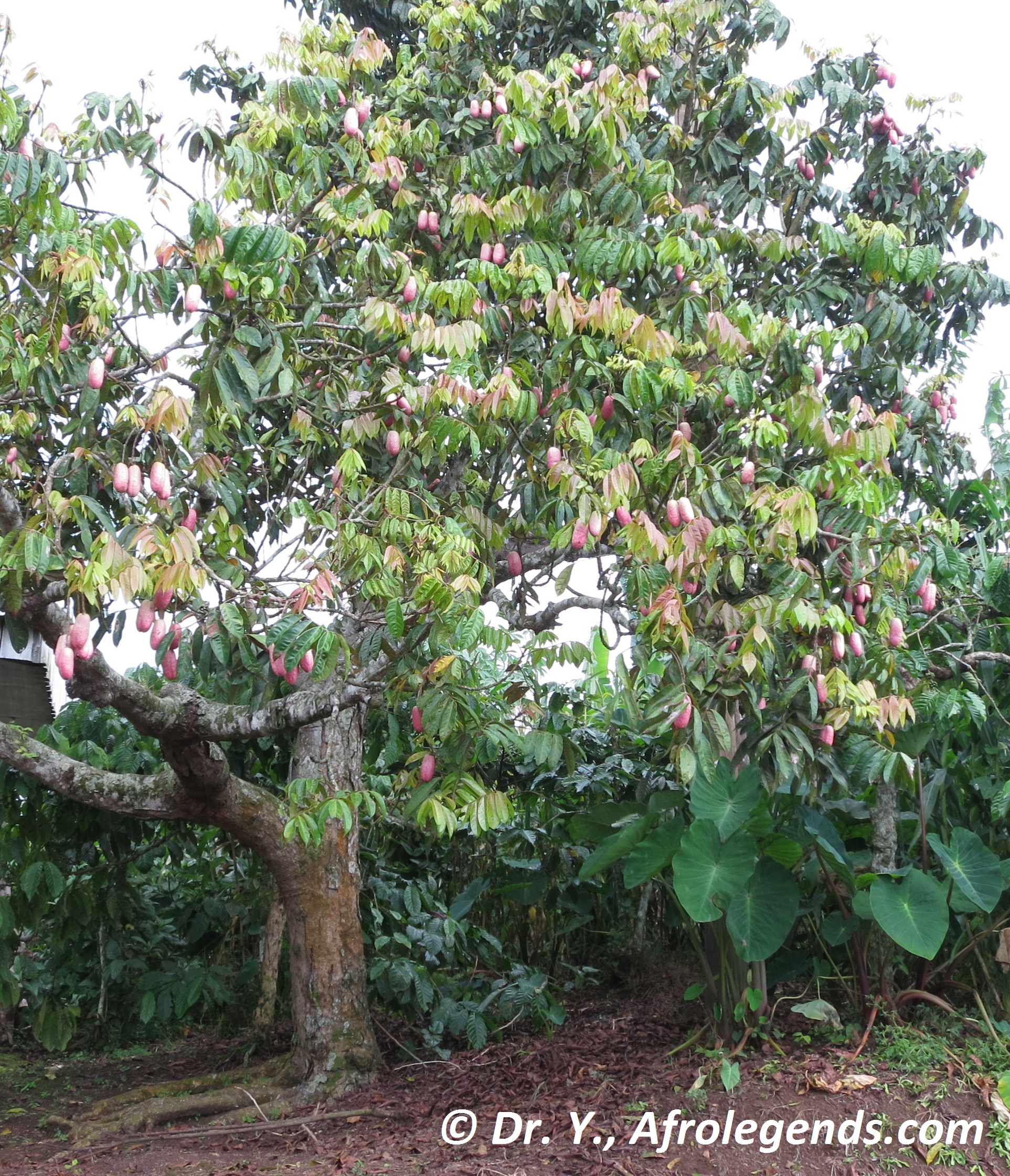
Safoutier / Safou tree

Ce que tu donnes, tu l’obtiens dix fois plus (Proverbe Yoruba – Nigeria, Benin)

What you give you get, ten times over (Yoruba proverb – Nigeria, Benin)

African Art Restitution: France puts out 9 Conditions

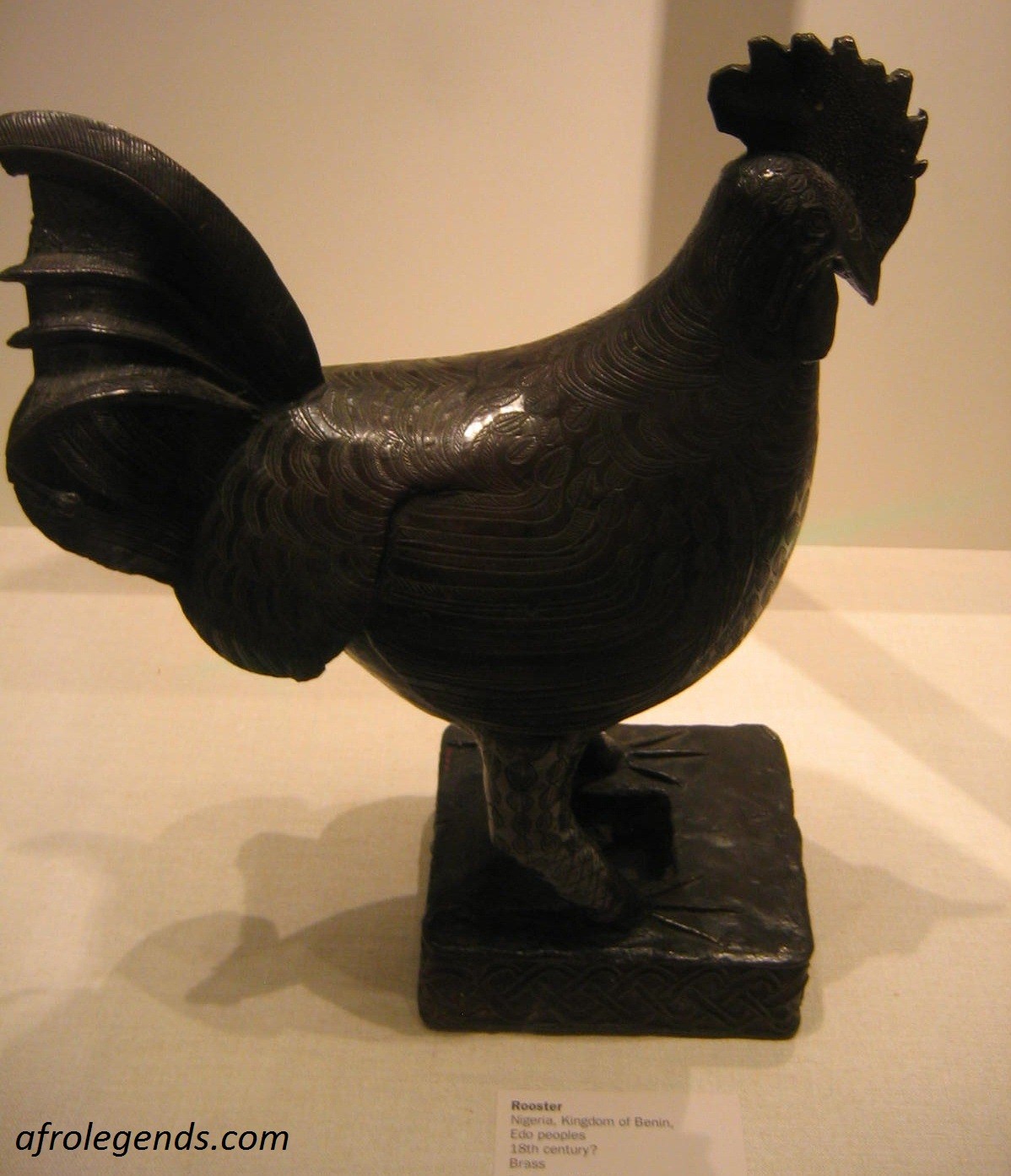
Rooster from Benin Kingdom (18th century)
Rooster from Benin Kingdom (18th century), exposed at the MET

A thief comes to your house, steals from you, and then years later when you try to recover what is yours, he gives you conditions for the return of what he looted from your house. Does it not sound unbelievable? This is what is currently going on with the restitution of African artifacts: everyday new conditions are given for the return of African art. Conditions such as “the works be well kept and exhibited after their return,” make no sense given that these objects in African cultures were mostly not used for art-sake but rather held functional values. It is sad, but hey, if you have no power, it is hard for others to return what they have stolen from you. Just because one artifact is returned here and there, it does not account for all of them. As stated countless times before, united we stand, divided we fall. As African nations ask for the return of what is rightfully theirs, each country should not go on its own to ask for the return of its national treasures, we should all be united. A couple of years back, Madagascar paid for the return of the belongings of Queen Ranavalona III. Similarly, this past April, Algeria recently got the return of a 17th-century manuscript written by the venerated leader of Algerian fight against colonialism Abd el Kader, which had been confiscated by French authorities in 1842; Algerian diaspora mobilized to combine money and resources to recover this Islamic manuscript. Being united will also help in countering conditions like “the object must not be claimed by another nation and the request cannot be accompanied by a request for monetary reparations,” especially since the current boundaries of African countries were formed after independence, thus there are bound to be common artifacts between countries.

Below are excerpts from The Art Newspaper. To learn more, also read new French laws on restitution of looted art on RFI, and Hyperallergic…  simply appalling.

====

Queen from Benin kingdom
Queen from Benin kingdom, exposed at the MET

France is finally releasing its long-awaited policy on the charged issue of the restitution of cultural property… The report was commissioned by President Emmanuel Macron [to ex-Director of the Louvre Museum Jean-Luc Martinez, who has since then been charged with complicity in fraud and concealing the artworks’ origins] and the government has already implemented some of its recommendations, most notably a bill on art looted by the Nazis, which will be discussed by the Senate on 23 May.

And a further two laws will be passed in coming months, … One could apply to items from the former colonies of Western empires, which the report defines in global terms, rather than just Africa and its former French dominions. The other pertains to human remains.

… Martinez tells the Art Newspaper that his report recommends studying the requests for restitutions by eight African countries to establish a “criteria of returnability”. Rather than basing this on an ideological or moral standpoint, he says he wishes to take a “pragmatic approach in order to define a framework policy of restitutions“.

He has come up with two main criteria as the basis for restitutions: “illegality and illegitimacy“. For example, according to French law at the time of France’s colonial invasion of Algeria in the early 19th century, weapons can be legally seized from an enemy but cultural goods had to be returned after battle. So the books and clothes of the rebel leader Abdelkader ibn Muhieddine (commonly known as Abdelkader) should have been given back to him when he surrendered, making their status in France “illegitimate“.

Likewise, if an officer handed looted goods to a French museum, as was the case for many objects looted from the Kingdom of Benin, the donation should be considered “illegal because such personal war booty is not allowed.” A key recommendation of the report is that requests for restitution be studied by a bilateral scientific commission which will publicly provide an opinion before the final decision of French courts [more bureaucracy].

… This report comes nearly six years after Macron publicly called for the “return of African heritage” during a state visit to Burkina Faso. And it has been four-and-a-half years since the academics Bénédicte Savoy and Felwine Sarr made the case for systematic restitutions to African countries. Since then, the issue has been somewhat downplayed, but it remains a sensitive subject.

Proverbe Yoruba sur l’importance des ancêtres / Yoruba Proverb on the Importance of Ancestors

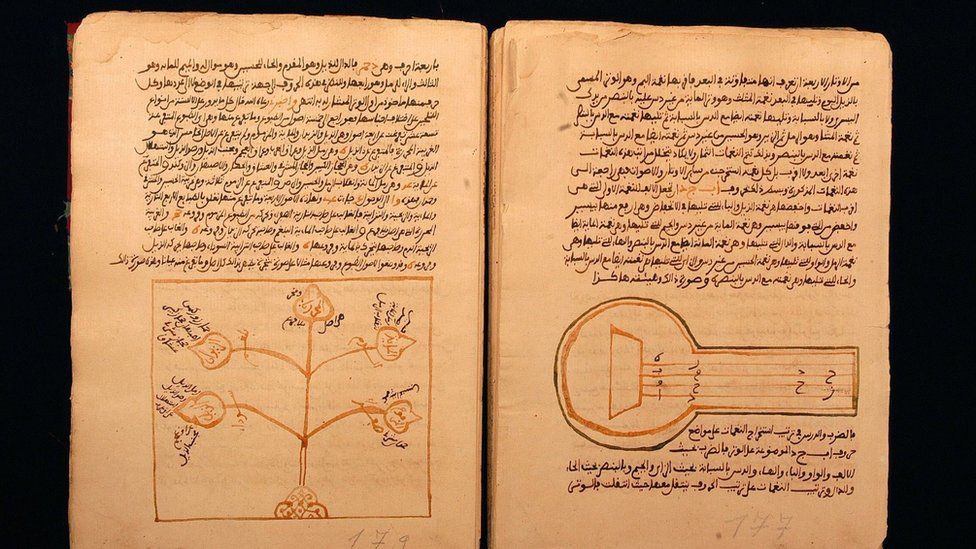
Manuscript of Timbuktu (Source: Google Arts and Culture)

Si nous nous tenons debout, c’est parce que nous nous tenons sur le dos de ceux qui nous ont précédés (proverbe Yoruba – Nigeria, Benin).

If we stand tall it is because we stand on the backs of those who came before us (Yoruba proverb – Nigeria, Benin).