Last July, Dutch King Willem-Alexander apologized for his country’s involvement in slavery, transporting Africans to the Americas. At this point, any blind person can clearly see the rush for the New Scramble for Africa. As said earlier, although we hear these apologies, Africans are tired of these empty words followed by no actions; words spoken to put Africans back to sleep, while another New Scramble starts. Africans are not dumb: Africa is at the center of the survival of the world. Now we see all these heads of state, kings, queens, and pope, crisscross the African continent; Africans have to wake up… to not fall asleep to these sign off the continent.
The Netherlands is marking a century and a half since the end of the Dutch slave trade which transported Africans to the Americas. King Willem-Alexander used the occasion to apologize on behalf of his country.
The king issued his apology during a speech marking the event.
“Today I’m standing here in front of you as your king and as part of the government. Today I am apologizing myself,” Willem-Alexander said. “And I feel the weight of the words in my heart and my soul.”
The king commissioned a study into the exact role the Dutch royal family, the House of Orange-Nassau, played in slavery in the Netherlands.
He asked for forgiveness “for the clear failure to act in the face of this crime against humanity.”
The back of a slave
Thousands of descendants from the former Dutch colony of Suriname and the Dutch overseas territories of Aruba, Bonaire and Curacao are attending celebrations in Amsterdam.
The event has been dubbed “Keti Koti,” meaning “breaking chains” in Sranan Togo, a Creole language spoken in Suriname.
…
Beginning in the 17th Century, the Netherlands grew into one of Europe’s major colonial powers and was responsible for about 5% of the trans-Atlantic slave trade.
Some 600,000 slaves were transported from Africa to colonies in the Americas, and many Javanese and Balinese people were enslaved and taken to South Africa under Dutch colonial rule.
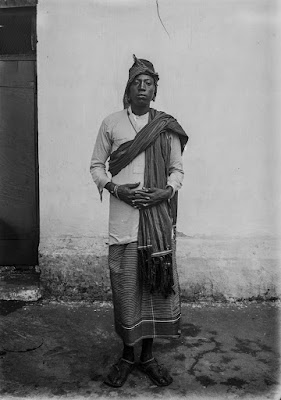
Mangi Meli of the Chagga of Moshi, ca 1890s (Source: Deutsche Fotothek)
Last week, the German President apologized for colonial past in Tanzania just a few days after the grandson of Mangi Meli reiterated his demand for the return of his grandfather’s skull. The story was published in the BBC. To us, Africans, it is a painful read: how can someone decapitate your father, and then take away his skull is inconceivable. It has been over 120 years; and some ask us to forgive, forgive when words are not followed by actions?
Isaria Anael Meli has been looking for his grandfather’s remains for more than six decades.
He believes the skull ended up in a Berlin museum after his grandfather, Mangi Meli, along with 18 other chiefs and advisers, was hanged by a German colonial force 123 years ago.
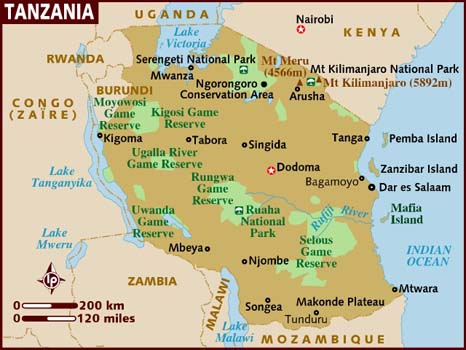
Map of Tanzania
After all this time, a German minister has told the BBC the country is prepared to apologise for the executions in what is now northern Tanzania.
Other descendants have also been searching for the remains and recently, in an unprecedented use of DNA research, two of the skulls of those killed have been identified among a museum collection of thousands [Germany Matches DNA from African Skulls looted during Colonial Era].
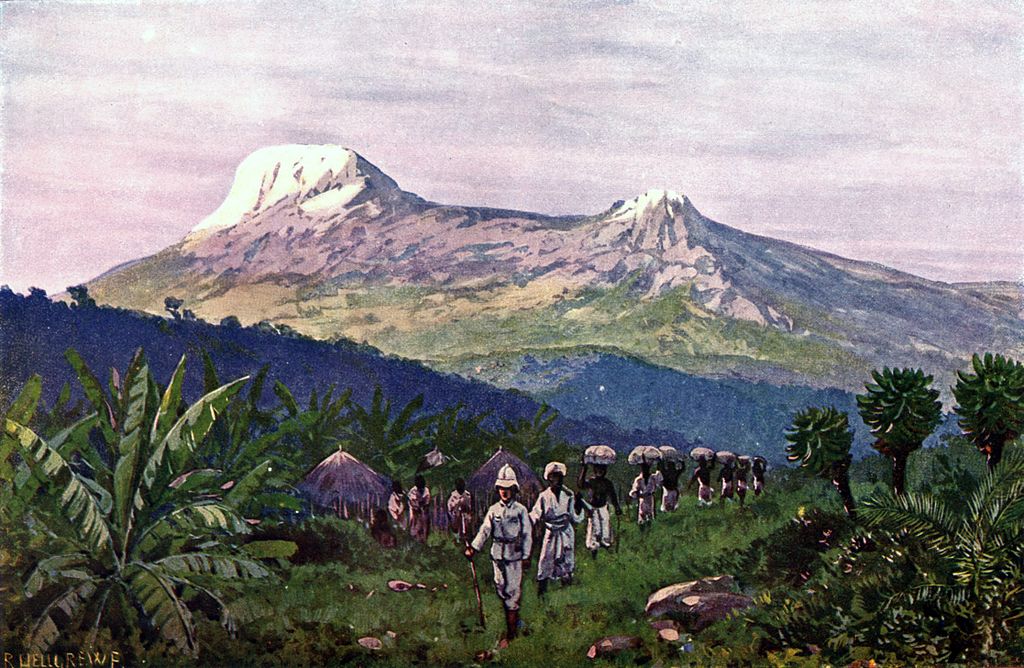
Mt Kilimanjaro in 1911
It is rare to find an acacia tree on the lower slopes of Mount Kilimanjaro. Its twisting branches reach above the steep road and stand out among the denser lush vegetation.
At one time, it shaded a market for the villagers of Tsudunyi, a part of what is now called Old Moshi, who lived off the fertile land and enjoyed the cooler temperatures that the higher altitude brought.
But this focal point for the community became the scene of a great tragedy. Despite the peace of the natural surroundings today, its impact has reverberated down the decades.
It was here on 2 March 1900 that, as the descendants tell it, one-by-one the 19 men were hanged. They had been hastily tried the day before, accused of plotting to attack the German colonial forces.
…
Mangi Meli and his Njama 1890s at the German Moshi Boma (Source: Deutsche Fotothek)
Mangi Meli, the most prominent mangi, or chief, among those who were killed, had in 1892 successfully defeated the German forces. That success was later reversed and by the end of the 19th Century, the Europeans were keen to stamp their authority on this part of what was known as German East Africa.
They wanted to make an example of Mangi Meli and other local leaders who may have been planning an uprising.
The humiliation did not end there. While most of the torsos are believed to be buried in a mass grave somewhere near the tree, their heads were at some point removed, packed up and sent 6,600km (4,100miles) to the German capital. In some cases the complete skeletons were shipped.
When speaking about what happened to his grandfather, Mr Meli does not sound angry, but there is a sadness in his voice and a sense of bewilderment that this was allowed to happen.
The lively 92-year-old was told about the killing of Mangi Meli by his grandmother, who he says was forced to watch the execution, and explains that the chief came to him at night telling him that he would return one day.
“Always, always, always he was coming to me in my dreams,” he says.
His floppy sun hat and twinkling eyes when he smiles disguise his tenacious personality.
Since at least the 1960s, Mr Meli had been writing to the German and Tanzanian authorities urging them to look for the remains of his grandfather.
Flag of Tanzania
He says officials tried to put him off by telling him that relevant records had been destroyed during World War Two. But Mr Meli was not deterred.
“Visitors are always crying: ‘Tell all the people of Germany to return the skull.’
“They kept it somewhere just because they thought the Mangi Meli family were small people – believing that they could do what they wanted. But remember that this skull is needed by the whole country – not me, myself, only.”
There is a sense of profound loss that goes beyond the idea that this was a historical injustice.
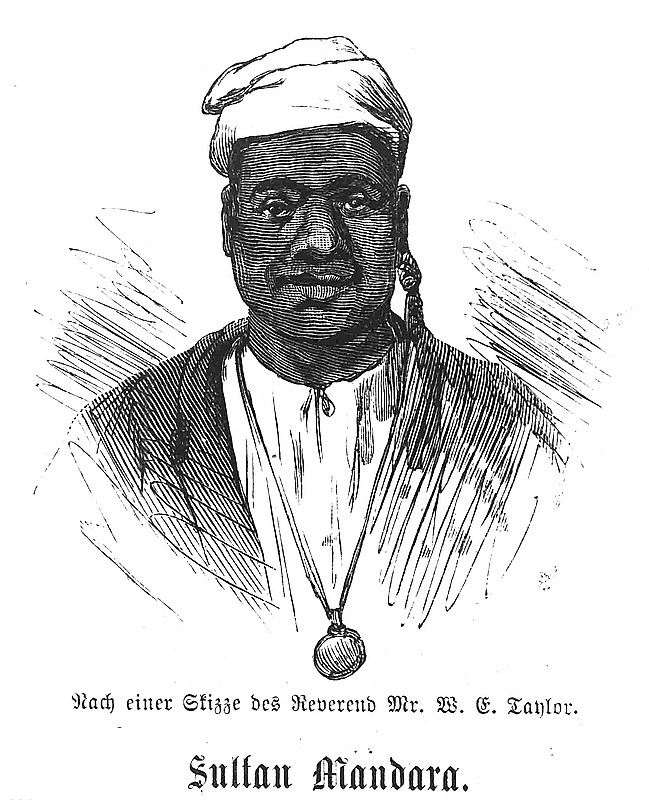
Mangi (King) Meli was a ruler of the Chagga people of Moshi, one of the sovereignChagga states, in the 1890s. He was the first son of Mangi Rindi Mandara from his second wife Sesembu. Born in 1866, he ascended his father’s throne in 1891. It is said that he was smart, exuberant, and extremely valiant.
Meli is hailed as one of the heroes of the former Tanganyika colony which was part of German East Africa which encompassed Rwanda, Burundi (Ruanda-Urundi), modern-day Tanzania (except Zanzibar), and part of the Kionga triangle in Mozambique. Meli has been prominent in the fight against colonial encroachment on the slopes of Mount Kilimanjaro.
Mangi Meli and his Njama 1890s at the German Moshi Boma (Source: Deutsche Fotothek)
At the time when he became Mangi, the Germans were trying to lay hold on African territories, and every means were used. In 1892, there was an incident involving a young girl who the German forces wanted to capture, and when the Mangi of Moshi refused, the German troops fired, and the Moshi retaliated, killing one Askari (African serving in the German colonial forces). The German troops, led by Lt von Bulow, attacked, but were successfully defeated by Mangi Meli. This victory of the Meli made the Germans back down for 51 days.
Friedrich von Schele
Based on the lie of a “Chagga revolt” orchestrated by a neighboring king, Mangi Marealle of Marangu who had made pacts with the Germans including the notorious murderer explorer Carl Peters, Col. Friedrich von Schele, the deputy governor, led the Germans as they moved back to Kilimanjaro on July 31, 1892, launching an effort to seize Meli of Moshi, destroying and plundering Meli’s lands. Yet they could not capture Mangi Meli. They occupied his lands and started enslaving his people. However, bidding his time to strike back, Mangi Meli united over following years with other Mangis of neighboring Chagga states, forming alliances with other Meru and Arusha kings as well. However, his plan was betrayed by an informant from Mangi Marealle. This plan culminated on 02 March 1900, when the Germans called the Chagga kings whom they accused of fomenting rebellion.
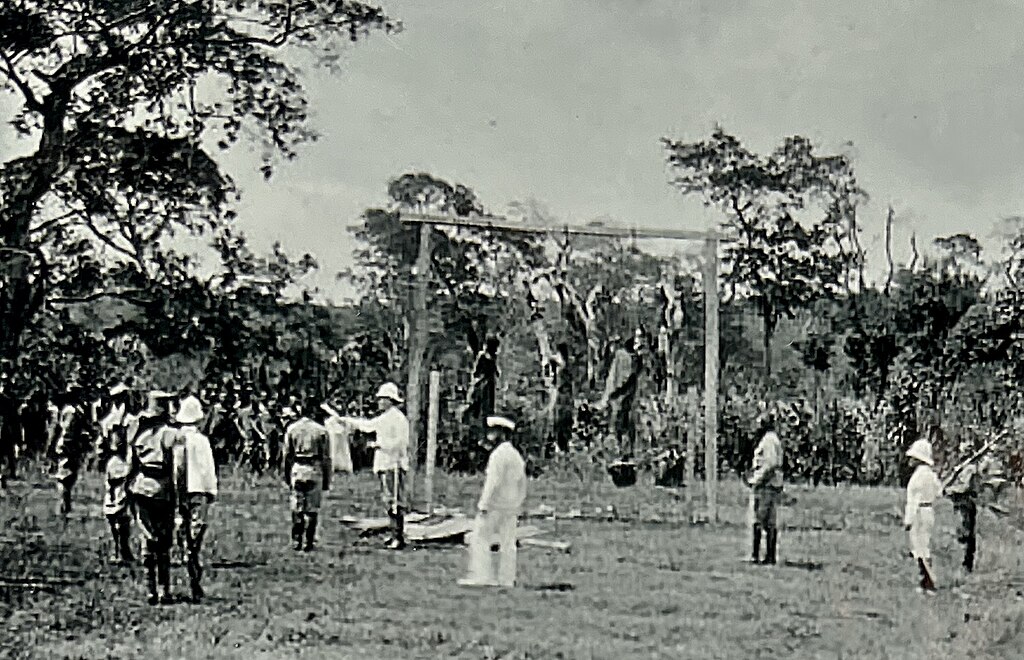
Hanging of Chagga men by the German Colonial Government ca 1890s – 1900
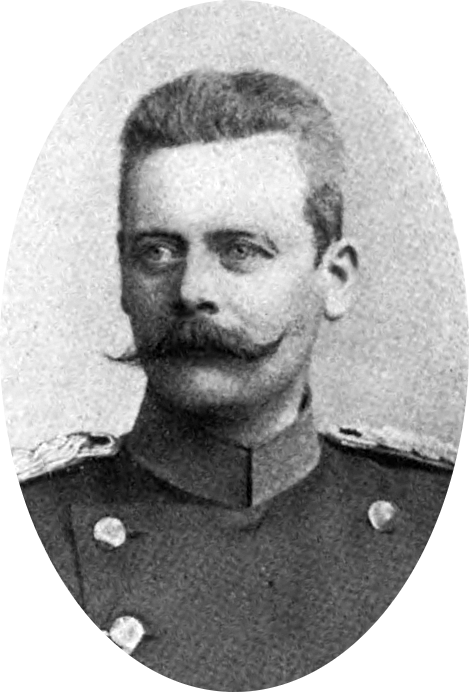
After his capture, Meli was convicted of rebellion and was hanged alongside 18 other kings and noblemen of Chagga, Meru, and Arusha; one of these kings was Mangi Ngalami of the Siha Kingdom, one of the numerous Chagga states. Their execution was public. However, when Meli was hanged, he did not die immediately; it is said that he hung on the tree for 7 hours alive until he was shot by a soldier. Following his death, the German colonial administration ordered his head be severed from the body; this was the fate for many executed on that day. The skulls are believed to have been sent to Berlin to Felix von Luschan, an anthropologist and curator at the Royal museum of Ethnology of Berlin, who requested them to Lt. Col. Moritz Merker who was second in command at the German military outpost of Moshi.
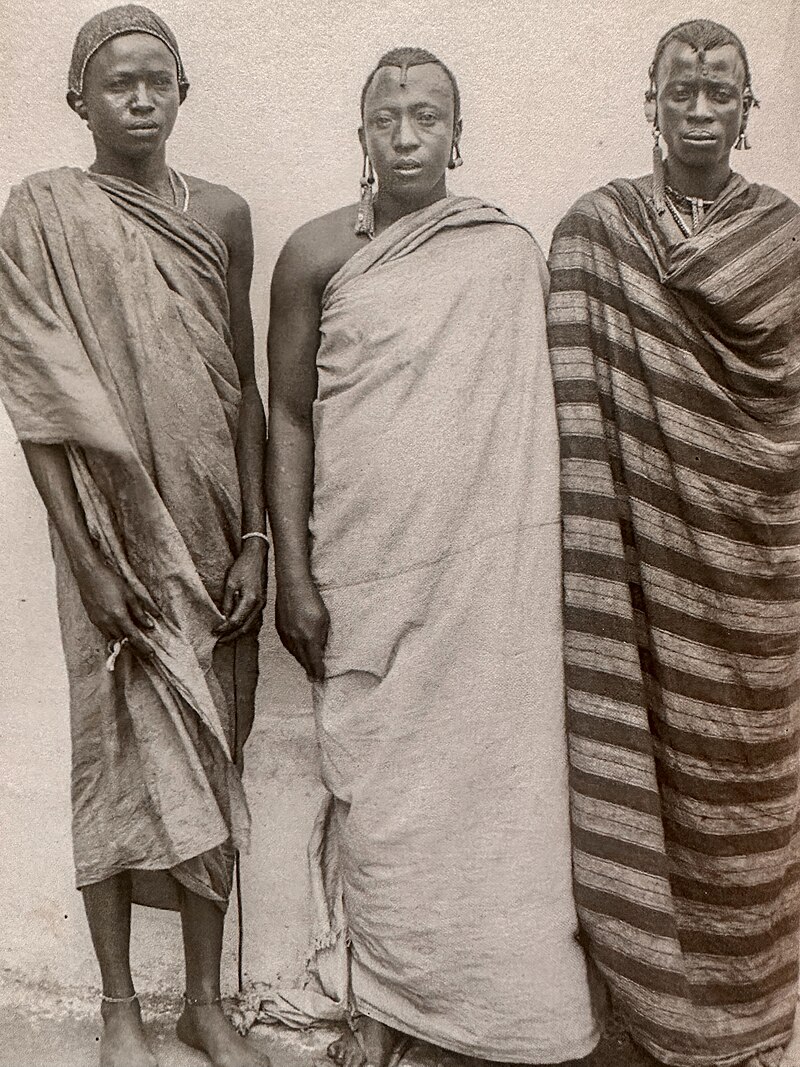
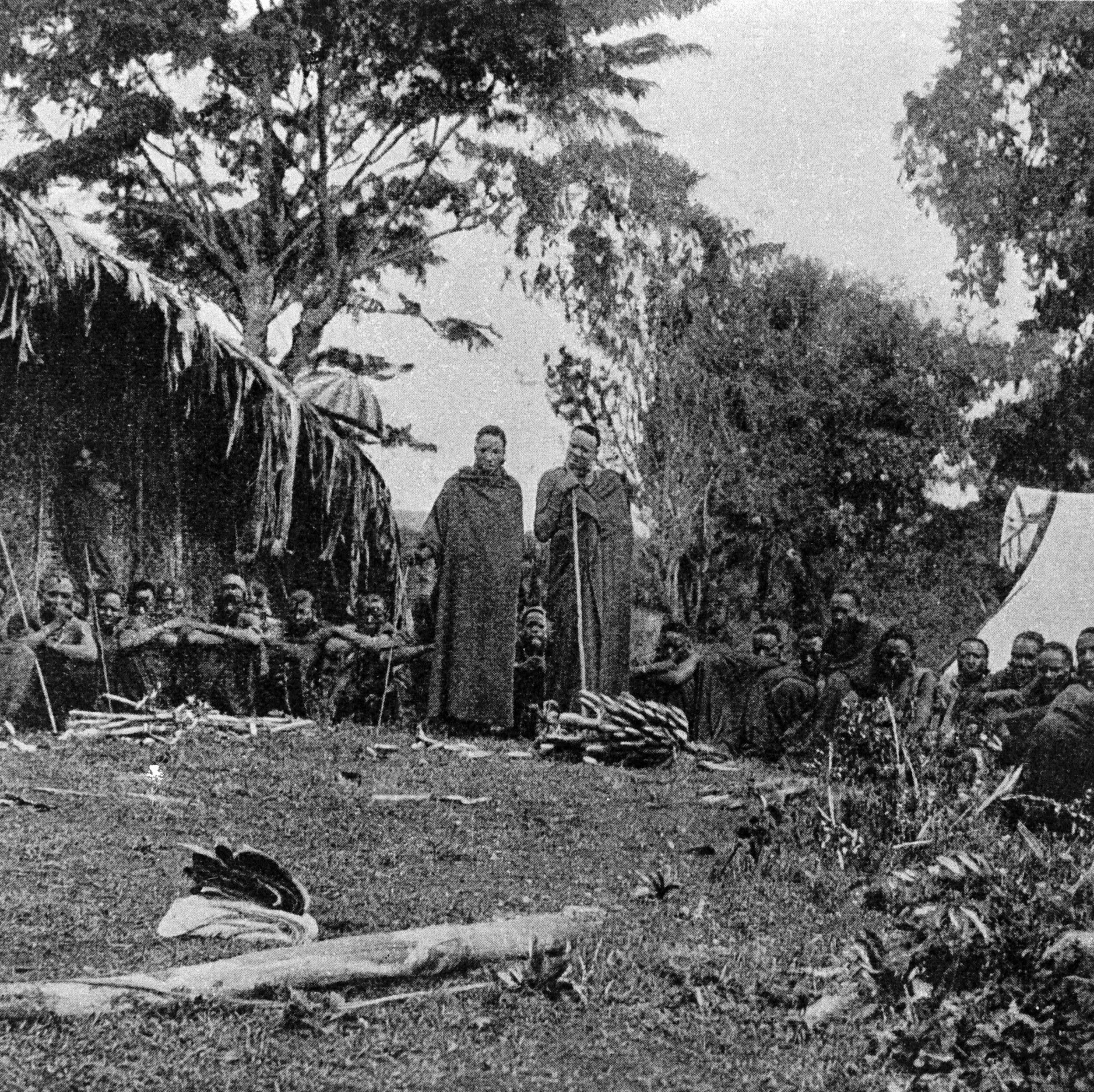
Mangi Ngalami, King of Shira, with another chief and their entourage. Reproduction from Johannes Schanz/ H. Adolphi, Am Fuße der Bergriesen-Ostafrikas, and published with the permission of the Evangelisch-Lutherisches Missionswerk Leipzig (Source: The Dial)
Today, descendants of both Mangi Meli and Mangi Ngalami and others are searching for the skulls of their ancestors. The grandson of Mangi Meli, Isaria Meli, has founded a foundation to search for the skull of Mangi Meli and turned to Stiftung Preußischer Kulturbesitz (SPK, Prussian Cultural Heritage Foundation) in 2016 to identify the remains of his grandfather, to no avail. Efforts are being made to recover his remains (and those of the other kings) and return them for proper burial in Tanzania. In Chagga culture, and many African cultures, the burial of a body after death is an essential ritual; without a proper funeral and resting place, the soul cannot find peace. Many of the skulls and remains ended up in different museums of Berlin, or in private collections (I cannot fathom why someone would want someone’s skull in their private collection ???). There are cases where entire skeletons were shipped to Germany. This was the case when in 1902, the whole skeleton of Mangi Lobulu of the Meru, another leader executed at the same time as Mangi Meli and Mangi Ngalami, was sent to Germany by Merker; over the decades, it eventually made its way to the American Museum of Natural History in New York City where it was located by German researcher Konradin Kunze 100 years later.
As you think of Mangi Meli, remember his bravery, and celebrate his spirit for the freedom of the Chagga people, and others, on the slope of Mount Kilimanjaro.
On a visit to Tanzania on November 1, 2023, German President Frank-Walter Steinmeier apologized for the first time for the Maji Maji massacre and other colonial crimes committed by Germany in eastern Africa in what was then German East Africa, a colony comprised of Burundi, Rwanda (Ruanda-Urundi), mainland Tanzania (Tanganyika), and a small region in modern-day Mozambique known as the Kionga Triangle. The Maji Maji rebellion led to the murder of over 300,000 Africans at the hand of German forces in 1905, in Tanganyika .
Flag of German East Africa
President Steinmeier vowed to raise awareness of the atrocities in his country, in a step towards “communal healing” of the bloody past. “I would like to ask for forgiveness for what Germans did to your ancestors here,” Steinmeier said during a visit to the Maji Maji Museum in the southern Tanzanian city of Songea. “What happened here is our shared history, the history of your ancestors and the history of our ancestors in Germany.” “I want to assure you that we Germans will search with you for answers to the unanswered questions that give you no peace.”
Flag of Germany
A few years back, we shared how the German people we met did not even know that Germany had African colonies! or that Germany committed the very first genocide of the 20th century on African soil! What do they think was the place of Otto Von Bismark in the 1884 Berlin Conference? (Most are Unaware of Germany’s Colonial Past and the First Genocide of the 20th Century). This to say that Germans suffer from amnesia when it comes to Africa, so the German president is vowing to make it known.
We appreciate the German President’s formal apology. However, it needs to be followed by actions, and cannot be just another empty “sorry” meant to appease us so we close our eyes to future atrocities committed in the name of cooperation. Clear actions need to follow: return of remains, return of lands, opening of archives, a clear “here is what we will do to right the wrongs,…” a clear correction and inclusion in the history textbooks, and above all a clear “respect for those killed, and for those living today,” reparations, and so much more. We are tired of empty sorry!
German troops commanded by Wilhelm Kuhnert during the Battle of Mahenge in 1905
The German president has expressed “shame” for the colonial atrocities his country inflicted on Tanzania.
German forces killed almost 300,000 people during the Maji Maji rebellion in the early 1900s, one of the bloodiest anti-colonial uprisings.
President Frank-Walter Steinmeier was speaking at a museum in Songea, where the uprising took place.
“I would like to ask for forgiveness for what Germans did to your ancestors here,” he said.
“What happened here is our shared history, the history of your ancestors and the history of our ancestors in Germany.”
The Maji Maji rebellion was triggered by a German policy designed to force the indigenous population to grow cotton for export. Tanzania, then known as Tanganyika, was a part of German East Africa, which also consisted of modern-day Rwanda, Burundi and parts of Mozambique.
President Steinmeier said he hoped Tanzania and Germany could work towards “communal processing” of the past. He promised to “take these stories with me to Germany, so that more people in my country will know about them.” Germany has, until recently, had “colonial amnesia”, according to Jürgen Zimmerer, a history professor at the University of Hamburg. “The brutality and the racism of this colonial empire was not understood in the German public.”
As part of the three-day visit, the president met the descendants of one of the Maji Maji leaders, Chief Songea Mbano, who was among those executed in 1906. He is now considered a national hero in Tanzania and President Steinmeier told the family the German authorities would try to find his remains.
Thousands of human remains were brought from German colonies – partly as “trophies” but also for racist research.
… On Tuesday, after meeting President Samia Suluhu Hassan in Dar es Salaam, he [President Steinmeier] promised that Germany would co-operate with Tanzania for the “repatriation of cultural property“.
Tanzania historian Mohamed Said welcomed the president’s apology but told the BBC it did not go far enough. “They decided to set farms on fire so people would run out of food and be unable to fight. This is unacceptable, in today’s world they would be taken to court,” he said.
King Charles III landed in Kenya on Tuesday October 31, 2023. On his first official visit to Kenya as monarch, the king of the British gave a speech in which he acknowledged the past atrocities committed by Great Britain and its colonial legacy. He said there were ‘no excuses‘ for it, yet did not apologize! He told guests that “the wrongdoings of the past are a cause of the greatest sorrow and the deepest regret.” He recognized the “abhorrent and unjustifiable acts of violence committed against Kenyans” in their struggle for statehood adding, “there can be no excuse.” Today, he held a private meeting with the family of Kenyan freedom fighter Dedan Kimathi murdered by the British colonial regime, and whose remains are still to be found to this day; the British High Commission said that the meeting was an “opportunity for the king to hear firsthand about the violence committed against Kenyans during their struggle for independence.” Are we supposed to clap for the king? Why does it have to be a private meeting? Kimathi no longer just belongs to his family, but to the whole of Kenya as he led the rebellion to liberate the whole country; thus whatever concerns him, concerns ALL Kenyans!
NAIROBI — In his first public remarks as monarch on colonial atrocities, during his first visit as king to a Commonwealth country, King Charles III said there were “no excuses” for the “abhorrent and unjustifiable acts of violence committed against Kenyans” during their struggle for independence from Britain, but he did not offer the full apology that many people in Kenya have called for.
Speaking at a state banquet Tuesday, Charles hewed closely to the British government line, saying he felt “the greatest sorrow and the deepest regret” for the wrongdoings of the past. He steered clear of any language that might open a broader conversation about reparations.
Nonetheless, Britain, like other former colonial powers, is in a period of reckoning, and the king has been under pressure to address the legacy of decades of British rule in East Africa.
…
Britain-Kenya relations at the “official level are very good,” said Nick Westcott, a professor of diplomacy at SOAS University of London and former director of the Royal African Society, but “that’s not to say there’s not some difficult issues that go back to the colonial period.”
… There have been calls for Charles to acknowledge, in particular, the violent suppression carried out by British authorities in Kenya during the early reign of his mother, Queen Elizabeth II. In the 1950s, British officials responded to what was known as the Mau Mau revolt — a movement to reclaim land and independence — with a brutal crackdown on the broader population. Thousands were killed and significant numbers imprisoned and tortured…
King Charles III is visiting Kenya on October 31. The leaders of the Nandi community in Western Kenya are requesting the returns of the skull of Koitalel arap Samoei, their chief, spiritual, and military leader killed by the British in 1905. Samoei waged a fierce resistance against the colonialists, and was killed by British soldier Richard Meinertzehagen, who had tricked him (the usual European colonial trick) into attending a truce meeting. A few months ago, we discussed the refusal of King Charles III to return the remains of Prince Alemayehu, son of Emperor Tewodros II, to Ethiopia; Ethiopians were told that returning his remains will not be possible, as it will disturb the resting place of several others in the vicinity (UK rejects Calls to Return Ethiopian Prince’s Remains). NONSENSE! Will the king agree to the return of the skull of Koitalel arap Samoei? Or will this be like the skull of King Mkwawa?
Koitalel arap Samoei, Supreme leader of the Nandi people of Kenya
Who was Koitalel arap Samoei?
Koitalel arap Samoei was the fourth of five sons of Kimnyole arap Turukat, Orkoiyot (king / Supreme leader) of the Nandi people of Kenya. His brothers were Kipchomber arap Koilege, Kipeles arap Kimnyole, Chebochok Kiptonui arap Boisyo, and Siratei arap Simbolei. His father, Kimnyole arap Turukat, was a strong leader with outstanding prophetic talents who predicted the arrival of Europeans on his soil. It is said that he also predicted his son Koitalel’s murder. Concerned by his son’s bravery, and to protect them all, Kimnyole sent 3 brothers to live among the Kipsigis people, while Koitalel was sent to live with the Tugen people.
Nandi warriors, ca 1905-1923
At Kimnyole’s passing, 25 years-old Koitalel succeeded to his father after a succession dispute with his brother Kipchomber arap Koilege. In the end, Koitalel was crowned Orkoiyot of the Nandi people, while his brother became the first Orkoiyot of the Kipsigis . He was a strong and fierce warrior. When the British started building the Uganda Railway going from Mombasa in Kenya to Kampala in Uganda passing through the Nandi territory, Koitalel led an eleven-year resistance movement against the railway. He understood that this marked the doom for his people, and most likely dispossession of their ancestral lands. The Nandi people were fierce warriors and never gave up, even when faced with British artillery. Samoei was a strategic military leader, planning surprise attacks on the railroad workers, and the British when they least expected. He resisted fearlessly.
Richard Meinertzhagen ca 1922
For almost 12 years, the British could not capture him. On October 19, 1905, to end the resistance, British officer Richard Meinertzhagen lured Koitalel to a peace truce meeting after leading a rebellion against the colonial invasion of the Nandi. Both parties agreed to come with five companions each. While Samoei brought five companions, Meinertzhagen brought an entire battalion of 80 people, 75 of which hid in the bushes surrounding the area. When Koitalel extended his hand to greet Meinertzhagen, he killed Koitalel with a shot at point-blank range. Then the British man decapitated Koitalel’s body and took his head to London as proof of his death as well as a macabre trophy of colonialism. This was such a traumatic event to the Nandi people that it ended the Nandi resistance. This is a people who had time-outs to allow all parties to take care of wounded warriors.
Kipsigis warriors ca 1954
The colonial administration subsequently set about banishing, detaining or killing his brothers and sons. In 1909, his brother Kipeles arap Kimnyole was installed by the colonial government as Orkoiyot; Kipeles died in 1912. In 1919 Koitalel’s second son, Barsirian Arap Manyei took over the leadership. However, his reign only lasted until 1922, at which point the British colonial government incarcerated him. He stayed in jail until 1964, making him the longest-serving political prisoner in the history of Kenya; after his release, he died in abject poverty.
Today, there is a museum built in the Nandi Hills to commemorate Koitalel Arap Samoei and his effort. He has also been celebrated by the Google Arts and Culture. Koitalel Arap Samoei is seen as Kenya’s first freedom fighter.
As King Charles III visits Kenya, the Nandi elders are calling for the repatriation of the skull of their great leader, Koitalel Arap Samoei, and their cultural artifacts and compensation for the grievous atrocities suffered during the colonial era. Do you think King Charles III would return Koitalel arap Samoei’s skull?
Over the past few years, especially since the war in Ukraine, we have seen a lot of countries go back to ancestral grains native to their lands and alternatives to wheat. In Africa, it has been sorghum, millet, fonio, sweet potatoes, cassava, and so much more: How Africa Copes with the War in Ukraine : Alternatives to Wheat and How Africa Copes with The War in Ukraine: Alternatives to Wheat – Ancient Grains? Sorghum is one of those plants, and this week Ethiopian-born scientist Gebisa Ejeta has been honored with the National Medal of Science, the highest state honor attainable by scientists in the United States. His work focuses on sorghum, and he has developed a sorghum hybrid that is resistant to drought and parasites. We applaud Gebisa Ejeta for his contributions. Excerpts below are from the BBC. Please also read from the announcement from Purdue University where he is a faculty.
=====
Ethiopian-born scientist Gebisa Ejeta has received the National Medal of Science, the highest state honour attainable by scientists in the United States.
US President Joe Biden said he awarded Mr Ejeta the medal for his “outstanding contributions to the science of plant genetics“.
Mr Ejeta is acclaimed as one of the world’s leading plant geneticists. He specialises in the study of sorghum, a popular source of food in Africa.
In 2009, Mr Ejeta won the prestigious World Food Prize for developing a sorghum hybrid that is resistant to both drought and the parasitic weed Striga, which commonly invades farms in Africa.
Sorghum is the fifth-most important cereal crop globally – after maize, wheat, rice and barley. It is also the second-most important cereal in Africa and has been embraced as a staple by several countries on the continent, particularly those prone to drought.
… Mr Ejeta, who holds American nationality, was one of nine leading US scientists awarded at the White House by President Biden on Tuesday.
“By developing sorghum strains that withstand droughts and parasites, he has improved food security for millions,” President Biden said at the award ceremony.
“His advocacy for science, policy, and institutions as key to economic development has lifted the fortunes of farmers and strengthened the souls of nations,” he added.
Ruben Um Nyobé, assassinated during the French genocide in Cameroon
Last week, France delivered classified files to a joint commission of historians from both France and Cameroon; this comes 2 years after France sped up access to Algeria War secret archives (why did it take so long?). The mixed multidisciplinary commission was created 6 months ago under the impulse of Cameroonian and French civil societies to focus on the role of France in Cameroon during the period ranging from 1945 to 1971. The commission is led by the French historian Karine Ramondy and the Cameroonian singer Blick Bassy. A big part of the work now is to collect all the information, 70+ year old information, and interviews from the remaining witnesses. Although we applaud this, and we look forward to this part of Cameroonian history being brought forward, we cannot help but wonder why the French government waited 70 years to declassify these documents? It is so reminiscent of King Philippe of Belgium’s Visit to the Democratic Republic of Congo (DRC) to, among other things, acknowledge the last surviving World War II Congolese veteran soldier who served for Belgium, 97 year-old Corporal Albert Kunyuku; or the story of the 9 tirailleurs Senegalais who at last are now allowed to receive their pension while living in Senegal after serving to free up France during World wars I and II (they are aged 85 to 96 years old); or the British Government which apologized for Mau Mau atrocities. Sadly, this happens when the last witnesses are on their deathbeds, or dead already. We hope to be proven wrong, but these acts feel like these governments think, “let’s open this now that there are no survivors to point out our faults, nobody to complain on the other side, no eyewitnesses left, and just gratitude for our candid opening of classified documents.” We, the descendants, and generations to come will not forget, and we will keep the memories of our ancestors alive.
UPC Leaders (L. to R.) front row: Castor Osende Afana, Abel Kingué, Ruben Um Nyobé, Felix Moumié, and Ernest Ouandié, all killed by France during the Cameroonian wars of independence
In a recent turn of events, Paris willingly delivered its classified files to a commission of historians from both countries charged by President Paul Biya of Cameroon and French President Emmanuel Macron to unveil the gruesome yet often ignored part of colonisation and decolonization process of the central African country, as it would seem colonial history remained a negligible component of French Identity.
This comes as one of many actions undertaken by French President Macron to prone a new relationship with Africa.
“Since president Macron, was committed to it, Cameroonian researchers benefit from conditions of access to these files which are classified,” stated Mrs. Ramondy.
Decapitated Heads during the genocide in Cameroon
Comprised of 15 historians, the team, directed by Karine Ramondy, will work on France’s involvement in Cameroon in the repression of independence and opposition movements between 1945 and 1971.
…
Nevertheless, some historians, such as Boniface Mongo-Mboussa, conceptualize memory work as selective and belonging to the realm of enchantment as opposed to the truth of history which is undeniable and indelible.
Our hearts go out to those who have been displaced from their homes, and lands, because of conflicts, wars, famines, floods, etc., as we have seen with the conflicts in the East of the Democratic Republic of Congo, Sudan, the earthquake in Morocco, the floods in Libya, the western funded conflicts in Sub-Saharan Africa, and much more. Among the displaced, women and children are particularly at risk, as they face violence, maternal health, malnutrition, reproductive complications, inadequate access to water and sanitation, and other diseases.
An expectant mother, a pregnant woman’s belly
I found this gem of a poem by our venerated Chinua Achebe, “Refugee Mother and Child.” In this poem, Achebe highlights the case of the refugee mother who has to watch her child die because she cannot feed him, the one who still hopes for a miracle. Achebe particularly offers a comparison of a Madonna with her child in her arms, to the horrors of a refugee mother whose child is on death’s bead; or a normal day when this woman was not a refugee, to her life as a refugee. It is very heart-wrenching. This poem was written during the time of the Biafran war or Nigerian Civil War of the late 1960s; Achebe found poetry easier to write in the tough times of war. Let’s all send a prayer to our refugee mothers and children, and to refugees all over the world.
Enjoy!
=====
REFUGEE MOTHER AND CHILD Chinua Achebe
No Madonna and Child could touch that picture of a mother’s tenderness for a son she soon will have to forget.
The air was heavy with odors of diarrhea of unwashed children with washed-out ribs and dried-up bottoms struggling in labored steps behind blown empty bellies. Most mothers there had long ceased to care but not this one; she held a ghost smile between her teeth and in her eyes the ghost of a mother’s pride as she combed the rust-colored hair left on his skull and then – singing in her eyes – began carefully to part it… In another life this would have been a little daily act of no consequence before his breakfast and school; now she did it like putting flowers on a tiny grave.








 African Heritage