African Victories at the Paris 2024 Olympics

The Paris 2024 Olympics have just ended, and African athletes have shined in usual disciplines i.e. those where we are used to seeing them, but also on those never conquered before. They made us proud and served us joy, endurance, and passion. At these games, we also saw more Africans representing other countries European and even Asian and winning medals: Bahrain, Qatar, Japan, Netherlands, France, Spain, Portugal, Italy, Canada, US, … and winning for them as well. In essence, Africa shined a lot! For this article, our focus will be on African athletes representing the continent.
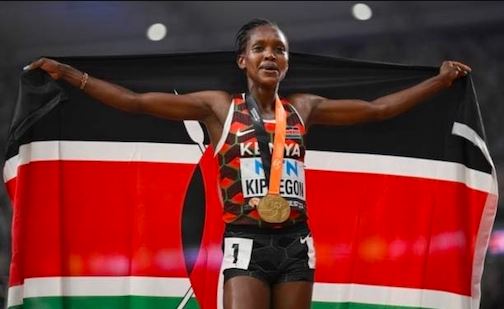
Faith Kipyegon (Source: StarConnectMedia)

We had faith in our Kenyan sister Faith Kipyegon… and she delivered: Faith won her 3rd successive Olympic gold in the women’s 1500 m, making her the first African to ever win gold in the same event 3 times in a row. Last Monday, she had won silver in a very contested Women’s 5000 m at the Olympics, where she was first disqualified for track obstruction, and then reinstated as the silver medal winner after appeal by the Kenyan federation. Her compatriot Beatrice Chebet won the first Kenyan gold medal of these Olympics in the Women’s 5000 m, and proved unbeatable in the Women’s 10,000 m delivering gold there as well. Mary Moraa, Faith Cherotich, and Hellen Obiri all took home the bronze medal in the Women’s 800 m, Women’s 3000m steeplechase, and in the Women’s Marathon respectively. Emmanuel Wanyonyi won gold in the Men’s 800 m. Ronald Kwemoi won silver in the Men’s 5000 m, while Benson Kipruto and Abraham Kibiwot took home bronze in the Men’s Marathon and Men’s 3000m steeplechase respectively. In total, Kenya earned 11 olympic medals: 4 gold, 2 silver, and 5 bronzes.
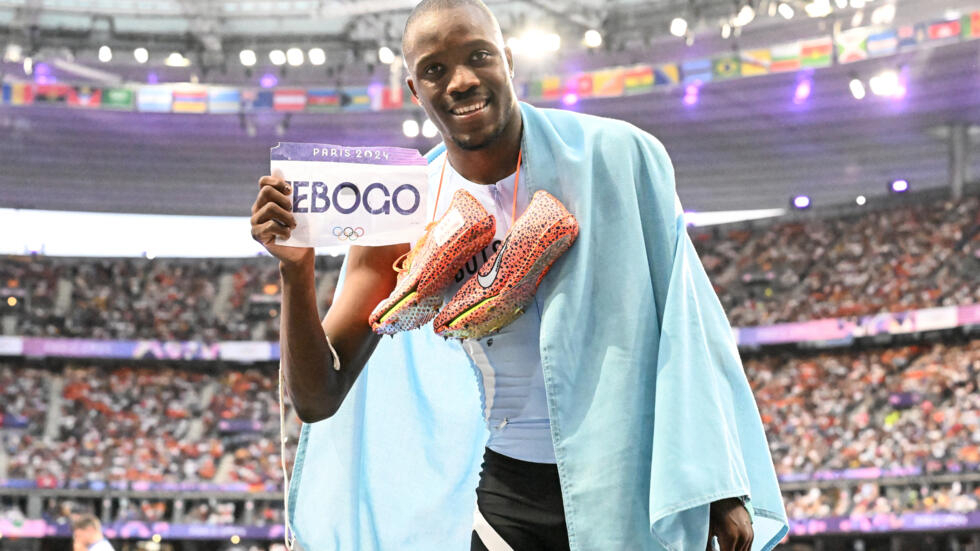
Letsile Tebogo after winning gold in 200m (Source: Onuaonline)

We had our eyes on Letsile Tebogo who missed out on the 100m  podium, but earned the top most place in the Men’s 200 m thus giving Botswana and Africa as a whole its first ever gold medal in a 200 m. Since our brother Frankie Fredericks of Namibia who used to delight us, and always ended with silver, this is a very first. Tebogo also led the Botswana’s team to a silver medal in the Men’s 4x400m relay, again a first for any African country ever, letting the world know that Africans can no longer be discarded in these disciplines.

Joshua Cheptegei (Source: Dailyexpress.co.ug)

Before the Olympics, our Ugandan brother Joshua Cheptegei told us that this will be his last Olympics, and promised us magic. Cheptegei did not disappoint, he ran his heart out serving us a performance worthy of a novel, coming from behind to win gold in the Men’s 10,000 m, and landing Uganda its first gold at the games. Compatriot Peruth Chemutai won silver in the Women’s 3000m steeplechase.
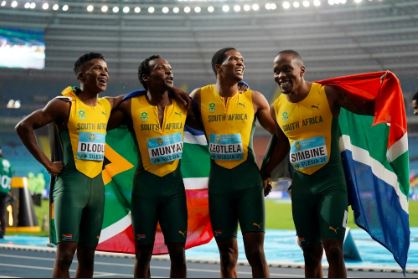
South African team after 4 x 100m Relay win (Source: dispatchlive.co.za)

In swimming, Tatjana Smith of South Africa made her country proud by winning gold and silver medals in the Women’s 200m and 100m breaststroke events; recall that Smith, born Schoenmaker, was the Tokyo 2020 Gold medalist in the 200m breaststroke category. South Africa also landed 2 bronze medals in rugby and mountain bike with Alan Hatherly. Although flag bearer Akani Simbine ended 4th in a highly contested Men’s 100 m track and field, Simbine and the rest of his team delivered us silver in the Men’s 4 x 100 m relay, again a first for South Africa, and for Africa as a whole in winning a medal in the discipline. Jo-Ane van Dyk delivered silver in the Women’s javelin throw.

Algeria took home 2 gold and 1 bronze medals, one gold from the controversial athlete Imane Khelif who is said to be a man competing in female boxing, and another gold from Kaylia Nemour in the Women’s Uneven bars in artistic gymnastics. Nemour‘s victory is a first for Africans in gymnastics. Djamel Sedjati took home the bronze medal in the Men’s 800 m.

Tamirat Tola wins Men’s Marathon at Paris 2024 Olympics (Source: afrik.com)

Tamirat Tola, who was just added to the Ethiopian Olympics’s team 2 weeks ago after his compatriot Sisay Lemma was injured, took home the gold medal in the Men’s Marathon, making Ethiopia and our legend Haile Gebrselassie who opened the marathon, proud. Berihu Aregawi won a silver medal for his participation in the Men’s 10,000 m. Tsige Duguma and Tigst Assefa both won silver in the Women’s 800 m, and the Women’s Marathon respectively.
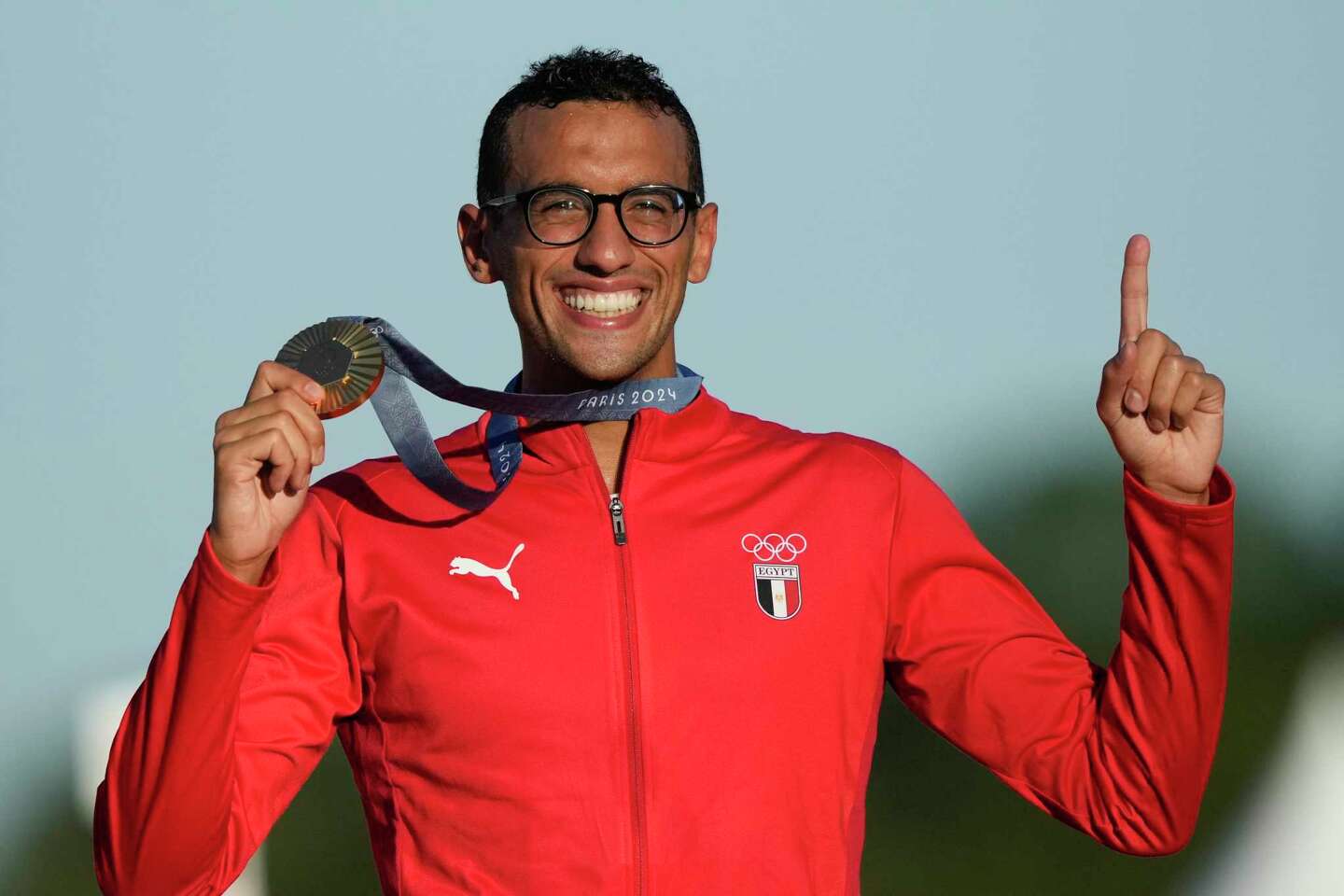
Ahmed Elgendy wins gold in the first ever modern pentathlon (Source: TheTelegraph.com)

Egypt won 3 medals: 1 gold in the Men’s Modern Pentathlon with Ahmed Elgendy, 1 silver in Women’s 81kg weightlifting with Sara Ahmed, and 1 bronze in fencing with the Men’s individual Epee with Mohamed Elsayed. Elgendy‘s gold is the first gold medal for Egypt at any olympics, and a first in the discipline for an African athlete; he also becomes the first person to win in this brand new discipline at the Olympics.

Morocco  delighted us when Soufiane El Bakkali won the gold medal in the Men’s 3000m steeplechase; and the Moroccan football (soccer) team, currently Africa’s highest ranked soccer team at number 4 (the senior men’s team) in the world’s ranking of football team, took home the bronze medal by defeating Egypt.

Tunisia reveled us with gold in Taekwondo in the Men’s 80 kg with Firas Katoussi, and bronze in the Men’s 58 kg with Mohamed Khalil Jendoubi. Fares Ferjani won silver in Fencing the Men’s Individual Sabre.

Our dear brother Cheikh Sallah Cisse of Ivory Coast did not disappoint by taking the bronze medal in Taekwondo for Ivory Coast, in the Men’s 80kg; Cisse had given Côte d’Ivoire its very first gold medal at the Rio 2016 Olympics.

Cabo Verde got its very first medal at the Olympic games through David de Pina who won bronze in the Men’s 51 kg Boxing.

Muzala Samukonga of Zambia wins Bronze in the Men’s 400m (Source: pulsesports.ng)

Zambian Muzala Samukonga won the bronze medal in the Men’s 400m. This may be Zambia’s first medal at the Olympics; if not, it is Zambia’s first medal in the discipline ever. And the Zambian team also came out 4th in the Men’s 4 x 100 m relay one step short of a place on the podium; this tells you the future that this Zambian team holds if it perseveres.

We cannot wait to see Africa at the Los Angeles Games in 2028!

Proverbe Bamiléké sur la duplicité/ Bamileke Proverb on Duplicity

Femme africaine / African Woman

Promettre la même fille à plusieurs, c’est se placer sous un arbre pourri (Proverbe Bamiléké – Cameroun).

Promising the same girl to several people is like standing under a rotten tree (Bamileke proverb – Cameroon).

Africans at the Paris 2024 Olympics so far …

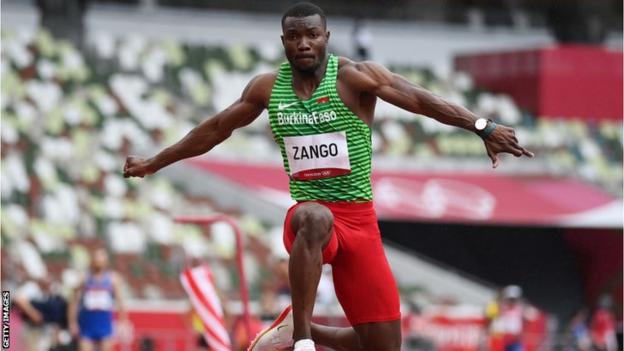
Hugues Fabrice Zango getting his triple jump (Source: bbc.co.uk)

The controversial opening ceremony of the 2024 Paris Olympic Games has not dimmed the spirits of African athletes, they know that they are there to work and make their continent proud.

Before the beginning of the games, there were a few African athletes to watch out for:

Our golden athlete Hugues Fabrice Zango, the first gold medal of Burkina Faso, and representing us all on the triple jump. As a fun fact, Zango also recently defended his PhD thesis in Electrical Engineering, and looks to make the colors of his country shine again this year.

Faith Kipyegon (Source: StarConnectMedia)

Our loved one, Kenyan Faith Kipyegon… we all have faith in her to make us proud again. With 2 world titles won and 4 world records, Faith is hoping to win her 3rd successive Olympic gold in the women’s 1500m; if she manages to accomplish this, she will be the first African to even win gold in the same event 3 times in a row. On Monday, she already won silver in a very contested Women’s 5000 m at the Olympics, where she was first disqualified for track obstruction, and then reinstated as the silver medal winner after appeal by the Kenyan federation. Her compatriot Beatrice Chebet won the first Kenyan gold medal of these olympics.

The revelation is this year’s Eritrean athlete Biniam Girmay who has won stage events at the Tour de France, becoming the first African to ever do so, and also topping the points classification. We will be on the look out for him in cycling.

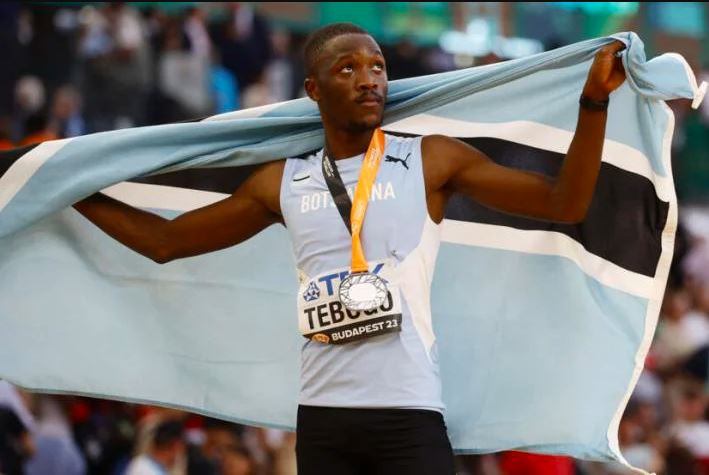
Letsile Tebogo (Source: SportNewsAfrica)

We had our eyes on Letsile Tebogo of Botswana who took silver in the 100m and bronze over 200m  at the world championships; however, the 100m did not go well for Tebogo, but we are all throwing our support behind him for the 200m. Our young brother lost his mother, Seratiwa Tebogo, his pillar and rock back in May, and we are sending him lots of love and support.

Blessing Oborududu of Nigeria is a wrestling baobab in Nigeria and Africa, with 14 continental titles, 4 commonwealth medals, and a silver medal at the Tokyo 2020 Olympics. However, today, Oborududu lost on advancing to gold or silver, but will be competing for the Bronze medal tomorrow.

Flag of Uganda

Before the Olympics, our Ugandan brother Joshua Cheptegei told us that this will be his last Olympics, and promised us magic. Cheptegei did not disappoint, he ran his heart out serving us a performance worthy of a novel, he came from behind to win gold in the men’s 10,000m, and land Uganda its first gold at the games so far. Compatriot Peruth Chemutai won silver in the Women’s 3000m steeplechase, while Kenyan Faith Cherotich won the Bronze medal.

In swimming, Tatjana Smith of South Africa made her country proud by winning gold and silver medals in 200m and 100m breaststroke events. South Africa also landed 2 bronze medals in rugby and mountain bike with Alan Hatherly. Flag bearer Akani Simbine ended 4th in a highly contested 100m track and field men’s final.

I will write an article at the end of the Paris 2024 Olympics games to tally all our victories.

Proverbe sur le mariage / Proverb on Marriage

La main gauche nettoie la droite (proverbe Ngombe, Basonge – République Démocratique du Congo (RDC)). – L’homme et la femme s’entraident.

The left hand cleans the right (Ngombe and Basonge proverb – Democratic Republic of Congo (DRC)). – The man and the woman help each other.

Ne vous déclarez pas vainqueur trop tôt/ Don’t Declare Yourself Winner too soon

Riviere / River

Vous êtes encore dans l’eau et vous essorez déjà vos vêtements (Proverbe Mongo – République Démocratique du Congo). – Ne vous croyez pas trop vite vainqueur.

You are still in the water and you are already wringing out your clothes (Mongo proverb – Democratic Republic of Congo (DRC)). – Don’t think yourself winner too quickly.

Strategies to Destabilize a Country : the Case of Guinea

Sekou Toure, Cover Time Magazine, Feb. 16, 1959

The Guinea of Sekou Toure was the first country to say ‘NO’ to the General de Gaulle. Sekou Touré, proud descendent of one of the great African leaders who fought colonialism, Samori Touré, said, on 25 August 1958, Sekou Touré said: “Il n’ya pas de dignité sans liberté. Nous préférons la liberté dans la pauvreté à la richesse dans l’esclavage.” [There is no dignity without freedom. We prefer freedom in poverty to wealth in slavery].

After Sekou Toure said ‘No‘, De Gaulle did not take it lightly and reacted harshly to crush the new Guinean state, and ensure that no other African countries followed the Guinean example.  The Washington Post back then, observed how brutal the French were in tearing down all what they thought was their contributions to Guinea: “In reaction, and as a warning to other French-speaking territories, the French pulled out of Guinea over a two-month period, taking everything they could with them. They unscrewed light bulbs, removed plans for sewage pipelines in Conakry, the capital, and even burned medicines rather than leave them for the Guineans.” Imagine that, they unscrewed light bulbs! It is said that they even poured cement on water pipes!… the French reacted like a really angry boyfriend who had been thrown out.

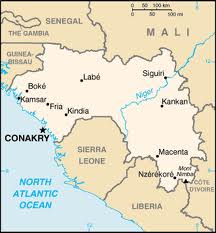
Guinea-Conakry
Guinea-Conakry

Maurice Robert, head of the African cell for the Service de documentation extérieure et de contre-espionnage (SDECE), France‘s external intelligence agency from 6 November 1944 to 2 April 1982 said in an interview, « Nous devions déstabiliser Sékou Touré, le rendre vulnérable, impopulaire et faciliter la prise du pouvoir par l’opposition. Une opération de cette envergure comporte plusieurs phases : le recueil et l’analyse des renseignements, l’élaboration d’un plan d’action à partir de ces renseignements, l’étude et la mise en place des moyens logistiques, l’adoption de mesures pour la réalisation du plan. Avec l’aide d’exilés guinéens réfugiés au Sénégal, nous avons aussi organisé des maquis d’opposition dans le Fouta-Djalon. L’encadrement était assuré par des experts français en opérations clandestines. Nous avons armé et entraîné ces opposants guinéens pour qu’ils développent un climat d’insécurité en Guinée et, si possible, qu’ils renversent Sékou Touré. Parmi ces actions de déstabilisation, je peux citer l’opération Persil, par exemple, qui a consisté à introduire dans le pays une grande quantité de faux billets de banque guinéens dans le but de déséquilibrer l’économie. » [“We had to destabilize Sékou Touré, make him vulnerable, unpopular and facilitate the seizure of power by the opposition. An operation of this scale involves several phases: the collection and analysis of information, the development of an action plan based on this information, the study and implementation of logistical means, the adoption of measures to implement the plan. With the help of Guinean exiles who had taken refuge in Senegal, we also organized opposition groups in Fouta-Djallon. Supervision was provided by French experts in clandestine operations. We have armed and trained these Guinean opponents so that they develop a climate of insecurity in Guinea and, if possible, overthrow Sékou Touré. Among these destabilizing actions, I can cite Operation Persil, for example, which consisted of introducing a large quantity of counterfeit Guinean banknotes into the country with the aim of unbalancing the economy.”]

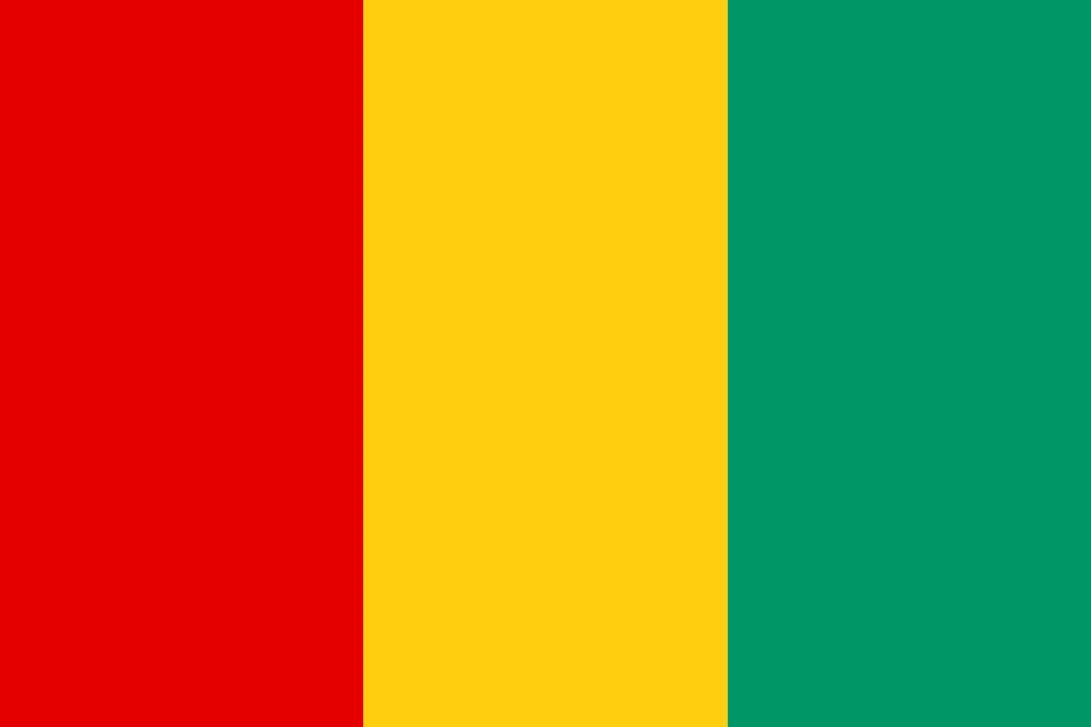
Flag of Guinea

Thus, the strategies to destabilize Guinea were, among others, 1) Make Sekou Toure weak and impopular by financing and arming his opponents; 2) using exiled Guineans in neighboring Senegal, training them militarily to create zones of insecurities in the country to eventually topple off Sekou Toure’s government; 3) economically weaken the country by using fake currency.

There are numerous examples of how these strategies were used in recent years: in Cote d’Ivoire during the presidency of Laurent Gbagbo with the armed rebellion financed from external forces, terrorist forces’ attacks in the AES countries, and much more…

African Joke: The Gospel of Mark, Chapter 17

The Bible

One Sunday, at worship, the pastor of a small village says :

Next week, I will give my sermon on lying. To learn more about this sin, I invite you to read and prepare the passage from the gospel of Mark, chapter 17.

The following Sunday arrives and as he prepares to take the pulpit to preach, the pastor asks the question to the congregation:

Who among you has read St Mark, chapter 17 ? And everyone raises their hand.

The pastor smiles and says:

The gospel of Mark contains only 16 chapters. So now you are all ready to hear my sermon on this sin that is lying!

The original in French is found on Nouchi.com . Adapted and Translated to English by Dr. Y. Afrolegends.com

On est aimé quand … / You are loved when …

On vous invite à accompagner à la chasse, parce qu’on a vu vos filets (proverbe Ntomba – République Démocratique du Congo (RDC)). – On est aimé quand on a beaucoup de choses.

We invite you to go hunting, because we have seen your nets (Ntomba proverb – Democratic Republic of Congo (DRC)). – We are loved when we have many things.

Lumumba’s Letter to Rajeshwar Dayal, Special Representative to the UN Secretary General

Patrice Lumumba

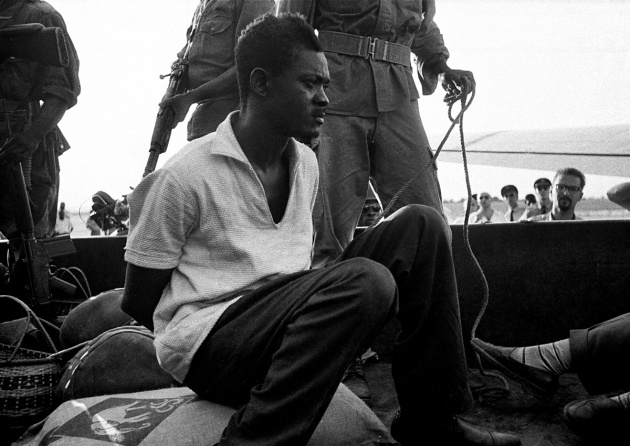
Two weeks before his murder, on January 4th 1961, Patrice Lumumba wrote from prison in Thysville (now Mbanza-Ngungu) to Rajeshwar Dayal, a Special Representative to the UN Secretary General. In prison, Lumumba was accompanied by Maurice Mpolo and Joseph Okito, two political associates who had planned to assist him in setting up a new government. They were fed poorly by the prison guards, as per Mobutu’s orders. In one of Lumumba’s last documented letter, he wrote to Dayal who was the head of the United Nations Operation in the Congo: “In a word, we are living amid absolutely impossible conditions; moreover, they are against the law.”

=====

LETTER TO M. DAYAL, SPECIAL REPRESENTATIVE OF THE U.N. SECRETARY-GENERAL
Thysville, January 4, 1961

Mr. Special Representative,

On December 27 last, I had the pleasure of receiving a visit from the Red Cross, which occupied itself with my plight and with the plight of the other parliamentarians imprisoned together with me. I told them of the inhuman conditions we are living in.

Lumumba detained
Lumumba detained

Briefly, the situation is as follows. I am here with seven other parliamentarians. In addition there are with us Mr. Okito, President of the Senate, a Senate employee and a driver. Altogether there are ten of us. We have been locked up in damp cells since December 2, 1960, and at no time have we been permitted to leave them. The meals that we are brought twice a day are very bad. For three or four days 1 ate nothing but a banana. I told this to the Red Cross medical officer sent to me. I spoke to him in the presence of a colonel from Thysville. I demanded that fruit be bought on my own money because the food that I am given here is atrocious. Although the medical officer gave his permission, the military authorities guarding me turned down my request, stating that they were following orders from Kasavubu and Colonel Mobutu. The medical officer from Thysville prescribed a short walk every evening so that I could leave my cell for at least a little while. But the colonel and the district commissioner denied me this. The clothes that I wear have not been washed for thirty-five days. I am forbidden to wear shoes.

In a word, the conditions we are living in are absolutely intolerable and run counter to all rules.

Moreover, I receive no news of my wife and I do not even know where she is. Normally I should have had regular visits from her as is provided for by the prison regulations in force in the Congo. On the other hand, the prison regulations clearly state that not later than a day after his arrest a prisoner must be brought before the investigator handling his case. Five days after this a prisoner must again be arraigned before a judge, who must decide whether to remand him in custody or not. In any case, a prisoner must have a lawyer.

The criminal code provides that a prisoner is released from prison if five days after he is taken into custody the judge takes no decision on remanding him. The same happens in cases when the first decision (which is taken five days after a person is arrested) is not reaffirmed within fifteen days. Since our arrest on December 1 and to this day we have not been arraigned before a judge or visited by a judge. No arrest warrant has been shown to us. We are kept simply in a military camp and have been here for thirty-four days. We are kept in military detention cells.

The criminal code is ignored as are the prison rules. Ours is purely a case of arbitrary imprisonment. I must add that we possess parliamentary immunity.

Such is the situation and I ask you to inform the United Nations Secretary-General of it.

I remain calm and hope the United Nations will help us out of this situation.

I stand for reconciliation between all the children of this country.

I am writing this letter secretly on bad paper. I have the honour to be, etc.

Patrice LUMUMBA,
Prime Minister

Niger, Mali, and Burkina Faso sign New Pact at the First Summit of the AES

Flag of Niger

Mali, Niger, and Burkina Faso’s leaders met on July 6, 2024 in Niamey, Niger, as part of the first summit of the Alliance des Etats du Sahel (AES – Alliance of the Sahel States). During the summit, the three leaders signed a confederation treaty aimed at strengthening the links between the three nations in terms of defence, and other aspects such as the economy, infrastructures, and more. They reinforced their mutual defence pact. This is a pivotal moment whih marks a new era, and we rejoice for Mali, Niger and Burkina Faso, and the whole of Africa.

Below are excerpts from Al-Jazeera.

=====

Flag of Mali
Flag of Mali

The military leaders of Burkina Faso, Mali and Niger have hailed a newly signed treaty as a step “towards greater integration” between the three countries, in the latest showing of their shift away from traditional regional and Western allies.

During a summit in the Nigerien capital of Niamey on Saturday, the three leaders signed a confederation treaty that aims to strengthen a mutual defence pact announced last year, the Alliance of Sahel States (AES).

The signing capped the first joint summit of the leaders – Niger’s General Abdourahmane Tchiani, Burkina Faso’s Captain Ibrahim Traore, and Mali’s Colonel Assimi Goita – since they came to power in successive coups in their bordering West African nations.

… Speaking at the summit on Saturday, Tchiani called the 50-year-old ECOWAS “a threat to our states”.

… “We are going to create an AES of the peoples, instead of an ECOWAS whose directives and instructions are dictated to it by powers that are foreign to Africa,” Tchiani said.

Flag of Burkina Faso

Burkina Faso’s Traore also accused foreign powers of seeking to exploit the countries. The three nations have regularly accused former colonial ruler France of meddling in ECOWAS.

Westerners consider that we belong to them and our wealth also belongs to them. They think that they are the ones who must continue to tell us what is good for our states,” he said.

This era is gone forever. Our resources will remain for us and our population’s.”

… For his part, Mali’s Goita said the strengthened relationship means an “attack on one of us will be an attack on all the other members”.

… The Niamey summit also came a day before the United States is set to complete its withdrawal from a key base in Niger, underscoring how the new military leaders have redrawn security relations that had defined the region in recent years.

… French troops completed their withdrawal from Mali in 2022, and they left Niger and Burkina Faso last year.

Meanwhile, US Air Force Major General Kenneth Ekman said earlier this week that about 1,000 military personnel would complete their withdrawal from Niger’s Air Base 101 by Sunday.

The US is also in the process of leaving a separate, $100m drone base near Agadez in central Niger, which officials have described as essential to gathering intelligence about armed groups in the region.