Cheikh Anta Diop and the African Origin of Civilization

Cheikh Anta Diop
Cheikh Anta Diop

Cheikh Anta Diop was a great Senegalese historian, anthropologist, philosopher, physicist and politician.  He should be considered as one of the greatest scientists after Darwin, as he demonstrated that Africa was the cradle of humanity; that everything started in Africa, and that Egypt and modern day Africans descended from the same ancestors, in other words, were the same people.  Before Cheikh Anta Diop, the world, and Africans in particular, had been taught that Africa was nothing, and that Egypt and Egyptians were not Africans… that the great Egyptian civilization which gave so much to the world, could not have come from the dark brown Africans.  Europeans refused to admit that although in Africa, Egyptians could be Africans i.e. Black, or rather believed that Blacks were so backwards that their ancestors could not have possibly made the great pyramids of Giza or the great sphinx.  Well Cheikh Anta Diop proved them all wrong!
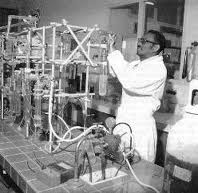
Cheikh Anta Diop in the laboratory

As a physicist, I was amazed to learn that Cheikh Anta Diop was a PhD student of Frédéric Joliot-Curie, the 1935 physics nobel laureate, and Marie Curie‘s son-in-law (first woman to receive a Nobel in Physics, and first to have two nobel prizes). So Diop’s pedigree, in physics terms, was quite impressive!  Moreover, he had earned two PhDs: one in history and the other in nuclear physics.  He was also the only African student of his generation to have received a training in egyptology. He was well-versed in prehistoric archaeology, and linguistics.  It took him almost a decade to have his doctorate degree granted: he submitted a thesis in 1951 which was based on the premise that the Egypt of the great pharaohs and pyramids was an African civilization– it was rejected.  He then published it in 1955, as Nations Nègres et Culture, and received world-wide acclaim.  Two additional attempts at submitting it were rejected, until 1960 when he finally managed to convince a room full of physicists, sociologists, anthropologists, egyptologists, and historians.  Having gone through the hurdle of submitting and defending a doctoral dissertation, I truly raise my hat to someone like Diop who had so much stamina and endurance, and could endure a decade of rejection like that; he was truly destined for greatness!
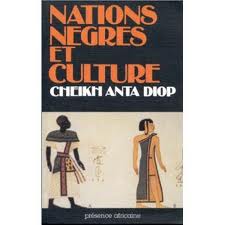
'Nations Negres et Culture' de Cheikh Anta Diop

In 1974, Diop managed to prove beyond a shadow of a doubt, that Egyptians were Black people.  He obtained pigment from Egyptian mummies and tested for their melanin content.  He was able to determine their melanin content accurately, and later published his technique and methodology for the melanin dosage test in scholarly journals.  This technique is used today by Forensic investigators around the world, to determine the “racial identity” of badly burnt accident victims.

He was affectionately known as the Pharaoh of knowledge, and the Université Cheikh Anta Diop (UCAD) of Dakar was re-named after him.  Check out CheikhAntaDiop.net a website dedicated to this great man, Wikipedia, Cheikh Anta Diop: The Pharaoh of Knowledge, and Africawithin.com.  Don’t forget to read his books: Nations Nègres et Cultures: de l’Antiquité Nègre Egyptienne aux Problèmes Culturels de l’Afrique Noire d’Aujourd’hui, The African Origin of Civilization: Myth or Reality, Precolonial Black Africa, Civilization or Barbarism: An Authentic Anthropology [Civilisation ou Barbarie: Anthropology sans Complaisance], and many others.

'The African Origin of Civilization' by Cheikh Anta Diop

Please watch one of the greatest African thinkers of the 20th century, and above all one of Africa’s greatest sons (… and renowned physicist). I salute this great soul who made us proud of being Africans, who re-define history or rather wrote History the way it should have been, with Africa in its right place, as the origin of civilization. If there was an African Pantheon for great minds, Cheikh Anta Diop’s remains should be in it!

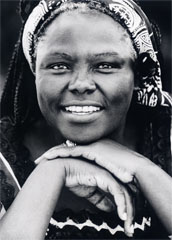
Wangari Maathai, first African Woman Nobel Peace Prize Laureate

Wangari Maathai
Wangari Maathai

I once took a class in environmental and social changes, where I studied the work of Dr. Wangari Maathai.  Her boldness and her stand for truth made her a great role model for many African women, and Africans in general.  She was bold! “Wangari Maathai was known to speak truth to power,” said John Githongo, an anticorruption campaigner in Kenya who was forced into exile for years for his own outspoken views.  “She blazed a trail in whatever she did, whether it was in the environment, politics, whatever.”  Indeed, Wangari Maathai was one of the most widely respected women on the continent, where she played many roles: environmentalist, politician, feminist, professor, human rights advocate, and head of the Green Belt Movement which she started in 1977. She was scoffed at by the Kenyan Forestry department who thought that uneducated women could not fight the desert.  She told them ‘We need millions of trees and you foresters are too few, you’ll never produce them. So you need to make everyone foresters.’ I call the women of the Green Belt Movement foresters without diplomas.

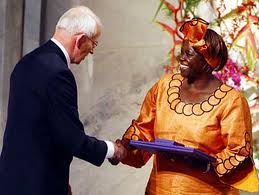
Wangari Maathai receiving the Nobel Peace Prize

As a star student after high school, she won a scholarship to study biology in Kansas (US), and went on for a Masters of Science at the University of Pittsburgh, and later a doctorate degree in veterinary anatomy at the University of Nairobi where she later taught and became chair of the department in the 1970s.  Wangari’s work started with the Green Belt Movement with the mission of planting trees across Kenya to fight erosion, stop desertification, create firewood for fuel, provide jobs for women, and empower the women of Kenya.  According to the United Nations’ data, her organization has planted over 45 million trees in Kenya, helped 900,000 women, and inspired similar projects in other African countries.  “Wangari Maathai was a force of nature,” said Achim Steiner, the executive director of the United Nations’ environmental program.  He likened her to Africa’s ubiquitous acacia trees, “strong in character and able to survive sometimes the harshest of conditions.

Maathai planting a tree

Her work was illustrated in one of my secondary school English textbook.  The government of Arap Moi was trying to build a skyscraper in one of Nairobi’s only parks, and she brought women who protested until the government abandoned the project.  She was beaten by police until she faintedWangari was not one to back down from her beliefsShe would go to jail for what she believed in.  For instance, her husband divorced her because he said she was too strong-minded for a woman.  When she lost her case in court, she criticized the judge and told him her mind, and was thus thrown to jail.

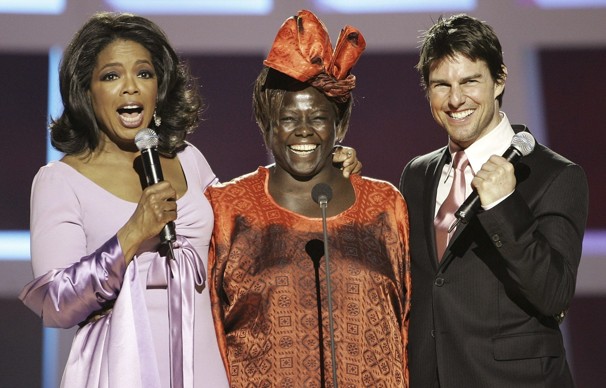
Oprah Winfrey and Tom Cruise congratulating Wangari Maathai on her Nobel Peace Prize

In presenting her with the Peace Prize, the Nobel committee hailed her for taking “a holistic approach to sustainable development that embraces democracy, human rights and women’s rights in particular” and for serving “as inspiration for many in the fight for democratic rights.”  Wangari Maathai has received many honorary degrees, including an honorary doctorate from the University of Pittsburg, her alma mater.  Check out articles by the BBC, CNN, her Interview on NPR, and the Huffington Post whose article is entitled “Wangari Maathai and the Real Work of Hope .”  Don’t forget to click also on the The Green Belt Movement website, and the movie “Taking Root: The Vision of Wangari Maathai.”   She once said that ‘we should all be hummingbirds‘: doers, and not spectators, even in the face of great challenges; do the best you canGoodbye Wangari, your work is not over, for Africa has been blessed with millions of Wangari Maathais who will continue your outstanding work.

Cheikh Modibo Diarra: NASA’s First African Astrophysicist

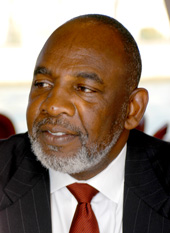
Cheikh Modibo Diarra

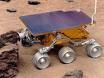
NASA’s First African astrophysicist and key player in the exploration of Mars with the Pathfinder and Sojourner projects, Cheikh Modibo Diarra is without doubt a brilliant scientist.  As a physicist from similar background, this Malian scientist has inspired me by his intelligence and hard work.  Cheikh Modibo Diarra earned his baccalaureate in Mali; he then went on to study mathematics, physics and analytical mechanics at the Pierre and Marie Curie University in Paris.  After a while, he got bored by his classes (a sign of genius?) and went on an adventure exploring the world, and ended up in the USA at a friend’s invitation.  He then attended Howard University in Washington DC where he earned a PhD in aerospatial engineering. Later, he taught at Howard as a physics professor, until one day he met two recruiters from Jet Propulsion Laboratory (a NASA Lab) in the corridor of his building.  That’s when his career with NASA started.  Recruited as NASA’s first African researcher, Diarra participated in programs such as the Magellan probe to Venus, the Ulysses probe to the Sun, the Galileo spacecraft to Jupiter, the Mars Observer and the Mars Pathfinder.  He later became the director of NASA’s “Mars Exploration Program Education and Public Outreach.”

The Sojourner rover
The Sojourner rover

In 1999, he created the Pathfinder Foundation for the education and development of Africa.  Three years later, he founded the solar energy research laboratory of Bamako in Mali.  He is involved in programs for the development of Africa. On the 20th of February 2006, he was appointed the head of Microsoft Africa.  Cheikh Diarra is currently based in Johannesburg where he works with Microsoft South Africa and WECA (West , East and Central Africa).

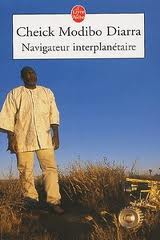
"Navigateur Interplanetaire" de Cheikh Modibo Diarra
“Navigateur Interplanetaire” de Cheikh Modibo Diarra

Please help me applaud this proud African scientist, hailing from Segou, in the heart of the Bambara kingdom!  If you have a chance, check out his book Navigateur Interplanétaire, which is available in French, and other languages.  Other sites such as Grioo.com, africansuccess.org, and Wikipedia will provide you with more biographical information about this world-renowned Malian scientist!

Palm wine: White Wine Made in Africa/ Le Vin de Palme: Vin Blanc Made in Africa

Palm Wine/ Le vin blanc

Today, I would like to talk about palm wine. Have you ever tasted palm wine? hummmmmh so sweet! So good! so delicious! or rather palmilicious! Palm wine or white wine made in Africa or raffia wine is wine from the sap of the palm or coconut tree. It is actually white in color, not transparent like its European counterpart.

Tapper harvesting palm wine

Palm wine sap is gathered in two ways. The first: A tapper extracts and collects the sap from the tree by making a triangular cut onto the raffia tree just like during the harvest of hevea: a receptacle is attached to the tree where the cut was made, and the sap can thus be collected. The second way involves cutting down the tree and allowing it to lie for two weeks. After, a rectangular well is cut in it. At this stage, a bamboo tube is inserted into the well to drain the sap as it collects. The quantity of sap that is extracted from one palm tree depends on the mode of extraction, the palm species, season and the fertility of the soil. The white liquid that comes out is at first very sweet and non-alcoholic: this is what we as kids would love to drink. Fermentation begins naturally and immediately after collection. After fermentation, the liquid becomes alcoholic and has some sourness and acidity to it. It could sometime happen that we would drink it two – three hours after collection, and it would still be good, but would have a sour after-taste to it. After one day, it is fully alcoholic, and more than one kid has certainly fallen to it!

The Palm Wine Drinkard by Amos Tutuola

In the old days, and at night in the village, children and adults will sit around the fire to hear storytelling from a village elder while enjoying some palm wine, grilled corn or grilled safou! It is drank at celebrations, weddings, etc… Chinua Achebe mentions palm wine in his novel “Things Fall Apart“, and it is the title of the novel by Amos TutuolaThe Palm Wine Drinkard“.  In Cameroon, it is harvested from raffia palm tree, and collected into a container communally called ‘dame-jeanne’. The traditional version of this container is also made from raffia or African bamboo wood! Palm wine is often called ‘matango‘ in the Cameroonian slang.  What is it called in your country?

Please enjoy this great video about the harvesting of palm wine from Cameroon!

I also liked this lady’s description of her first taste of palm wine: Palm wine drinkards.

Cosmic Africa: Africans and Astronomy

Cosmic Africa
Cosmic Africa

Dear all,

As a physicist, I could not pass on the opportunity to talk about the fellow South African astrophysicist Thebe Medupe ‘s work on Cosmic Africa. Cosmic Africa is a project/documentary about astronomy in African cultures, exploring astronomy among two of the oldest African tribes: the Namib (or Bushmen or San) of Namibia, and the Dogon people of Mali.  I heard this documentary one evening on PRI.  It felt so great hearing an elder from the Dogon tribe talking about their use of the moon, stars, etc, for their harvest.  People still study the sky and the stars to guide them during the hunting season; astronomy is an integral part of their daily lives, dances, and ceremonies.  This knowledge of the sky was passed on from generation to generations for the past 500 years.

Thebe Medupe
Thebe Medupe

The Dogon people knew certain celestial bodies that were just discovered/identified properly by Western science in the 50s and 60s.  They used the stars in spirituality and devised a divination system as discussed in the movie.  One of their great treasures is the knowledge of the star Sirius which Dogon elders confided about its existence to French anthropologists in the 1940s.  The Dogon elders said that Sirius had a companion star that was invisible to the human eye.

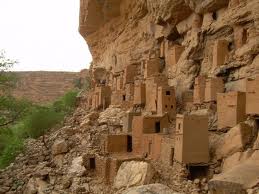
Dogon village
Dogon village

“They also stated that the star moved in a 50-year elliptical orbit around Sirius, that it was small and incredibly heavy, and that it rotated on its axis.  All these things happen to be true.  What makes this so remarkable is that the companion star of Sirius, called Sirius B, was first photographed in 1970.  While people began to suspect its existence around 1844, it was not seen through a telescope until 1862 — and even then its great density was not known or understood until the early decades of the twentieth century.  The Dogon beliefs, on the other hand, were supposedly thousands of years old.”  To read the full account, check out: The Sirius Mystery and the The Dogon Website.

San (Basarwa/Bushmen) hunters

The Bushmen of Namibia are the oldest people in Africa, as well as in the world.  They have lived in the Southern area of Africa for the past 20,000 years, and their celestial stories are just as old.  In the documentary, I love the way their celestial stories, and their story of creation was centered around the lion. Isn’t it interesting?  The lion, which is the king of the jungle,…purely African! I simply loved it.  The sky is interpreted in African terms: giraffes, lions, and zebras are seen among the stars where other people see bears and horses.  From the documentary, one sees that the Namib (Bushmen or San) healers welcome the bright evening star, the planet Venus, with a special dance….  The elders observe the shadows cast by the Sun and still count the days by the phases of the Moon, orient themselves, decide when to hunt, harvest, etc… with the sky.  They call the Milky Way the Spine of the Night and observe its three different positions during the night: it tells them about time and the changing seasons. Read more about the Khoisan people of Botswana and their fight for survival amidst government/Corporation’s menace.

To learn more check out the books: Sacred Symbols of the Dogon and The Sirius Mystery. Also check out the Foster brothers’ website (the producers): Sense Africa.

The Mpemba effect: Hot water freezes faster than cold water

As an African physicist, I have always wondered why there were no laws, theorems, equations named after African scientists. Living in a world where Schrodinger equation, Bose-Einstein statistics, Pythagorean theorem, and Newton’s laws are norms, and being African, I have always felt left out… It is as if my forefathers were not interested in science, or that modern day Africans were not as bright as Raman (Physics Nobel 1930) or Chandrasekhar (Physics Nobel 1983). Well… I was amazingly surprised when I stumbled upon ‘the Mpemba effect‘: made in Africa, by an African high schooler in 1963 (he later published his findings in 1969). Today, people apply his law without even thinking about where it comes from.

Erasto B. Mpemba, hailing from Tanzania, was still in high school when he came across this phenomenon when freezing hot milk; he noticed that it would freeze before the cold one. After repeating his experiments several times with water and milk, the Mpemba effect was born.  The heat transfer is bigger between the warm water and the freezer, than between the cold water and the freezer, leading to a faster process. Several mechanisms can be used to explain this effect, such as: – Evaporation (endothermic process); – Convection (faster heat transfers); frost formation (the colder water will tend to freeze from the top, reducing further heat loss by radiation and air convection, while the warmer water will tend to freeze from the bottom and sides because of water convection); supercooling; and – dissolved gases (Hot water can hold less dissolved gas than cold water, and large amounts of gas escape upon boiling.  So the initially warmer water may have less dissolved gas than the initially cooler water). More information on the ‘Mpemba effect’ can be found on Mpemba and Osborne, “Cool”, Physics Education vol. 4, pgs 172–5 (1969) and Can hot water freeze faster than cold water?

As of 2002 Erasto B. Mpemba is retired from being Principal Game Officer for the African Forestry and Wildlife Commission. This might not give rise to a Nobel prize, but it is enough to inspire others.