The former prime minister of Kenya, Raila Odinga, said of Dr. John Pombe Magufuli, “He was determined to put Tanzania ahead in the region and Africa through industrialisation. … His primary business was Tanzania. Outside Tanzania, his other business was Africa. He … embraced some of the founding President Mwalimu Julius Kambarage Nyerere’s ideals on patriotism, nationalism and self-reliance for his country. In about six-years, he went farther than Mwalimu Nyerere in trying to economically empower his people. While Mwalimu Nyerere embraced internationalism and had a broader view of the world and Tanzania’s place in it, Dr Magufuli was a super nationalist … Where Mwalimu Nyerere was a constant voice on the global stage, especially for Africa and the Third World, Dr Magulfuli reserved his voice and energy for Tanzania…. Dr Magufuli was, however, overly successful in transforming Tanzania in just about six years. He transformed Tanzania’s highways, ports, created Rapid Bus Transit to decongest Dar es Salaam and delivered SGR at a competitive rate, all because of a crackdown on corruption. Despite all these, Dr Magufuli’s … pushed hard the idea that success comes from hard work. In Tanzania today, people report to offices very early and they do not just sit there, they work. … May Dr Magufuli fare well in the next world.” [Raila Odinga, former Prime minister of Kenya in MarketWatch.com]
President John Pombe Magufuli has shown us, Africans, just like Thomas Sankara, that you do not need 20 or 40 years in power to make palpable improvement to the lives of Africans. Just look at what this man was able to achieve in 5 years! It is so reminiscent of Thomas Sankara‘s 4 years in power where he eradicated hunger, had roads and railways built by the local people, and influenced generations. So to all those African dinosaurs, the sellouts, or to anybody who applaud those treacherous creatures, please let them know that it is possible to get Africans out of poverty! All that is needed is visionary leaders who love their own… who love their fellow humans and not just their pockets! As always, we need to remember not to fall into the trap of democracy [Africans and the Trap of Democracy] laid out by the west, where democracy is a word used by the West against any government which does not abide by their will, and does not sell out to them…
Below are some of the quotes by the great man Dr. John Pombe Magufuli. May he rest in Power! Enjoy!
=====
As the 5th president of Tanzania, John Magufuli vowed, “My government will put emphasis on fighting corruption, job creation and industrialization.”
To fight against corruption he said, “The way to treat a boil is to squeeze it out, and I have made it my responsibility to do that. I know squeezing out a boil hurts but unfortunately, there are no two ways about it.“
Flag of Tanzania
Reflecting on his youth, as the son of a farmer, and on his knowledge of the people’s conditions, and need to make their lives better, Magufuli said, “Our home was grass thatched and like many boys I was assigned to herd cattle, as well as selling milk and fish to support my family, I know what it means to be poor. I will strive to help improve people’s welfare.“
As soon as he was elected, he divided his own salary by four, making him one of the lowest-paid African heads of state, cut public spending drastically, cancelled independence ceremonies as too costly, and began sweeping the streets of Dar es Salaam himself to set an example. As said earlier, this is reminiscent of what Thomas Sankara did in Burkina Faso.
Tanzania is the largest country in East Africa, and includes about 120 different African tribes. Believing in the unity of Tanzanians, Magufuli said, “It’s now time for us to unite and put our ideological differences aside, I will work hard for all Tanzanians regardless of their tribal, religious or ideological affiliations.”
John Magufuli was a doctor of chemistry, and had both taught chemistry and mathematics at the Sengerema Secondary School, before joining the Nyanza Cooperative Union Limited as an industrial chemist.With a PhD in Chemistry, he was among the top 5 most educated Presidents in Africa. He said, “You cannot talk of preserving the environment when the majority of the citizens are depending on charcoal or wood for most of their energy source;” there needs to be other ways, focusing first on getting them out of poverty.
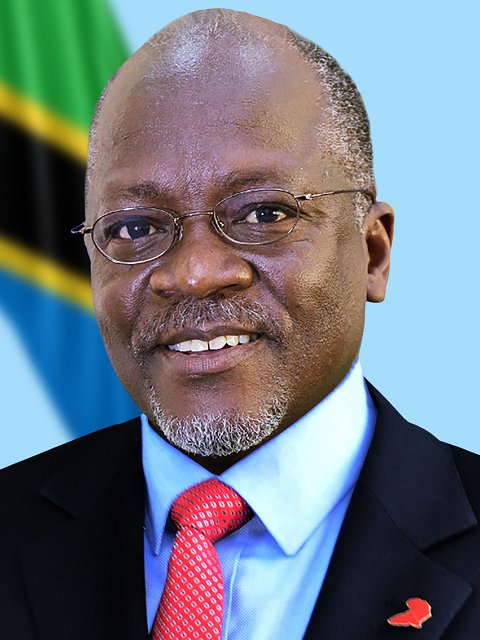
President John Pombe Magufuli of Tanzania
“African countries’ economic capacity is not the same as that of developed countries,” Magufuli told a televised meeting of top security organs. He singled out the World Bank, which has been offering new lending to nations on the continent to help them tackle the health crisis. “Instead of offering more loans to fight corona, they should forgive debts,” the president said [see… the west is always eager to give out loans at high rates, why not remove the unfair debt they have put on African countries? remember Thomas Sankara Speech on Debt and Unity?]. Tanzania spends 700 billion shillings ($303.03 million) every month to service its debts, with close to 200 billion shillings going to the World Bank, Magufuli said.
In 2020, after his re-election, he said, “As you are aware, elections have been a source of conflict in many countries, but we Tanzanians have safely passed this test. This is proof to the world that Tanzanians are peace-loving, and we have matured in our democracy.”
Dr John Magufuli was a remarkable economic leader, who understood that food security is a national security issue that needs the highest attention. He fought for his people, and loved them deeply. He was a nationalist!
I live you here with the speech by the Africant poet, Obert Dube. Enjoy!!!
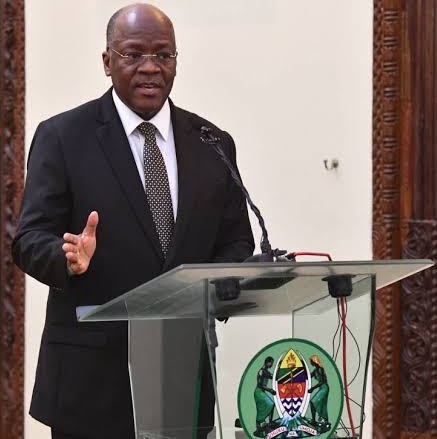
President John Magufuli of Tanzania (Source: eahealth.org)
My heart is bleeding from the news of the passing of President John Magufuli of Tanzania. When I learned the news, all I could think of were Bob Marley‘s words “How long shall they kill our prophets …?” As you scroll through the media, all Western world newspapers seem so cheerful announcing that the African president who was a coronavirus denier has died, brushing away the legacy of this man and what he has done for the people of Tanzania and of Africa in general. President John Magufuli passed away yesterday on March 17, of a heart attack! Odd for this very healthy man who was seen doing push-ups with soldiers just a few weeks ago. So who was John Magufuli?
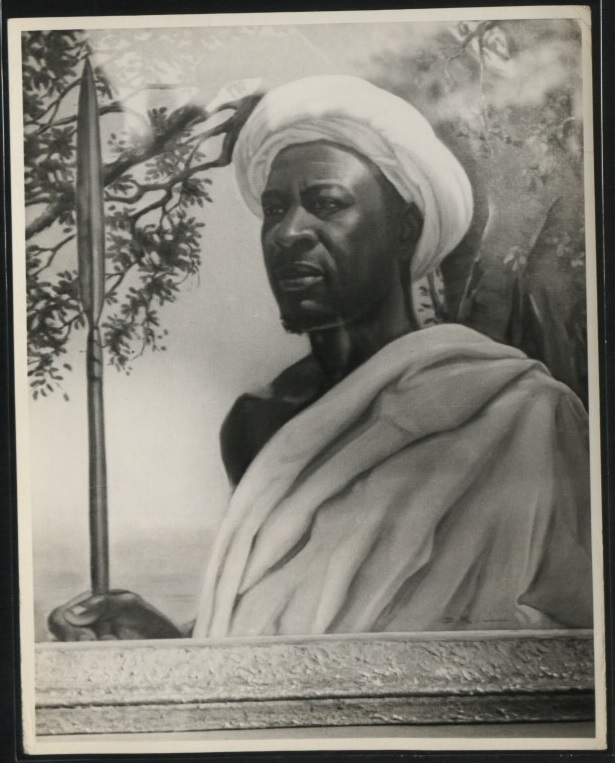
John Pombe Magufuli was born on October 29, 1959 in the Chato region of then Tanganyika (now Tanzania). He earned a bachelor’s degree in mathematics and chemistry at the University of Dar es Salaam in 1988. Later, he earned his master’s and doctorate degrees in chemistry from the same university in 1994 and 2009, respectively. I was happy to learn that he had attended the Mkwawa High School, named after the great king Mkwawa who defied and defeated the Germans, and later Mkwawa College of Education at the University of Dar es Salaam.
King Mkwawa
For years he was a secondary school teacher and then a chemist with a farmers’ cooperative union before entering politics as a lawmaker representing Chato in the National Assembly. He also worked as an industrial chemist before going into politics under the ruling Chama Cha Mapinduzi (CCM) party. He was elected a member of parliament in 1995 and that same year appointed deputy minister of works, later becoming full minister in 2000. He served in several Cabinet positions, notably as the hardworking public works minister nicknamed “the bulldozer” in the administration of predecessor Jakaya Kikwete. In 2010, he gained popularity after he was appointed Tanzania’s minister for works and transportation for the second time. His bullish leadership style and fight against graft in the road construction industry was endearing for Tanzanians, who affectionately nicknamed him “the bulldozer.” Under his leadership, Tanzania saw growth and development. For instance, to leave Dar es Salaam the capital could take 4 hours, but Magufuli had so many roads build, that in just a few years, Tanzania was seen under a brand new lens.
Flag of Tanzania
He ran as president in 2015 and won 58% of the vote, defeating Edward Lowassa of the Chadema opposition party. He had a reputation as an incorruptible man. In 2015, the newly elected Magufuli made news on his first day in office. He showed up unannounced in the morning at the Ministry of Finance offices to see how many officials had come to work on time (this is reminiscent of Thomas Sankara). That week he also banned unnecessary trips by government officials, as an austerity measure. He soon canceled Independence Day celebrations and said the funds budgeted for the event would be used to improve roads and infrastructure in Dar es Salaam, the commercial capital; he also urged citizens to clean up their communities to fight a cholera outbreak. Magufuli also fired a number of top government officials in his anti-corruption crusade. Under his command, his government passed laws to increase Tanzania’s stake in its mineral resources and demanded millions of dollars in back taxes from foreign mining companies, giving itself the right to renegotiate or terminate bad mining contracts in the event of proven fraud, which these multinationals did not appreciate; after all they are used to plundering Africa without paying a dime, so you can imagine their anger.
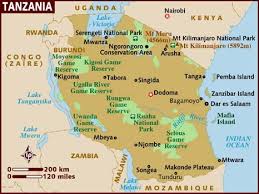
Map of Tanzania
Magufuli was focused on Tanzania’s economic success and sought to implement ambitious projects that would lift more of his people out of poverty. Under his reign, he expanded free education, and rural electrification. Scores of infrastructure programs, including trains and railways, a hydropower dam set to double electricity output, and the revival of Air Tanzania, were launched. Tanzania is one of the fastest-growing economies in the world, and in July 2020 the World Bank categorized it as a middle-income country five years ahead of schedule. “We had envisaged achieving this status by 2025 but, with strong determination, this has been possible in 2020,” Magufuli tweeted at the time.
In Tanzania, President Magufuli was a popular figure. His lean government and cost-cutting measures greatly earned him respect among citizens. As said earlier, he embarked on major infrastructure projects such as the port of Bagamoyo, and upgrading the Dar-es-Salaam International Airport. His hands-on war against corruption was admired not just in Tanzania — but the entire continent. “Magufuli came in on the platform of fighting corruption and empowering the masses,” Martin Adati, a Kenyan political analyst, told DW. “It is the people who have been benefiting from corruption and all these other funny things who are not very happy with him.”Magufuli remained a popular figure at home
President John Magufuli of Tanzania
So, why are Bob Marley’s words on my mind “How long shall they kill our prophets…?” Isn’t it strange that in Africa, the best ones are always the ones dying while the ones who are selling out their countries to the West are still standing? You know, the ones like P.B., I.D., S.N., F.E., A.B., ADO, P.K., M.S., and all of them? They can murder their populations, impoverish them, open their frontiers to all sorts of experiments by the big multinationals, and they stay so long in power… oh, and they get accolades from Western media as well. Isn’t it odd that this is the second president to die in office in East Africa, after Pierre Nkurunziza last year? And both were called “deniers” by the west? We have to pray for the people of Tanzania, because this might open the door to all sorts of funky business, nullifying Magufuli’s legacy, name, and efforts, and killing the wind of independence which was blowing on other African countries as well. May the spirits of Mirambo, Mkwawa, Nyerere, and Magufuli watch over Tanzania! So long President Magufuli, we liked your “bulldozer” style, because it included us, the people!
Congratulations to Professor Hulda Swai of Tanzania for winning the 2020 prize of the African Union Kwame Nkrumah Continental Awards for Scientific Excellence. This is a prestigious scientific award in Africa. Her work with nanotechnology has helped to study more effective anti-malarial medicines, and through the World Bank, she has helped to secure millions of dollars to fund African researchers. She is an outstanding scientist, and Oliver Tambo Chair for Nanotechnology as well as the director of the African Center of Excellence at the Nelson Mandela Institute of Science and Technology (NM-AIST) in Tanzania. The award comes with the sum of $20,000. She told the BBC’s Focus on Africa radio programme, “I’m using nanotechnology, which is my training and expertise, to improve the availability of existing herbal extracts which are very potent but are lacking for example solubility.” Excerpts below are from the The Citizen. Please also take the time to listen to her interview to the BBC at the BBC’s Focus on Africa radio programme.
=====
Flag of Tanzania
Arusha. Tanzanian scholar Hulda Swai has won a prestigious scientific award in Africa. The award has been given since 2008 by the African Union (AU) Commission as part of its drive to promote science, technology and innovation. The professor of life sciences and bioengineering was declared the 2020 winner of AU Kwame Nkrumah Continental Awards for Scientific Excellence.
“It is sweet news but I’m not entirely surprised. Science has been part of my life since childhood.”
… The award goes with a $20,000 (about Sh 47 million) cash prize for the 66 year old female scholar specializing in nanotechnology.
Prof Swai is the current leader of the African Centre for Research, Agricultural Advancement, Teaching Excellence, and Sustainability at NM-AIST. …
Last year, Prof Swai was appointed as one of the chair holders of the prestigious O.R Tambo Africa Research Chairs Initiative. … The objective, she noted, is to give out scientific awards to top African scientists “for their scientific achievements and valuable discoveries and findings.”
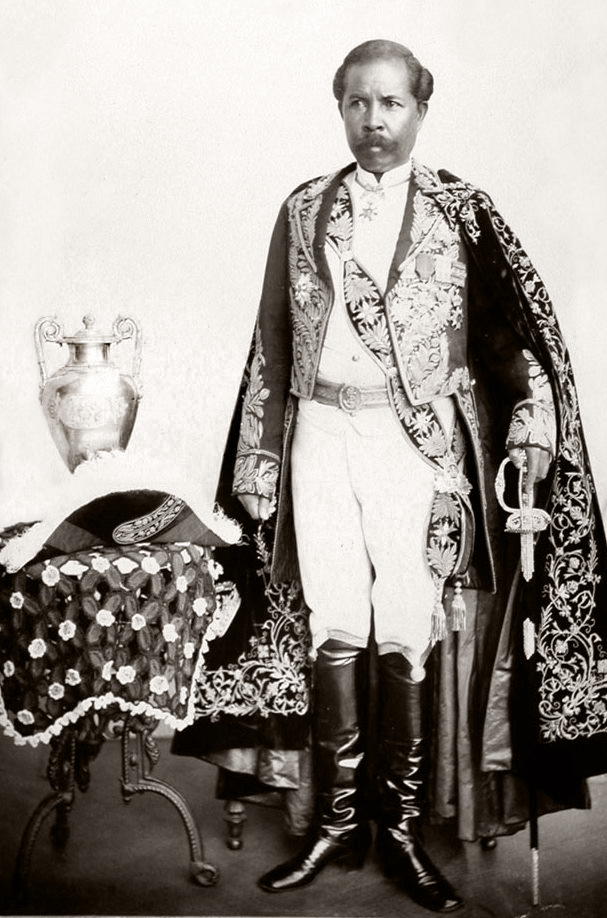
Below is a description of Rainilaiarivony, the Prime minister of the Kingdom of Madagascar, in 1868, by a Frenchman. As you remember, this was a man who was married to 3 queens: Rasoherina, Ranavalona II, and Ranavalona III. He was in reality the one holding the true power. He held that position for 31 years from 1864 to 1895, when the Kingdom of Madagascar became a French protectorate, and he was destituted, and sent to exile in Algeria.
====
Prime Minister Rainilaiarivony of Madagascar, ca 1880
Rainilaiarivony is of small height ; his hair is a bit kinky, the complexion is brown, mulatto, the mouth is thick, pronounced. He does not have the Malaysian [Austronesian] phenotype. He looks shy, embarrassed, and yet he is considered to have great willpower and remarkable eloquence. Moreover, this figure, of gentle appearance, is as if closed, the furtive glances convey a distrust which always dominates in men who think themselves constantly threatened, from inside as well as from outside,
Docteur Lacaze, from a note from G. Grandidier, Les Africains, Editions J.A., Vol 5, p. 310 (1977). Translated to English by Dr. Y., Afrolegends.com
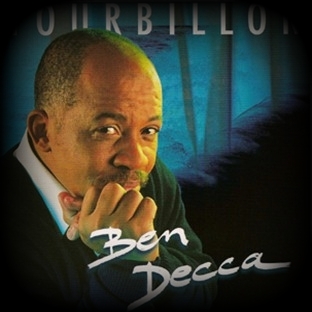
For this year’s Valentine, we will introduce you to “Souffrance d’Amour” by the Cameroonian singer Ben Decca. The song, “Souffrance d’Amour” translated as “Love suffering” tells of a love so deep, so strong between two people, but which does not work. So it is, in the words of Ben Decca himself, “proof that two people can go their separate ways and remain in love despite everything. “Souffrance d’Amour” is a shout-out to people who give themselves entirely to the other with sincerity and loyalty, but unfortunately, in general they receive the opposite of what they put in… sad reality…” [“Souffrance d’Amour” est la preuve que deux personnes peuvent se quitter et demeurer amoureuses l’une de l’autre malgré tout. Souffrance d’Amour” est une dédicace aux personnes qui se donnent à l’autre entièrement avec sincérité et loyauté, hélas en général ils reçoivent l’opposé de ce qu’ils ont misé… triste réalité…]. “To love is to forget oneself and to think only of the one we love” [“Aimer c’est s’oublier soi-meme, et ne penser qu’a celui qu’on aime…”]
For those who do not know him, Ben Decca, he is the ultimate crooner of Cameroon… You could think of a Luther Vandross type… His career spans over 40 years of constantly amazing music. He is a pure talent, and hails from a family of musicians, with 3 younger siblings who are also renowned singers Grâce Decca, Dora Decca, and Isaac Decca, and nephew to the great Cameroonian legend Eboa Lotin, and great grandson to Lobe Lobe Rameau one of the pioneers of Makossa in Cameroon. His work has been the legendary, and he has lightened to lives of so many of us lovers of life, given life to our feelings of joy, pain, grace, hurt,…. Kudos to the great, and only Ben Decca.
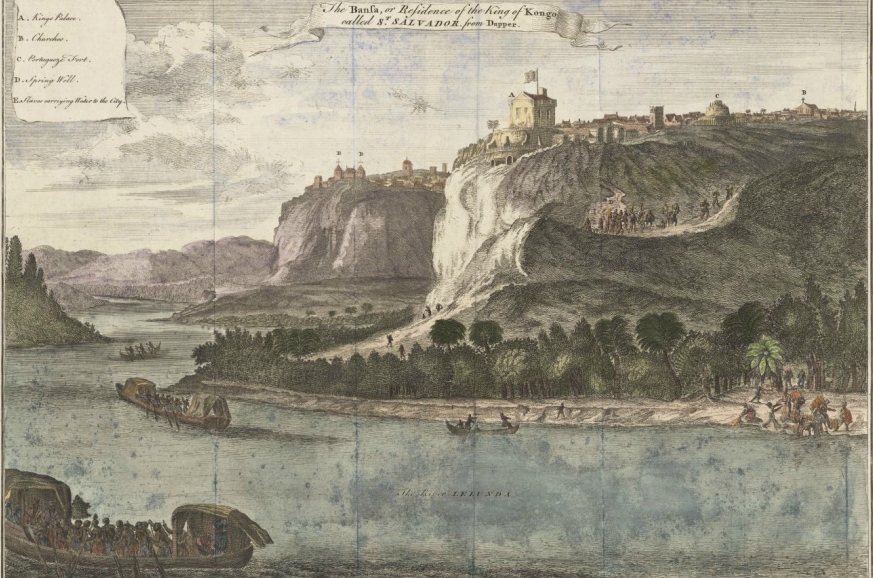
Mbanza Kongo, capital of the Kingdom of Kongo, in 1745
King Mvemba a Nzinga, most commonly known as Afonso I of Kongo, or Nzinga Mbemba, was a Kongo king who ruled over the Kongo Empire from 1509 to late 1542 or 1543. He wrote a letter in 1526 to the Portuguese king decrying the capture of his subjects to be taken as slaves in the transatlantic slave trade. The Portuguese were also assisting brigands in Kongo and illegally purchasing free people as slaves. This letter contradicts the story that African kings sold their own into slavery, as has been re-told countless times in history books; moreover, this is also similar to Queen Nzingha‘s stance against slavery a century later; she fought almost 40 years against the Portuguese for the freedom of her people. Afonso I of Kongo wrote:
=====
“Each day the traders are kidnapping our people – children of this country, sons of our nobles and vassals, even people of our own family. This corruption and depravity are so widespread that our land is entirely depopulated. We need in this kingdom only priests and schoolteachers, and no merchandise, unless it is wine and flour for Mass. It is our wish that this Kingdom not be a place for the trade or transport of slaves.”
Many of our subjects eagerly lust after Portuguese merchandise that your subjects have brought into our domains. To satisfy this inordinate appetite, they seize many of our black free subjects…. They sell them. After having taken these prisoners [to the coast] secretly or at night….. As soon as the captives are in the hands of white men they are branded with a red-hot iron.
Afonso was also concerned about the depopulation of his kingdom through the exportation of his own citizens into slavery. The king of Portugal responded to Afonso’s concerns, writing that because the Kongo purchased their slaves from outside of the kingdom and converted them to Christianity and then intermarried with them, the kingdom probably maintained a high population and probably was not affected by the missing subjects. To lessen Afonso’s concerns, the king [of Portugal] suggested sending two men to a designated point in the city to monitor who was being traded and who could object to any sale involving a subject of Afonso’s kingdom. The king of Portugal then wrote that if he were to cease the slave trade from the inside of the Kongo, he would still require provisions from Afonso, such as wheat and wine.
I found this really good video on the story of the last monarch of the Kingdom of Madagascar, Queen Ranavalona III. It is a short documentary, very well done with footage from those years… As you can see the queen had a gentle nature, and calm resolve around her. She was also beautiful and fashionable. A tiny note, in the video, it is said that Princess Marie-Louise Razafinkeriefo, heiress to the queen, was the daughter of Ranavalona III’s sister. In reality, Marie-Louise was the grand-daughter of the Queen’s sister Princess Rasendranoro, and was born in exile. Her mother was Princess Razafinandriamanitra, a daughter of Princess Rasendranoro and a niece of Ranavalona III. Please enjoy!
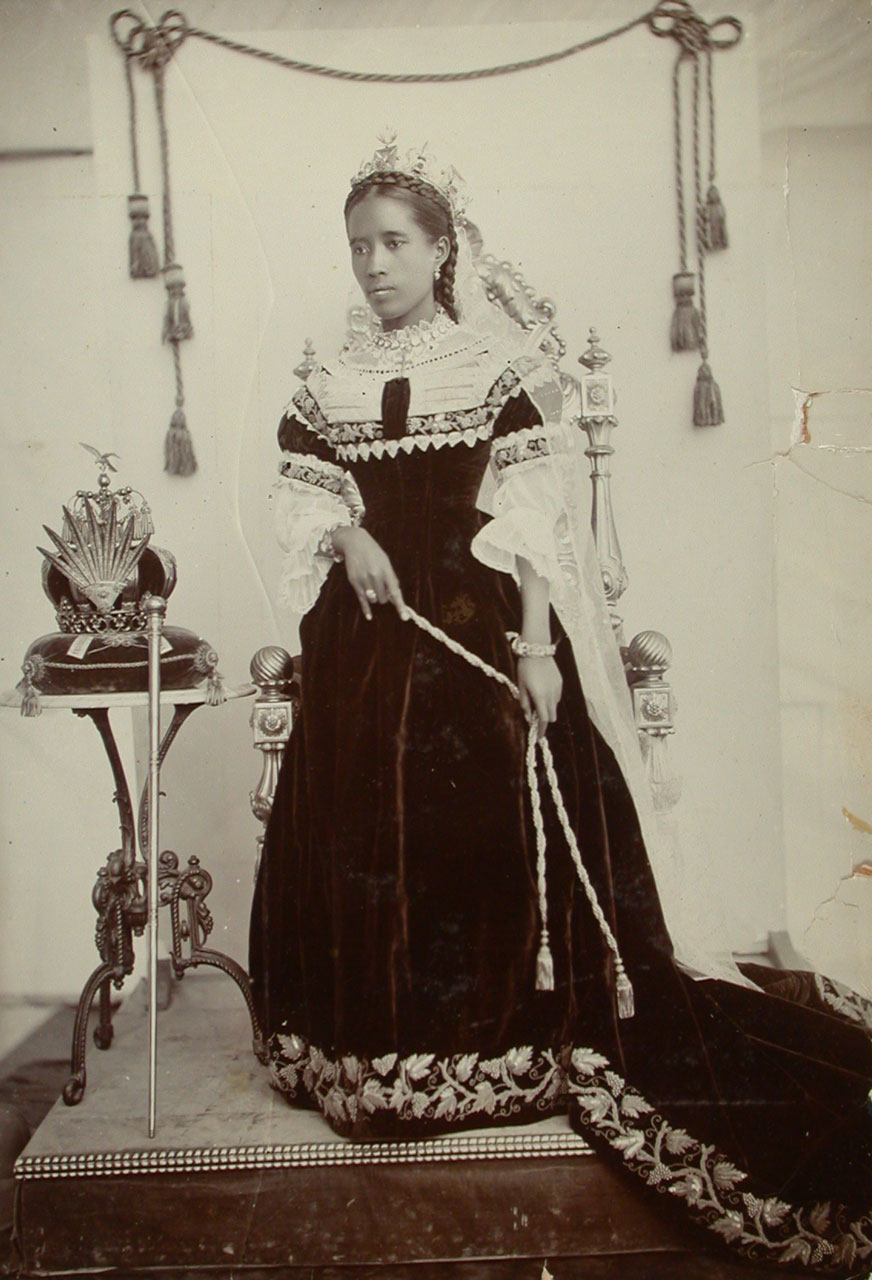
Queen Ranavalona III in full regalia, standing beside a throne table on which are the Royal crown and sceptre, ca 1890 – 1895
Last December, there was an auction in England of Queen Ranavalona III, the Last Monarch of the Kingdom of Madagascar photographs, letters, and fashion belongings. These were collected by Clara Herbert, who worked for the Madagascan royal family from the late 1890s to the 1920s, and were passed down through her family, and ended up in the attic of a house in Surrey. Auctioneer Kerry Taylor pieced together Ranavalona’s story from the box of photographs, postcards, souvenirs, receipts and diaries and sold them on auction. The government of Madagascar was able to purchase a lot of it. I was quite moved because this is part of the history and pride of Madagascar, and I am glad the government of Madagascar worked to have it returned. Enjoy! Excerpts below are from an article from The Guardian.
======
An archive of fashion, photographs and letters telling the remarkable story of the last queen of Madagascar will return home after it was bought at auction by the island’s government.
The jumble of ephemera, along with an ornate 19th-century dress, all relates to the life of Queen Ranavalona III, who was dethroned by the French and exiled to Algiers.
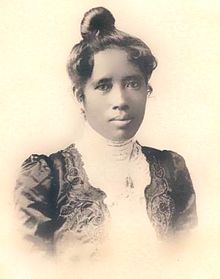
Queen Ranavalona III of Madagascar
… The president of Madagascar, Andry Rajoelina, said: “Madagascar attaches great importance to the acquisition of these royal items as part of the reappropriation of Malagasy national history and cultural heritage. They will be installed in the newly reopened, restored Queen’s palace, where they will be displayed to the general public.”
… Taylor [the auctioneer] said she was delighted the archive was heading to Madagascar. … “The queen and princess were separated during their lifetimes from their people and it gives me enormous satisfaction to know that this collection will soon be on its way home where it will be fully appreciated, admired and cared for in perpetuity.”
Today we will talk about the last queen of the Kingdom of Madagascar, Queen Ranavalona III. She reigned from July 30, 1883 to February 28, 1897. Like many African kings and queens of the late 1800s and early 1900, she was deposed by the European colonizer, in this case the French, and sent into exile first on the island of Reunion, and then later in Algeria (just like the King of Dahomey, Béhanzin) where she died, never to see her native Madagascar again.
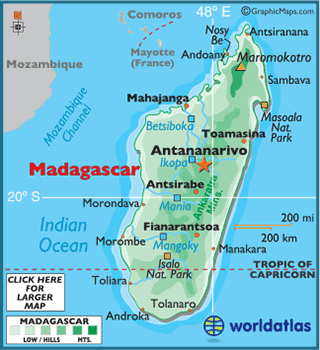
Map of modern-day Madagascar
Who was Ranavalona III? Well, as her name goes, she was the third Malagasy queen with the name Ranavalona. She became queen after the death of her grand-aunt, queen Ranavalona II. Ranavalona III was born Princess Razafindrahety in 1861. She was raised as a protestant, and taught by instructors from the London Missionary Society. Upon completion of her education, she married nobleman Ratrimo, but he died under suspicious circumstances in May 1883, just 2 months after Queen Ranavalona II’s passing. Rumor had it that the prime minister Rainilaiarivony had poisoned her husband, Ratrimo so as not to relinquish power. The young princess then ascended the throne of Madagascar at the tender age of 22, on July 13, 1883. It is said that she was chosen over her older sister, Rasendranoro, because of her conciliatory nature which the prime minister and other members of the Andriana looked for.
Prime Minister Rainilaiarivony of Madagascar
At the time of Ranavalona III’s ascension, Madagascar was navigating a shift from absolute rule (power in the hands of the king/queen) to constitutional monarchy. Under the new system, true authority was vested in the prime minister: in this case, Rainilaiarivony, who secured his grasp on power by marrying the newly crowned—and recently widowed—queen. In accordance with tradition, Rainilaiarivony had previously wed both of Ranavalona III’s predecessors, Ranavalona II and Rasoherina. Lucky man, wouldn’t you think? One man married to 3 successive queens! Probably the only one in history (this will be the story for another day)! Rainilaiarivony largely oversaw the day-to-day governance of the kingdom and managed its foreign affairs.
Illustration of France implanting its protectorate on Madagascar
As a queen, Ranavalona III inherited a kingdom which was assaulted by the French who wanted her country to be part of their protectorate. Throughout her reign, she tried to strengthen trade and diplomatic relations with the United States and Great Britain, in an effort to keep the French at bay. In 1886, the queen solicited U.S. intervention to help protect Madagascar from the French but was ignored. She, like many kings and queens of Africa back then, was probably not aware of the scramble for Africa, and the Berlin Conference (Selection from the 1885 Berlin Conference Final Act, The Berlin Conference 1884 – 1885 – Final Act (Continuation)), where Europeans allocated areas of the continent to themselves. She was forced to sign a treaty that gave France a certain control of Madagascar in order to prevent war, but the French wanted full control over Madagascar and did not back down. Ranavalona III successfully kept the French at bay until 1896 when the French declared Madagascar as their colony. Repeat French attacks on coastal port towns and an assault on the capital city of Antananarivo ultimately led to the capture of the royal palace in 1895, ending the sovereignty and political autonomy of the century-old kingdom (French Colonial Treaty in Madagascar : 18 January 1896).
Queen Ranavalona III
The newly installed French colonial government promptly exiled prime minister Rainilaiarivony to Algiers, Algeria. Ranavalona and her court were initially permitted to remain in Madagascar as symbolic figureheads, but the outbreak of a popular resistance movement – the menalamba rebellion – and discovery of anti-French political intrigues at court led the French to exile the queen to the island of Réunion on February 27, 1897.
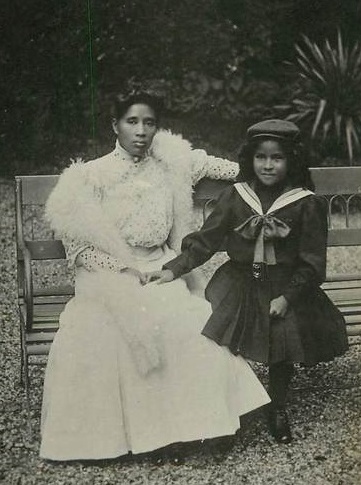
Queen Ranavalona III with her grandniece Marie-Louise ca 1905 in exile in Algiers, Algeria
Rainilaiarivony died that same year in Algiers, and shortly thereafter Ranavalona was relocated to a villa in Algiers, along with several members of her family. Despite Ranavalona’s repeated requests, she was never permitted to return home to Madagascar. Like many African kings and queens, she was deported (Deportation of African Heads of States). She died of an embolism at her villa in Algiers on May 3, 1917 at the age of 55. Her remains were buried in Algiers but were disinterred 21 years later and shipped to Madagascar, where they were placed within the tomb of Queen Rasoherina on the grounds of the Rova of Antananarivo (Rova de Manjakamiadana). you remember Queen Ranavalona III, remember that she was a queen who fought against the foreign invasion to the best of her ability, but above all remember that all she wanted was the independence of her people and culture.













 African Heritage