Has anybody ever heard of Lovinjitis? It is a sickness that catches you unaware… it can catch you anywhere, anyhow, and without notice… It is a disease of the heart: it pierces your heart and there is no way to avoid it. When you suffer from Lovinjitis, you are love struck. Here are the symptoms of Lovinjitis: sometimes you laugh by yourself, sometimes you cannot sleep, and you really desire the contact of that special one … you cannot wait to get home to see that one, you feel a genuine rush when you are with them, you cannot get them out of your head, they embalm your every thought, you are more open to new ideas and activities, you are planning the future with them, … . In short, you are in love!
Wizboyy Ofuasia, in collaboration with Teeyah, says it all and introduces you to Lovinjitis! This song is so good… the melody so good that it will make you suffer from Lovinjitis instantly! Happy Valentine day to all of you, and lots of love to everyone… today is the day to celebrate love, not just the valentine love, but the regular love, acknowledge our loved ones and be good to earth’s children!
During the last elections held on 30 December 2018 in the Democratic Republic of the Congo (DRC), Félix Tshisekedi was pronounced winner . He defeated another opposition leader, Martin Fayulu, as well as Emmanuel Ramazani Shadary, who was supported by term-limited outgoing president Joseph Kabila. Immediately, the ‘international community (I.C.)’ pounced on Tshisekedi claiming that he could not have won, and that it was but Martin Fayulu the second who had won. There were even threats by the ‘international community’ via the French government through her Ambassador to the Congolese government. Tshisekedi’s victory has since then been upheld by the constitutional court of the DRC, and he was installed as president on 24 January 2019.
Maurice Kamto (Maurice Kamto Facebook page)
In Cameroon, the story is a fair tale. After the 7 October 2018 presidential elections, opposition candidate Maurice Kamto, from all indications, came out winner of the elections against outgoing president, Paul Biya, who has been in power for the past 37 years… It was total silence by the I.C., in the case of Cameroon, who saw nothing wrong with a man who had been in power 37 years! They clapped and called those elections a standard of democracy! In the western media, there was no mention of Maurice Kamto, and the international community saw nothing wrong with the results of a presidential election being read 2 weeks after polling took place! This is the same international community that was so eager to get the results out in a timely manner in other countries such as the DRC, Madagascar, etc. Yet, Maurice Kamto won the elections and no mention of what happened to him took place. For Kabila in the DRC, the international community, via its medias, spent long time telling the world how Kabila had been in power for 18 years, and how anti-democratic that was. Yet in Cameroon, Paul Biya has been in power for 37 years, and they are clapping and calling the electoral hold-up democratic!
Map of Cameroon with all its regions
Since then, Cameroon has further descended into the abyss that it slipped into 37 years ago. Not only is the Cameroon territorial integrity in question: Boko Haram in the North has cut off the 2 northernmost regions from the rest of the country, the 2 English-speaking regions are cut off from the country ; in the East of the country, armed bands coming from the Central African Republic (CAR) are terrorizing the population, and in the Adamawa Region, armed groups coming from CAR are kidnapping people for ransom including traditional chiefs and stealing cattle; there are refugees both inside and outside the country, and post-electoral violence has ushered in a profound exacerbation of tribalism leading to the politics of divide-and-conquer. It looks like the ultimate objective is dividing Cameroon, like in Sudan, with an exacerbation of ethnic differences with a further push toward chaos for better exploitation of the country’s resources and emptying it of its youths.
Paul Biya, President of Cameroon
If the I.C. can scream for DRC, and publish articles about Martin Fayulu being the winner in its media the day after publication of results, with the catholic church complaining about results, why does it not show any indignation or some concern for Cameroon? How can a 37-year-old rulein Cameroon be applauded and referred to as being democratic by the I.C., while an 18-year rule in DRC is called a dictatorship? Why is 85-year-old Paul Biya’s 37-year rule being applauded when Mugabe in Zimbabwe was vilified? How can Biya, with nothing to show for his stewardship, not even the integrity of his territory, not even roads, but total chaos and backwardness, be applauded by BBC, RFI, The Guardian, and France 24? How can a president purposely destroy its country including its resources and be applauded by this so-called democratic I.C.? Well, because he serves the interests of the I.C., and has been a good student and puppet in helping the I.C. pillage the resources of his country. Cameroon is so rich in natural resources: oil, cocoa (6th producer), coffee, natural gas, gold, diamond, etc. In the robbery that is so synonymous with France’s predatory behavior in Africa (particularly in its so called “pré-carré”), why should this be a surprise? France’s nature in Africa, and the I.C.’s in general, has been and remain predatory.
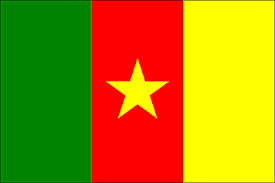
Flag of Cameroon
In Cameroon today, there is a strong dictatorship. The mafia that is synonymous with this regime has been repressing in blood all peaceful demonstrations and marches for the upholding of the genuine electoral results. All protest marches calling for the electoral records to be published are either banned or have seen the winner of the elections Maurice Kamto and his team arrested, including many innocents who have been screaming for a change, for a chance to have better life, roads, jobs, better healthcare, etc. People in the English-speaking provinces have been, hurt, beaten or killed, for simple claims which are basic human rights. A lot of them are currently displaced… people in the north provinces have been displaced, and hurt by Boko Haram… yet BBC, RFI, and the likes of them say nothing! Instead they applaud a government which refuses to negotiate with its own people. We do not ask them to intervene, but if those medias are supposed to be impartial, then they should be impartial, otherwise they should clearly state their agenda: portrayal of Africa as poor and in need of help, pillaging of African resources, promotion of wars on the African continent to help their cronies those western multinationals destroy and get all resources for nothing.
Thomas Sankara a Ouagadougou
We, Africans, should recognize that we are not, and never were independent. We should protest and fight pacifically like this is our last fight.A mother sending her child to school, a father being able to feed his family, university graduates finding jobs in countries where everything is yet to be built, roads, water, electricity, basic human rights to respect, all of that are rights… and it looks like we will have to earn them ourselves. Like Thomas Sankara said, “the slave who is not capable of assuming his rebellion does not deserve that we feel sorry for him. This slave will respond only to his misfortune if he is deluding himself about the suspect condescension of a master who claims to free him. Only struggle liberates…[ …l’esclave qui n’est pas capable d’assumer sa révolte ne mérite pas que l’on s’apitoie sur son sort.Cet esclave répondra seul de son malheur s’il se fait des illusions sur la condescendance suspecte d’un maître qui prétend l’affranchir.Seule la lutte libère …(Discours de Sankara à l’ONU le 4 octobre 1984 (texte intégral) Speech delivered on October 4, 1984 during the UN general Assembly)].” DO NOT trust this condescending I.C., DO NOT trust their media that is very partial, and were all against Laurent Gbagbo, who today has been acquitted from crimes invented by this I.C. and its cronies. We have to fight for our own rights, our own freedom, acknowledge that we are in charge of our own destinies, and never expect some partial Western media to report on the truth!
Rubies mined by Gemfields in Mozambique (businesslive.co.za)
This is a first, and I had to share the article. The precious gemstones miner Gemfields has agreed to pay £5.8 million (about $7.8 million) to community members residing near its Montepuez ruby mine in Mozambique, in a “no admission of liability” move that settles a claim of human rights abuses brought against it by locals. Security forces employed by the miner had shot, beat and subjected its clients to humiliating treatment and sexual abuse. I applaud this outcome for the communities and the work of the law firm who fought this, and I also wonder, given that Mozambique gems are now gaining ground because of their higher quality compared to the usual providers (Rise of the Mozambican Ruby), what will be the effect on the gems’ price in Mozambique? how many times have you seen a European firm settle victims in Africa? For the full article, go to: Mining.com and Journal du Cameroun.
=======
The United Kingdom mining firm, Gemfields, has agreed to pay£5.8 million to 273Mozambicans who alleged they were victims of human rights violations at its Montepuez ruby mine in the northern province of Cabo Delgado, APA can report on Wednesday. Gemfields, which is the majority shareholder in Montepuez Ruby Mining Ltd (MRM) has settled the claim on a “no-admission-of-liability basis” and acknowledged that “in the past, instances of violence have occurred on and around the MRM licence area, both before and after Gemfields’ arrival in Montepuez”.
The British legal company Leigh Day, which represented the273people in a class action, also recognised that “Gemfields has taken the claimant’s allegations seriously and has been proactive and constructive in addressing the wider issues raised by local communities through this case”.
Montepuez is an open-pit mine, considered the world’s most lucrative ruby operation. (Image courtesy of Gemfields. Mining.com)
Last February, Gemfields noted that the claim alleges that Gemfields and MRM are liable for human rights abuses including the deaths and mistreatment of artisanal miners and the seizure of land without due process.
… In addition to settling the claim through mediation, Gemfields has agreed to providehalf a million poundsto establish further community projects to improve the long-term agricultural productivity and livelihoods of residents of Ntoro and Namucho.
It also agreed to establish an independent grievance mechanism for people to obtain a timely response to complaints.
This will be overseen by international experts.
Gemfields’ chief executive Sean Gilbertson stressed that “we wish to ensure that we are regarded as trusted and transparent partners to members of our local communities, rather than legal adversaries”.
According to Leigh Day’s Daniel Leader, the settlement “provides significant redress to our clients and importantly puts in place a credible and independent mechanism for providing remedy to those we have been unable to represent.
These incidents should never have happened. However, we commend Gemfields for engaging constructively to resolve this case promptly and for putting in place an independent grievance mechanism”. …
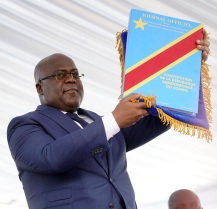
Felix Tshisekedi on investiture day 24 January 2019
On Thursday January 24th 2019, the Democratic Republic of the Congo saw a new day: the investiture of Félix Antoine Tshilombo Tshisekedi marked the first peaceful transfer of power in the history of the DRC in 60 years, since the Belgium granted it independence. This marked a great day not only for the DRC, but for Central Africa, and for Africa as a whole. Felix Tshisekedi won the presidential elections in DRC, which were also entirely funded by the country itself under the leadership of President Joseph Kabila … this is also a first in the nation’s history and the history of many countries on the African continent. So in clear, this was an election of the Congolese people for the Congolese people, entirely funded by the Congolese themselves.
Tshisekedi said, “We want to build a strong Congo in its cultural diversity.” He further declared, “We will promote its development in peace and security. A Congo for each and everyone, where everybody has his or her own place.”
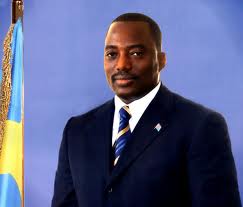
Joseph Kabila, outgoing President of DRC
Felix Tshisekedi is the son of Étienne Tshisekedi, a longtime beloved opposition leader who died in 2017, and has benefitted from the legacy his dad built. Tshisekedi is taking over the presidency from Joseph Kabila, the DRC’s president since 2001.
I take the time here to salute President Joseph Kabila who has allowed, by his selfless resolve to protect the Democratic Republic of the Congo. Joseph Kabila recently outlined some his achievements during his tenure of office, including the organization and total funding of the last democratic elections in 59 years, the construction of new infrastructures, the restoration of peace and the reunification of the country, and the financing of its own elections, and the peaceful passing of the banner to Felix Tshisekedi.
I live you here with Joseph Kabila’s last speech as President, and the passing of the baton, investiture of Felix Tshisekedi.
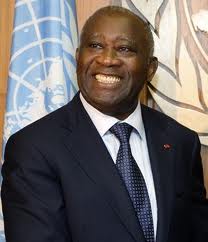
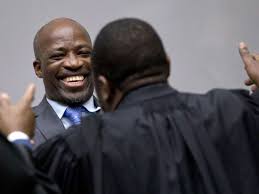
Joy is in our hearts! It has taken us 8 years but we have overcome, or rather Laurent Gbagbo and Charles Blé Goudé (How long shall they kill our prophets…?)have overcome. The hour is to joy, and gratitude, because truly perseverance has been their motto for the past few years. All these tough years of claiming their innocence, all these years of constant support and people’s prayers, dedication, love, and determination have born fruits. Yesterday, January 15th 2019, Laurent Gbagbo and Charles Blé Goudé were acquitted of war crimes at the ICC. I rejoice in this step forward. I live you with snippets of the article from the NPR below. In latest news, the prosecution is trying to bar Gbagbo and Blé Goudé from returning to their home country of Côte d’Ivoire, and instead wants to keep them roaming through in Europe: this is another case of Deportation of African Heads of States. We will keep fighting to the last drop! As Agostinho Neto said: “La luta continua e la victoria e certa!”
====
Charles Blé Goudé celebrating with his legal team on 01/15/2019 (SkyNews)
A panel of judges at the International Criminal Court has dismissedcharges of war crimesagainst former Ivory Coast President Laurent Gbagbo, the first former head of state to stand trial at the ICC. Charges against his former youth minister, Charles Blé Goudé, also were dropped.
[…] A majority of the three-judge panel concluded that prosecutors had failed to show that there was a “common plan” to keep Gbagbo in power, nor “the existence of patterns of violence from which it could be inferred that there was a ‘policy to attack a civilian population,’ ” the court said in a press release.
Public speeches by Gbagbo and Blé Goudé did not constitute ordering, soliciting or inducing the alleged crimes, the judges said – adding that they needed no further evidence from the defense.
[…] After refusing to hand over power, Gbagbo was pulled from an underground bunker at the presidential residence in Abidjan in April 2011, and thenwhisked to The Haguein November 2011. He was held in custody for more than seven years.
Fellow readers, we wish you all an AMAZING new year. May the year 2019 mark the beginning of new chapters, the fulfillment of some, and also the closure of old ones. May this new year bring you a lot of joy, may your dreams be fulfilled, and last a lifetime.We would like to express our profound gratitude for your constant support, as your readership has carried us forward. Thank you to all those who visited the blog, reblogged articles, commented, corrected us, and to all future visitors. 2018 was a beautiful year: Afrolegends.com had lots of views, subscribers, contributors, and many articles reblogged on multiple sites.
Happy 2019!
The top 6 posts of 2018 are listed below. For this new year, 2019, we will bring you even more amazing, fun, and rich articles. Keep trusting, reading, sharing, reblogging, and liking. We wish you all a beautiful, full, and amazing new year, rich in blessings, and rich in greatness. May 2019 be the year of greatness!Keep your heads up, and may your year be as bright and plentiful as the petals of this flower! As always, like Agostinho Neto said, “A luta continua … a vitória é certa!”
Who or what did we celebrate in 2018 in Africa. Here are 10 people, events and things, which marked the year 2018 (if there are some other you would like to share, please send them in):
Sahle-Work Zewde, Ethiopia’s first female president, with the Prime minister Abiy Ahmed, on the day she was elected
1. Abiy Ahmed Ali became prime minister of Ethiopia this year, and brought in a wave of new measures. He is particularly noted for ending decades of border disputes between Eritrea and Ethiopia, bringing in the 2 sisters back together, releasing thousands of political prisoners and for having half of his government made up of women, some in key positions including the ministry of defense.
2. Ethiopia welcomed its first female president in the person of Sahle-Work Zewde. Mrs. Zewde was unanimously elected president by members of the Federal Parliamentary Assembly on 25 October 2018. Sahle-Work’s appointment makes her the first female Ethiopian head of state since Empress Zewditu.
3. Peace between Eritrea and Ethiopia. Peace at last with the end of the border dispute in June and July of this year, marking the end to decades of tension between the 2 sisters.
4. The release from jail of Simone Gbagbo. The former first lady of Côte d’Ivoire was released on 8 August 2018, after 7 years in prison. We are so grateful; it took us 7 years, but Simone is free at last. Free at Last: Simone Gbagbo Liberated.
10. Not sure whether to applaud this or not: Major museums across Europe have agreed to loan important artifacts back to Nigeria for a new museum the country plans to open in 2021 (Europe’s Largest Museums to “Loan” Looted Benin (Nigerian) Artifacts back to Nigeria). How someone can loan you something they stole from you is beyond me! They should just return it!
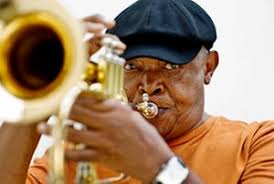
The trumpetist Hugh Masekela… no more “Strawberries” for me… but I still love dancing to the sound of the “The Boy is doing it!“. His genius, spirit and music remain with us. So Long to Africa’s Jazz Maestro: Hugh Masekela
We said goodbye to the name ‘Swaziland‘ for the country Swaziland, and welcomed Eswatini, officially known as the Kingdom of Eswatini.
The world said goodbye to Aretha Franklin, the African American singer, who reveled us with ‘I say a little prayer for you‘, ‘Respect‘, and so many other hit tubes.
Over 200 people lost their lives when a ferry capsized on Lake Victoria, in Tanzania. This marked the second-most deadliest ferry disaster in Tanzania.
Last week I published a poem by Sarah Anyang Agbor about the Anglophone plight in Cameroon, and the fact that Anglophones as any other children of Cameroon are treasured children of the nation and also ‘sing Cameroon’. Given that the history of Cameroon is so intertwined with that of the European colonizer: first becoming a German colony, then after Germany lost World War I, being divided into 2 and shared between France and Great Britain (the spoils of war, I guess), I have decided to publish here a few notes on German protectorates on the West Coast of Africa from 1884 to 1890. Note below that Cameroons, in the Ambas Bay section, refers to Cameroons Town which was the name for present-day Douala, Cribyrefers to the city of Kribi, while Victoriarefers to present-day Limbe in the country Cameroon. Porto Seguro is now Agbodrafo and Little Popo is now known as Anéhoin Togo. South-Western Africarefers to present-day Namibia.
=====
NOTES on German Protectorates on the West Coast of Africa 1884—1890, Map of Africa by Treaty vol 2, P. 694.
Togoland in 1908 (R. Hellgrewe)
Togoland.
On the 5th July, 1884, an Agreement was signed between Germany and Togo, by which the territory of the King of Togo, situated on the West Coast of Africa, from the Eastern frontier of Porto Seguro to the Western frontier of Lome or Bay Beach was placed under the Protectorate of Germany.
Cameroons. Togoland. Slave Coast, &c.
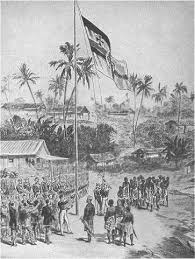
On the 12th July, 1884, a German Protectorate was proclaimed over the whole of the Cameroons District, and on the 15th October of the same year†, the following official communication was made by the German Government to the principal Powers of Europe and to the United States Government, notifying the exact extent of territory on the West and South-West Coasts of Africa which had been placed under the protection of the German Empire :—
Baron von Plessen to Earl Granville.
(Translation.) German Embassy, 15th October, 1884.
Gustav Nachtigal
“The Government of His Majesty the Emperor, with a view to insure more effectually German commercial interests on the West Coast of Africa, has taken certain districts of this coast under its protection. This has been effected in virtue of Treaties which have been in part concluded by Dr. Nachtigal, the Consul-General dispatched to West Africa, with independent Chiefs, and partly in virtue of applications for protection made by Imperial subjects, who have acquired certain tracts by covenants with independent Chiefs.
“Accordingly, the Togo tract, with the harbours of Lome and Bageida, the districts of Bimbia, with the Isle of Nicol, Cameroons, Malimba, to its northern extremity, Little Batanga, Plantation, and Criby, on the Slave Coast, and the tract of coastland between Cape Frio and the Orange River, with the exception of Valvisch (Walfish) Bay, in South-Western Africa, have been placed under the protection of His Majesty the Emperor. This has been notified by hoisting the Imperial military standard and planting frontier poles, and the engagement at the same time announced that all demonstrable existing rights of third parties are to be respected.”
Ambas Bay, Victoria.
German flag on the Joss plateau in Cameroons Town (Douala) on 14 July 1884
On the 19th July, 1884, a British Notification was issued announcing the assumption of British sovereignty over Ambas Bay,* but this territory was transferred to Germany on the 28th March, 1887, since which date it has formed part of the German Protectorate over the Cameroons.
Mahin and Mahin Beach.
On the 29th January, 1885, Mahin was sold by the King of Mahin to a German subject, Herr G. L. Gaiser ; and on the 11th March, 1885, a Treaty was signed by the King of Mahin with the German Commissioner and Consul-General for the West Coast of Africa, Dr. Nachtigal, for extending a German Protectorate over Mahin and Mahin Beach, but it was not ratified by the German Emperor ; and on the 24th October following, both Mahin and Mahin Beach were ceded to Great Britain.
Bight of Biafra, Slave Coast (Togoland, Little Popo, and Porto Seguro), Senegambia, and Southern Rivers Districts.
On the 24th December, 1885, a Protocol was signed between France and Germany, for defining their respective rights of Sovereignty or Protectorate in the Bight of Biafra, on the Slave Coast (Togoland, Little Popo, and Porto Seguro), on the Coast of Senegambia, and in the Southern Rivers Districts.
British and German Limits.
On the 1st July, 1890, an Agreement was entered into between the British and German Governments defining their respective spheres of influence in East, West, and South-West Africa. With respect to the West Coast, the line of boundary was marked between the British Gold Coast Colony and the German Protectorate of Togo, the Volta Districts, and the Rio del Rey.
† “ National Zeitung,” 15th February, 1885. S.P., vol. lxxvi, p. 756,
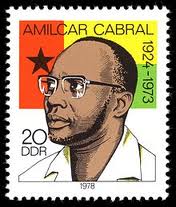
Amilcar Cabral on a stamp with the flag of Guinea Bissau
It so happens that in our country the Portuguese colonialists did not expropriate the land; they allowed us to cultivate the land. They did not create agricultural companies of the European type as they did, for instance, in Angola, displacing masses of Africans in order to settle Europeans. We maintained a basic structure under colonialism – the land as co-operative property of the village, of the community. This is a very important characteristic of our peasantry, which was not directly exploited by the colonisers but was exploited through trade, through the differences between the prices and the real value of products. This is where the exploitation occurs, not in work, as happens in Angola with the hired workers and company employees. This created a special difficulty in our struggle – that of showing the peasant that he was being exploited in his own country.
Map of Guinea Bissau
Telling the people that “the land belongs to those who work on it” was not enough to mobilise them, because we have more than enough land, there is all the land we need. We had to find appropriate formulae for mobilising our peasants, instead of using terms that our people could not yet understand. We could never mobilise our people simply on the basis of the struggle against colonialism-that has no effect. To speak of the fight against imperialism is not convincing enough. Instead we use a direct language that all can understand:
Flag of Cape Verde
“Why are you going to fight? What are you? What is your father? What has happened to your father up to now? What is the situation? Did you pay taxes? Did your father pay taxes? What have you seen from those taxes? How much do you get for your groundnuts? Have you thought about how much you will earn with your groundnuts? How much sweat has it cost your family? Which of you have been imprisoned? You are going to work on road-building: who gives you the tools? You bring the tools. Who provides your meals? You provide your meals. But who walks on the road? Who has a car? And your daughter who was raped-are you happy about that?”
Amilcar Cabral on the need to personalize, and adapt the fight to his country’s realities.



















 African Heritage