Cheikh Anta Diop and the African Origin of Civilization

Cheikh Anta Diop
Cheikh Anta Diop

Cheikh Anta Diop was a great Senegalese historian, anthropologist, philosopher, physicist and politician.  He should be considered as one of the greatest scientists after Darwin, as he demonstrated that Africa was the cradle of humanity; that everything started in Africa, and that Egypt and modern day Africans descended from the same ancestors, in other words, were the same people.  Before Cheikh Anta Diop, the world, and Africans in particular, had been taught that Africa was nothing, and that Egypt and Egyptians were not Africans… that the great Egyptian civilization which gave so much to the world, could not have come from the dark brown Africans.  Europeans refused to admit that although in Africa, Egyptians could be Africans i.e. Black, or rather believed that Blacks were so backwards that their ancestors could not have possibly made the great pyramids of Giza or the great sphinx.  Well Cheikh Anta Diop proved them all wrong!

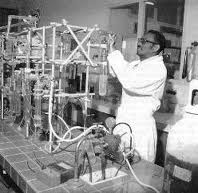
Cheikh Anta Diop in the laboratory

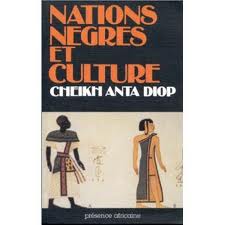
As a physicist, I was amazed to learn that Cheikh Anta Diop was a PhD student of Frédéric Joliot-Curie, the 1935 physics nobel laureate, and Marie Curie‘s son-in-law (first woman to receive a Nobel in Physics, and first to have two nobel prizes). So Diop’s pedigree, in physics terms, was quite impressive!  Moreover, he had earned two PhDs: one in history and the other in nuclear physics.  He was also the only African student of his generation to have received a training in egyptology. He was well-versed in prehistoric archaeology, and linguistics.  It took him almost a decade to have his doctorate degree granted: he submitted a thesis in 1951 which was based on the premise that the Egypt of the great pharaohs and pyramids was an African civilization– it was rejected.  He then published it in 1955, as Nations Nègres et Culture, and received world-wide acclaim.  Two additional attempts at submitting it were rejected, until 1960 when he finally managed to convince a room full of physicists, sociologists, anthropologists, egyptologists, and historians.  Having gone through the hurdle of submitting and defending a doctoral dissertation, I truly raise my hat to someone like Diop who had so much stamina and endurance, and could endure a decade of rejection like that; he was truly destined for greatness!

'Nations Negres et Culture' de Cheikh Anta Diop

In 1974, Diop managed to prove beyond a shadow of a doubt, that Egyptians were Black people.  He obtained pigment from Egyptian mummies and tested for their melanin content.  He was able to determine their melanin content accurately, and later published his technique and methodology for the melanin dosage test in scholarly journals.  This technique is used today by Forensic investigators around the world, to determine the “racial identity” of badly burnt accident victims.

He was affectionately known as the Pharaoh of knowledge, and the Université Cheikh Anta Diop (UCAD) of Dakar was re-named after him.  Check out CheikhAntaDiop.net a website dedicated to this great man, Wikipedia, Cheikh Anta Diop: The Pharaoh of Knowledge, and Africawithin.com.  Don’t forget to read his books: Nations Nègres et Cultures: de l’Antiquité Nègre Egyptienne aux Problèmes Culturels de l’Afrique Noire d’Aujourd’hui, The African Origin of Civilization: Myth or Reality, Precolonial Black Africa, Civilization or Barbarism: An Authentic Anthropology [Civilisation ou Barbarie: Anthropology sans Complaisance], and many others.

'The African Origin of Civilization' by Cheikh Anta Diop

Please watch one of the greatest African thinkers of the 20th century, and above all one of Africa’s greatest sons (… and renowned physicist). I salute this great soul who made us proud of being Africans, who re-define history or rather wrote History the way it should have been, with Africa in its right place, as the origin of civilization. If there was an African Pantheon for great minds, Cheikh Anta Diop’s remains should be in it!

‘My Name’ by Magoleng wa Selepe

African Savanna
African Savanna

I just thought about what happened to our fathers, mothers, grandmothers, and grandfathers during colonial times: to go to school African children were forced by European missionaries to adopt a christian name such as John, Peter (Jean, Pierre), etc… as opposed to their good old African name Nomzimo, Makeba, Ndoumbe, Keïta, etc.  Thus many Africans who would have just worn the name ‘Ndoumbe Mpondo‘ or ‘Binlin Dadié‘ or ‘Um Nyobé‘ had to adopt a European name such as John + their own name, such that they became: John Ndoumbe Mpondo or Bernard Binlin Dadié or Ruben Um Nyobé.  To this day, the tradition has remained… most Africans would have three or four names: their family name, and their given name, plus the European first name and in some cases a European middle name as well.  The poem below entitled ‘My name‘ by the South African poet Magoleng wa Selepe captures this very well.

My Name

Nomgqibelo Ncamisile Mnqhibisa

Look what they have done to my name……..

the wonderful name of my great-great-grandmother

Nomgqibelo Ncamisile Mnqhibisa

The burly bureaucrat was surprised

What he heard was music to his ears

‘Wat is daai, se nou weer?’

‘I am from Chief Daluxo Velayigodle of emalu podweni

And my name is Nomgqibelo Ncamisile Mnqhibisa.’

Messia, help me !

My name is simple

And yet so meaningful

But to this man it is trash…..

He gives me a name

Convenient enough to answer his whim…..

I end up being

Maria…..

I…………..

Nomgqibelo Ncamisile Mnqhibisa

by Magoleng wa Selepe

The Kanem-Bornu Empire: linking ancient Chad, Libya, Cameroon, Niger and Nigeria

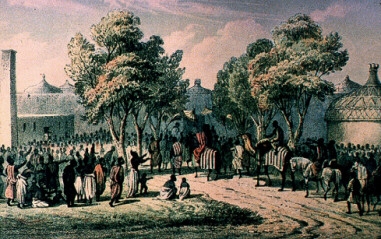
Kanem-Bornu court in the 1700s

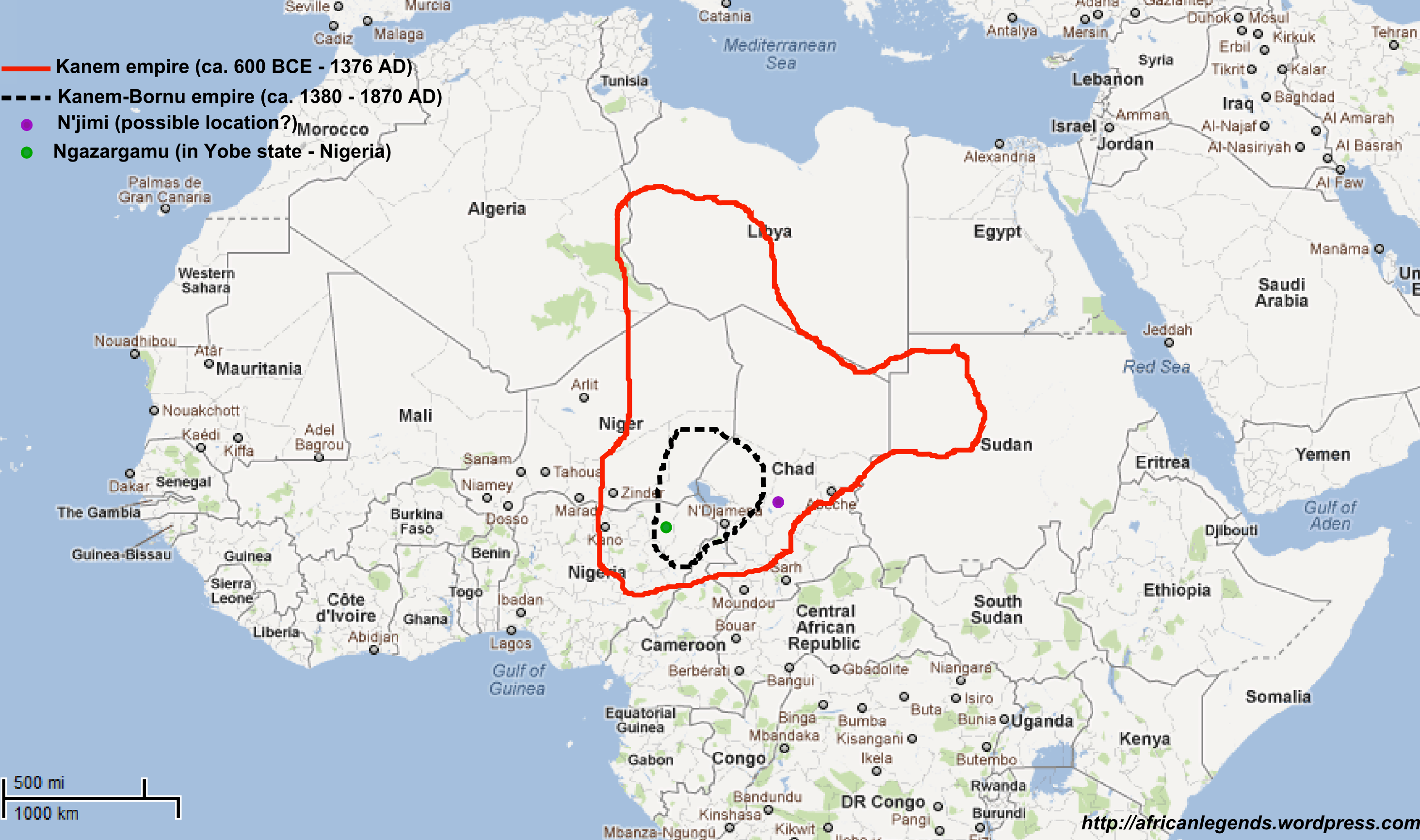
When the Zaghawa (people of Kanem) arrived in the area around Lake Chad, they found independent walled-cities states from the Sao civilization, a civilization which had flourished around the 6th century, with its center around the Chari river, south of Lake Chad.  The Zaghawa adopted some of the Sao customs, but fight among the two lasted from the 7th century until the 16th.  The conquest of Kanem by the Zaghawa was done under the Duguwa dynasty which was started by King Sef (also known as Saif… some people eager to change African history state that the Zaghawa were from Yemen… but we all know that they were local people) about 700 CE. The dynasty, Sayfawa or Sefuwa, is named for King Dugu, one of Sef’s sons, who was ruling about 785 CE.  Abandoning their nomadic lifestyle, the Zaghawa established a capital at N’Jimi (meaning “south” — the location of this town is still unknown, but it is believed to be around Lake Fitri).  Under the rule of Dugu, Kanem expanded to become an empire.  The Zaghawa kings, called maï, were regarded as divine and belonged to a ruling establishment known as the Magumi. They were recognized for a great amount of horses.  Kanem’s expansion peaked during the reign of Maï Dunama Dabbalemi (ca. 1221-59) and extended northward into the Fezzan region (Libya), westward into Kano (Nigeria), eastward to Ouaddaï (or Wadai), and southward into the Adamawa grasslands (Cameroon). They converted to islam around the 11th century CE.

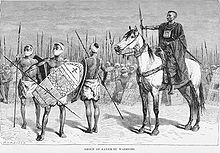
Group of Kanem-Bu warriors in the 1800s

By the end of the 14th century, internal struggles and external attacks had torn Kanem apart. Between 1376 and 1400, six Maïs reigned, but were killed by foreign invaders.  Finally, around 1396 the Bulala invaders forced the once strong Sayfawa dynasty to abandon Njimi and move to Bornu on the western edge of Lake Chad.  Around 1472, Maï Ali Dunamami fortified the Bornu state, and established the capital at Ngazargamu, which had more fertile lands. Over time the inter-marriage between the Kanembu and the Borno people created a new people, the Kanembu, and a language called Kanuri.

The Kanem-Bornu empire peaked during the reign of Maï Idris Alooma (ca. 15711603) who is remembered for his great military and diplomatic skills.  His main adversaries were the Hausa to the west, the Tuareg and Toubou to the north, and the Bulala to the east. One epic poem tells of his victories in 330 wars, and over 1,000 battles.  He was a true military genius, and some of his innovations included the use of fixed military camps (with walls), permanent sieges, and “scorched earth” tactics, armored horses and riders, the use of Berber camels, of skilled Kotoko boatmen, and of iron-helmeted musketeers trained by Turkish military advisers. He had very strong diplomatic ties with Tripoli, Egypt, and the Ottoman empire, which at some point sent a 200-member ambassadorial party across the desert to Alooma’s court in Ngazargamu.  The state revenues came from tribute from vassal states, trans-saharan trade route, and slave trade. Many products such as cotton, natron (sodium carbonate), kola nuts, ivory, ostrich feathers, perfume, was, and hides were exported north via the Sahara desert.

Map of the Kanem and Kanem-Bornu empires

By the end of the 17th century, the empire started declining, and by the 18th century, it only extended westward into the land of the Hausa. By the early 19th century, the declining empire could not sustain the advance from the fulani warriors of Usman Dan Fodio who proclaimed the jihad war against the non-muslims.

To learn more about the Kanem-Bornu empire, check out: Jamtan.com, Daily Kos- Ancient Africa, BlackPast.org, The empire by the lake. Don’t forget to check out the book “Kanem-Borno: One Thousand Years of Splendor (Kingdoms of Africa)”  by Philip Koslow.  Back in those days, Lake Chad covered an area of about 10,000 m2… today it has sadly shrunk down to 1,300 m2, and is still shrinking! I could not find a really good map of the Kanem or Kanem-Bornu empire, so I used Google maps  and known maps from history books to make my own with some of the boundaries cited earlier. I have overlaid the Kanem and the Kanem-Bornu empires on the same map to give a better idea. Enjoy!

The Baobab: Symbol of Power, Presence, Strength, and Grace

A baobab
A baobab

The symbol of my secondary school in Douala, Cameroon, was the Baobab tree.  In the old days, there were baobab trees everywhere in the school yard… by the time I arrived, there were only two left, and by the time I graduated, only one could be seen among all the mango trees that filled the school’s playground.  Found in African savannahs, the baobab is a tree which can grow as tall as 30 m, have a diameter as large as 15 m, and live for over several thousand years. I believe the ones in my school were at least a thousand years old. It is leafless during the dry season. A common description of the baobab is that it looks like it has been pulled from the ground, and re-planted upside down. It actually looks like this for a good reason: during the rainy season (wet months), the water is stored in the thick, corky, fire-resistant trunk to last throughout the dry and harsh season. The baobab flowers are white and luminous, and bloom for only a few hours, after which they fall to the ground leaving pods which are feasted on by baboons, monkeys, antelopes, and elephants. There is a tale about the rabbit and the baobab… which is very funny.

Fruit from baobab tree (source: Wikipedia)

The baobab’s leaves, bark, fruits, and trunk, are all very useful. The bark is used for clothes (just like the obom tree) and ropes, the leaves as seasoning in food or medicine, while the fruit (also known as “monkey’s bread“) is eaten directly or in porridge, or sold in some parts of Africa in a sugary mix as a snack; It is very rich in vitamin C and its fruit pulp is used to make juice. Its trunk will provide shelter for people as well as animals.

Baobab forest in Madagascar

In parts of Zambia and Zimbabwe, local traditions state that God was so displeased with the taste of the fruit of the baobab that it turned it upside down such that its roots were on top. I am not sure if I believe this, but in Cameroon, the baobab is a symbol of strength, power, grace, and presence! No wonder the Disney’s Lion King used the baobab as the tree of life… it is what it is: the tree of life, older than Christ and maybe even older or as old as the Egyptian pyramids! I think my school really embodied just that, it was the oldest secondary public school in the city of Douala, with the strongest records!

The video below is about the alley of baobabs in Madagascar: Enjoy!!!

Chinese presence in Africa in the 13th century and before

Zheng He
Zheng He

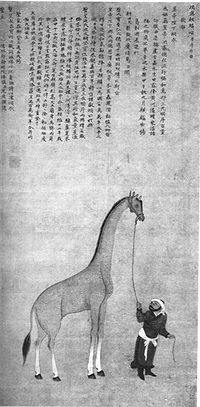
I always thought that since the Chinese invented the compass and the gunpowder, they should have been great navigators and explorers. I also always thought that they should have been among the first to navigate around the globe. What an amazing surprise when I learned that the most venerated Chinese maritime admiral Zheng He had reached the horn of Africa before Vasco da Gama, challenging the claim that VdG had been the first on the Eastern side of Africa. Indeed, Zheng He’s great armada rich of more than 300 ships and as many as 30,000 troops entered the coastal town of Malindi in modern day Kenya in 1418. He also visited Mogadishu and Barawa in present-day Somalia, and went as far as the coast Mozambique. It is said that he brought a giraffe from Somalia back to Emperor Yongle (1415).

Giraffe brought from Somalia (AD 1415) painting by Shen Du

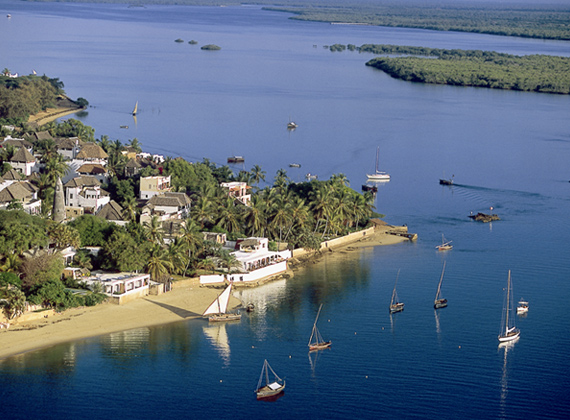
There are tribes in Kenya which have clear Chinese ancestry… they descent probably from some of Zheng He’s crew members.  In 1999, a journalist for the New York Times, Nicholas D. Kristof, reported a surprising encounter with the Shanga people on Pate island, just off the coast of Kenya. There, in a village of stone huts set amongst dense mangrove trees, Kristof met a number of elderly men who told him that they were descendants of Chinese sailors, shipwrecked on Pate many centuries ago. Their ancestors had traded with the local Africans, who had given them giraffes to take back to China; then their boat was driven onto the nearby reef. Kristof noted many clues that seemed to confirm the islanders’ tale, including their vaguely Asian appearance and the presence of antique porcelain heirlooms in their homes. You can read his account entitled: 1492: The Prequel on the New York Times website.

Lamu island, in Kenya

It is also reported that 7 centuries before the great admiral Zheng He, another Chinese, Du Huan, an officer of the Tang dynasty (618-907) visited the kingdoms of Nubia and Abyssinia (modern Sudan and Ethiopia respectively). He called these countries Molin-guo and Laobosa respectively. A full account of his trip can be found on Chroniques Yemenites. Check out the blog Curiosity killed the Eccentric Yoruba where the author did an outstanding job relating the Chinese presence in Africa, as well as African presence in China.  Trade flourished between East Africa and China. As such, many African products could be found in Chinese courts such as ivory, giraffes, myrrh, zebras, camels, powdered rhinocerous horn (used as prized aphrodisiac), tortoise shell (used to treat consumption) and frankincense and ambergris (used as a tonic to stimulate circulation). Similarly, as said earlier, Chinese artefacts such as porcelain have been found in coastal villages along East Africa. Chinese coins from the Song and Tang dynasties have been found in Zanzibar, and a huge amount were found in the town of Kajengwa in Zanzibar, illustrating trade between China and early East African kingdoms (some from the Song period have also been found in Mogadishu as well as in Kenya).  Chinese archaeologists arrived in July of 2010 to the beaches of Lamu and Malindi in Kenya, in search for a shipwreck from admiral Zheng He’s flotilla. Please watch this great video on the BBC website about the discovery of Chinese ancient coins in Kenya.

The video below tells of Admiral Zheng He’s travel and the size of his armada.

Beatrice of Congo: the African Priestess and Prophet

Beatriz Kimpa Vita
Beatriz Kimpa Vita

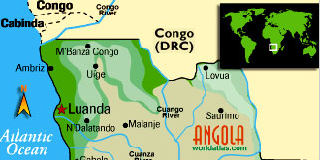
Beatriz Kimpa Vita, also known as Beatrice of Congo, or Dona Beatriz, or Tchimpa M’vita, was an African prophet (yeah… a female prophet) or priestess born around 1684 in the Kingdom of Kongo in a territory near Mt Kibangu which is in modern day Angola.  She created her own religious movement which used Christian symbols but revitalized traditional Kongo cultural roots. Born into a noble clan, the Mwana Kongo clan, she was baptized in her youth. In her childhood, Kimpa Vita was already having visions and dreams of playing with angels, and it is said that these as well as her high spirits caused her two youthful marriages to fail. This made her lean deeper into spiritual life. She was trained as a nganga marinda or as a person able to communicate with spirits (the supernatural world). However, she soon renounced that role to move closer to the catholic faith.

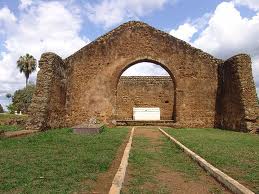
Church of Mbanza Kongo, ca 1549

She received visions of St Anthony of Padua, and believed to be a medium for his spirit. She started preaching soon after, in the city of Mbanza Kongo (which means ‘City of Kongo‘) or Sao Salvador. She occupied the old church of Mbanza Kongo. She said that God wanted Mbanza Kongo to be restored as the capital of the Kongo kingdom; she called it the biblical Bethlehem. She had direct revelations from God on her side; apparently, she died every Friday and spent each weekend in Heaven conferring with the Heavenly Father about the affairs of Kongo. From these sessions in Heaven she learned the stories of Jesus being born in Nsundi, baptized in Sao Salvador and Mary being a slave of a Kongo marquis. She basically made the catholic religion a Kongo religion based on Kongo’s rich culture for the Kongo people: she made God closer to the Kongo people! She healed people, and was able to make sterile women conceive.

Map of Angola showing Mbanza Kongo

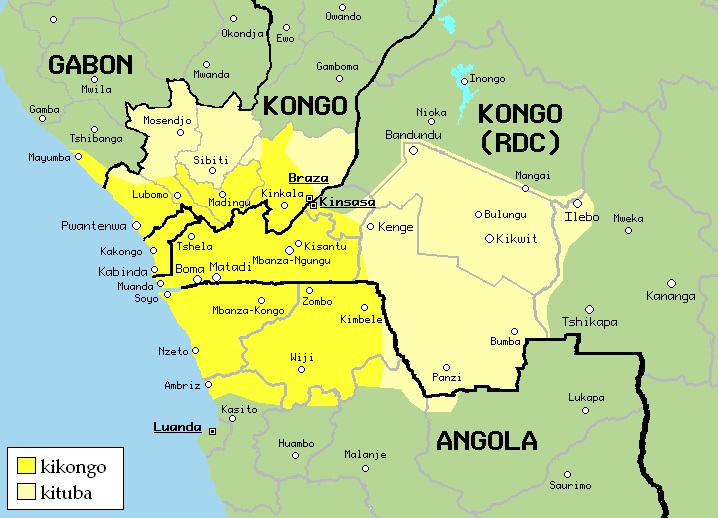
Her call to unity drew strong support among thousands of peasants, who flocked to the city. She told her followers that Jesus, Mary and other Christian saints were really Kongolese. In one of her visions, she saw that Kongo (which had been divided and under wars after the death of King Antonio I, with slave ships increasingly taking people to Brazil, Surinam, etc) must reunite under one king in order to prosper. She was ordered by God to build a specific Kongolese Catholicism and unite the Kongo under one king. Her message became so popular it could be called a Spiritual renaissance. This threatened the influence of the Catholic Church amongst the African people. Her Movement was called Antonian. Even though it integrated Kongolese culture with catholicism, the catholic priests drove the supporters of Kimpa Vita away. Some were imprisoned and beaten daily for their convictions. This is quite similar to the fate of the early apostles of Jesus Christ.

Kongo Kingdom map
Kongo Kingdom map

In 1706 Kimpa Vita gave birth to a son after two miscarriages. She continued to emphasize the closeness of God to the African people, which was a unifying factor amongst Antonians. The establishment of the Antonian movement and its consequent success led to the arrest of Kimpa Vita, her son and her followers. They were charged with heresy. The miracles performed by Kimpa Vita were denounced as “kindoki” or the use of supernatural powers. Kimpa Vita and her infant son were burned at the stake as a “witch” under the watchful eye of capuchin priests who had helped convicting her. The Antonian movement started by Kimpa lived throughout times and outlasted her. The Kongo king Pedro IV used it to unify and renew his kingdom. Her ideas remained among the peasants, appearing in various messianic cults until, two centuries later, it took new form in the preaching of Simon Kimbangu. It was also exported to the new world, in Brazil, Surinam, Haiti, Jamaica, and the US. It is said that the Haitian revolutionaries during their fights were screaming “Kanga Mundele, Kanga Ndoki” which are words used in the salva Antonina, one of Mama Kimpa Vita’s prayers.

Check out the writings of Norman C. Brockman, the book The Kongolese Saint Anthony: Dona Beatriz Kimpa Vita and the Antonian Movement, 1684-1706 by Pr. John K. Thornton and his very insightful interview to the website Execute Today, and R.S. Basi’s book “The Hand of God.” The article Kongo dia Ntotila posted on the website of ‘Le Front National Kongolais’ is a true jewel. The city of Mbanza Kongo which is the first church ever built south of the equator is now part of UNESCO World Heritage. There is piece of theatre made in Kimpa Vita’s great honor.

Kola nut: the ‘Welcome’ nut of Africa

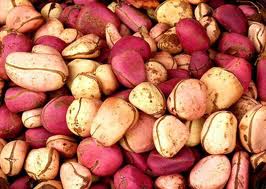
Kola nut
Kola nut

Have you ever been to an African ceremony where there was no kola nut?  Have you ever tasted that bitter nut?  The Kola nut?  Well… first off, there are rarely African ceremonies without kola nut; kola nut is to African ceremonies what silicon is for the semiconductor industry… ubiquitous!  Kola nut is usually eaten by adults and is used to welcome guests in African villages…  I have tried that bitter nut! My dad would not let me touch it when I was a child,… I don’t think children taste those!  Once older, I tried it, and really I could not understand what was so special about it…  It is soooooo bitter!   All I know is that it is the “Welcoming” nut! It is often presented to chiefs or to guests as a welcoming sign.  It has a sweet aroma, and an attractive pink color… maybe that’s why I was attracted to it as a child (before tasting it)!  Kola nuts are broken from their shell and then consumed by chewing just like gum.  One can usually recognize an avid Kola nut consumer, because his teeth will be stained with a yellowish color: an advise… just like in everything ‘do not overdo!’  It is a caffeine containing nut, which is used to re-energize oneself, and also to ease hunger pangs.  It is said that it contains three times the caffeine found in coffee! So all the coffee lovers should rejoice!  Kola nut is an important part of traditional life in Africa, particularly in West and Central Africa… it is used in religious rites, sacred offerings, weddings, naming ceremonies, funerals, etc.  Chinua Achebe often mentions it in his books.  In the Western world, it is well-known as the main ingredient of the soft-drink Coca Cola!  How is it called in your country? Describe your first encounter with kola nut.

The following video is not the greatest, but it shows a Kola nut trader…. Enjoy!

Lake Tana: Lake of Ethiopian Emperors’ Remains

Map of Ethiopia
Map of Ethiopia

This week, I will be talking about the great civilization of the Solomonic era in Ethiopia and particularly Lake Tana.  But what does a lake have to do with civilization? Well, lake Tana is Ethiopia’s largest lake and is also the source of the Blue Nile.  There are several islands on the lake: the Portuguese missionary Manuel de Almeida in the 17th century counted about 21 of which 8 had monasteries on them; today some count 45 of which 19 have monasteries dated from the 14th and 17th centuries on them.   So what does it have to do with civilization?
Well, the sepulchers and remains of many emperors (14th-17th centuries), treasures of the Ethiopian church, as well as ancient manuscripts are kept on some of the most isolated islands of Lake Tana (Ura Kidane Mehret, Narga Selassie, Kebran Gabriel, Daga Estifanos, Medhane Alem of Rema, Kota Maryam, Mertola Maryam, etc)!  It is being said that Frumentius, who introduced Christianity to Ethiopia, is buried on Tana Cherqos.  The body of Yekuno Amlak rests in the monastery of St. Stephen on Daga island. Emperors Dawit I, Zara Yaqob, Za Dengel and Fasilides, also lay on Daga island.

Mural at Uda Kidane Mihret

Lake Tana was already known by Ptolemee in the 2nd century BC, which he called Pseboe or ‘hollow swamps‘ (marais creux en francais).  It was very important in the 14th through the 17th centuries, as it played a key role in maintaining the Christian faith, and the rise of the Solomonic dynasty and the Christian Abyssinian empire. During the Solomonic dynasty, building churches and monasteries was emphasized, just like building pyramids in Egypt was emphasized by pharaohs.  Many crown jewels, treasures and precious manuscripts were stored on islands on Lake Tana.  The oldest of these forty churches from the Solomonic era was built in the 14th century.  The architecture reflects its era: the use of round shapes in the building technique.  Each monastery/church consists of three main rooms or areas: the inner sanctuary, the inner ambulatory, and the outer ambulatory.  The outside walls of the sanctuary are covered with magnificent colorful paintings reflecting that era.  Seven of these churches (and the most accessible) have been chosen by the UNESCO campaign for renovation.

Around the 16th century, lake Tana became an important trade center for travellers who were coming to the famous market of Bahir Dar by foot or tankwa (reed boats made out of papyrus).   Lake Tana was an important stop linking the north to the south of Ethiopia.

To learn more, go to the UNESCO World Heritage’s website, as well as the Selamta website whose emphasis is on Ethiopia’s lakes, Ethiopia travel, and check out pictures of the lake and other places in Ethiopia.  Enjoy this great video… of a lake full of ancient treasures!

Samori Touré: African Leader and Resistant to French Imperialism!

Samori Toure holding the Coran

One of the great kings, and fighters of African freedom was the great Samori Touré. Over 100 years ago, Samori Touré was captured by the French and deported to Gabon where he died of pneumonia.

But who was Samori Touré?

Well, Samori Touré was born in 1830 in Manyambaladugu (some texts mention Sanankoro instead), a village southeast of Kankan in present-day Guinea. Samori was a great warrior who fought imperialism in the 19th century such as many leaders today. He refused to submit to French colonization and thus chose the path of confrontation using warfare and diplomacy.

Until the age of 20, Samori was a trader. After his mother was captured in a slave raid by the king Sori Birama, he offered to serve in his army and excelled by his military prowess and skills.

Samori Touré had a vision of unity for the Malinké people, and thus started organizing his empire using traditional and innovative methods. He effectively organized Malinké chiefdoms into a single state under his authority, at the core of which was the army. He managed to increase loyalty to the state in the Malinké people who now thought as one united people… this intensified their allegiance to him. His state was well-organized and efficient. Samori’s army was powerful, disciplined, professional, and trained in modern day warfare. They were equipped with European guns. The army was divided into two flanks, the infantry or sofa, with 30,000 to 35,000 men, and the cavalry or sere of 3,000 men. Each wind was further subdivided into permanent units, fostering camaraderie among members and loyalty to both the local leaders and Samori himself. Talk about African organization and discipline… this was really a strong army! His empire reached his apogee between 1883 and 1887, and he took the title of Almami or religious leader of a Muslim empire.

"L'Almami Samori Toure" de Khalil Fofana

Samori Touré created the Mandinka empire (the Wassoulou empire) between 1852 and 1882. His empire extended to the east as far as Sikasso (present-day Mali), to the west up to the Fouta Djallon empire (middle of modern day Guinea), to the north from Kankan to Bamako (in Mali); to the south, down to the borders of present-day Sierra Leone, Liberia, and Cote d’Ivoire. His capital was Bisandugu, in present day Gambia.

In the 1850s, slavery being abolished, European powers decided to establish colonies in Africa, and could not tolerate strong states like the Mandinka empire, and strong leaders like Samori Touré. These African leaders had to be crushed!

In 1882, at the height of the Mandinka empire, the French accused Samori Touré of refusing to comply to their order to withdraw from an important market center, Kenyeran (his army had blockaded the market). They thus started war on him. This was an excuse to start war! From 1882 to 1885, Samori fought the French and had to sign infamous treaties in 1886 and then 1887. In 1888, he took up arms again when the French reneged on the treaty by attempting to foster rebellion within his empire. He defeated the French several time between 1885 and 1889. After several confrontations, he concluded several treaties with the French in 1889.

Stamp from the Republic of Guinea

In 1890, he reorganized his army, and signed a treaty with the British in Sierra Leone, where he obtained modern weapons. He re-organized his army so as to stress defense, and employed guerilla tactics.

In December 1891, French forces overran the major cities of the Mandinka empire, leaving death and desolation in their wake (sounds familiar? Côte d’Ivoire April 2011). These incursions into Touré’s empire led to exodus of the entire nation eastward. In 1893, Samori moved his capital east from Bisandugu to Dabakala. In 1894, the French assembled all their troops in western sudan (Senegal, Mali, Niger, etc…) to fight Samori.

Capture of Samori
Capture of Samori

Between 1893 and 1898, Samori’s army retreated eastward, toward the Bandama and Como (in modern day Cote d’Ivoire), conquering huge territories in the northern part of modern-day Cote d’ivoire. He led the scorched earth tactic, destroying every piece of land he evacuated. Although that tactic cut him from his new source of weapons in Liberia, he still managed to delay the French. He formed a second empire, and moved his capital to Kong, in upper Cote d’Ivoire. On May 1, 1898, the French seized the town of Sikasso and his army took up positions in the Liberian forests to resist a second invasion. This time Samori’s army fought valiantly but was no match to the power of the French arsenal. Samori forced to fight a total war against a foreign invader, and fighting against all odds, was captured on September 29, 1898, in his camp in Gué(lé)mou in present-day Côte d’Ivoire. He was exiled to Gabon where he died two years later on June 2, 1900.

Samori Touré was a warrior, a fighter, an empire builder, and one of the greatest African military leaders ever seen… he fought and won against the French army several times before his capture.

Interestingly enough, over 50 years later, the grandson of Samori, Sekou Touré, was the only one to say ‘NO’ to France, and to General De Gaulle: they preferred freedom over slavery under the European master… that was in Guinea!

Samori's empire
Samori’s empire

Please check out the work of Pr. Yves Person on WebMande.net who wrote a book on Samori Touré, BlackHistoryPages, and this article published by the New York Times in 1898 about the Capture of Samori Toure by the French. According to the New York Times, Samori, “for nearly 13 years, was the most dangerous antagonists Europeans had had to deal with“. I could not find a good map of Samori’s empire anywhere… so I made my own based on all the boundaries and main cities conquered and his capitals: Bisandougou, Kankan, Bamako, Sikasso, Kong, Dabakala, Guelemou, etc… some of the cities may not be the same today (or even exist after 100 years), particularly the city of Dabadugu: Samori Toure defeated the French at Dabadugu, was it the city of Dabadugu near Kankan, or was it the city of Dabadugu near Nzerekore? I used Google map and made my own, respecting all the information found in all the different books and atlases I read. This is the entire kingdom, without taking into account the first and second empires. If you have further information, I will be happy to hear more.

Cosmic Africa: Africans and Astronomy

Cosmic Africa
Cosmic Africa

Dear all,

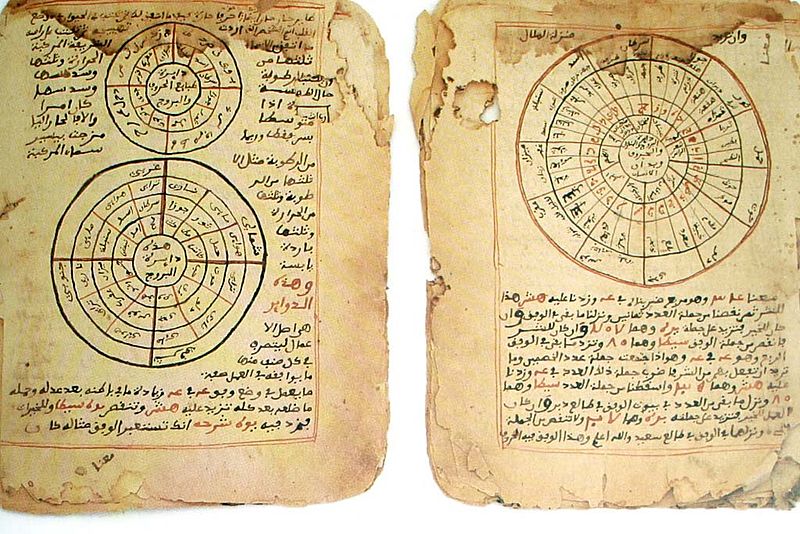
As a physicist, I could not pass on the opportunity to talk about the fellow South African astrophysicist Thebe Medupe ‘s work on Cosmic Africa. Cosmic Africa is a project/documentary about astronomy in African cultures, exploring astronomy among two of the oldest African tribes: the Namib (or Bushmen or San) of Namibia, and the Dogon people of Mali.  I heard this documentary one evening on PRI.  It felt so great hearing an elder from the Dogon tribe talking about their use of the moon, stars, etc, for their harvest.  People still study the sky and the stars to guide them during the hunting season; astronomy is an integral part of their daily lives, dances, and ceremonies.  This knowledge of the sky was passed on from generation to generations for the past 500 years.

Thebe Medupe
Thebe Medupe

The Dogon people knew certain celestial bodies that were just discovered/identified properly by Western science in the 50s and 60s.  They used the stars in spirituality and devised a divination system as discussed in the movie.  One of their great treasures is the knowledge of the star Sirius which Dogon elders confided about its existence to French anthropologists in the 1940s.  The Dogon elders said that Sirius had a companion star that was invisible to the human eye.

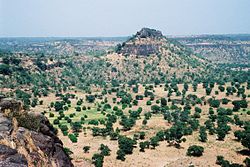
Dogon village
Dogon village

“They also stated that the star moved in a 50-year elliptical orbit around Sirius, that it was small and incredibly heavy, and that it rotated on its axis.  All these things happen to be true.  What makes this so remarkable is that the companion star of Sirius, called Sirius B, was first photographed in 1970.  While people began to suspect its existence around 1844, it was not seen through a telescope until 1862 — and even then its great density was not known or understood until the early decades of the twentieth century.  The Dogon beliefs, on the other hand, were supposedly thousands of years old.”  To read the full account, check out: The Sirius Mystery and the The Dogon Website.

San (Basarwa/Bushmen) hunters

The Bushmen of Namibia are the oldest people in Africa, as well as in the world.  They have lived in the Southern area of Africa for the past 20,000 years, and their celestial stories are just as old.  In the documentary, I love the way their celestial stories, and their story of creation was centered around the lion. Isn’t it interesting?  The lion, which is the king of the jungle,…purely African! I simply loved it.  The sky is interpreted in African terms: giraffes, lions, and zebras are seen among the stars where other people see bears and horses.  From the documentary, one sees that the Namib (Bushmen or San) healers welcome the bright evening star, the planet Venus, with a special dance….  The elders observe the shadows cast by the Sun and still count the days by the phases of the Moon, orient themselves, decide when to hunt, harvest, etc… with the sky.  They call the Milky Way the Spine of the Night and observe its three different positions during the night: it tells them about time and the changing seasons. Read more about the Khoisan people of Botswana and their fight for survival amidst government/Corporation’s menace.

To learn more check out the books: Sacred Symbols of the Dogon and The Sirius Mystery. Also check out the Foster brothers’ website (the producers): Sense Africa.