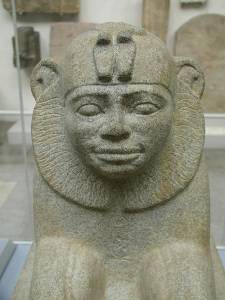
As I already told you about Nubia, and the Meroitic civilization which dominated Egypt for over 3 centuries, I also have to add that there are more pyramids in Nubia, modern-day Sudan, than in the whole of Egypt. Remember the great queen Amanishakheto and King Taharqa who ruled over Egypt.
Sphinx of King Taharqa (Wikipedia)
Enjoy the video below, made by a BBC journalist to get acquainted with Sudan’s rich history and pyramids!
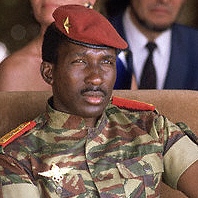
Today marks the 30-year anniversary of the death of Thomas Sankara, our African Che. The first article I ever wrote on this blog was on Thomas Sankara, Thomas Sankara, The African Che. To me, Thomas Sankara is one of the most charismatic, selfless, dedicated, and beautiful African leaders of all times. And I love his sense of humor, and humility. He may not have had a perfect time in power, but what I am certain of, is the deep love he had for his country, his people, and for the whole of Africa. Imagine, someone who renames his country and people to empower them, from Haute Volta to Burkina Faso, the land of the upright man. I would also like to thank the people running the website entirely dedicated to his memory, thomassankara.net; I raise my hat to them, and their tireless work throughout the years.
After renaming his country Burkina Faso, here are Thomas Sankara’s accomplishments, [after] ONLY 4 YEARS in power (1983–87).
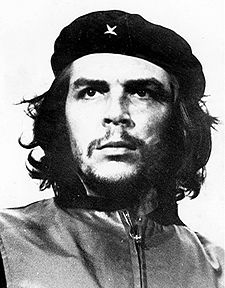
Thomas Isidore Noël Sankara (21 December 1949 – 15 October 1987) was a Burkinabé military captain, Marxist revolutionary, pan-Africanist theorist, and President of Burkina Faso from 1983 to 1987. Viewed by supporters as a charismatic and iconic figure of revolution, he is commonly referred to as “Africa’s Che Guevara.”
– He vaccinated 2.5 million children against meningitis, yellow fever and measles in a matter of weeks. – He initiated a nation-wide literacy campaign, increasing the literacy rate from 13% in 1983 to 73% in 1987. – He planted over 10 million trees to prevent desertification – He built roads and a railway to tie the nation together, without foreign aid – He appointed females to high governmental positions, encouraged them to work, recruited them into the military, and granted pregnancy leave during education. – He outlawed female genital mutilation, forced marriages and polygamy in support of Women’s rights
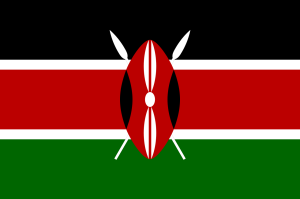
Flag of Burkina Faso
– He sold off the government fleet of Mercedes cars and made the Renault 5 (the cheapest car sold in Burkina Faso at that time) the official service car of the ministers. – He reduced the salaries of all public servants, including his own, and forbade the use of government chauffeurs and 1st class airline tickets. – He redistributed land from the feudal landlords and gave it directly to the peasants. Wheat production rose in three years from 1700 kg per hectare to 3800 kg per hectare, making the country food self-sufficient. – He opposed foreign aid, saying that “he who feeds you, controls you.”
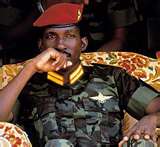
Thomas Sankara
– He spoke in forums like the Organization of African Unity [Thomas Sankara Speech on Debt and Unity] against continued neo-colonialist penetration of Africa through Western trade and finance. • He called for a united front of African nations to repudiate their foreign debt. He argued that the poor and exploited did not have an obligation to repay money to the rich and exploiting.[Thomas Sankara’s Speech at the United Nations / Discours de Thomas Sankara aux Nations Unies] – In Ouagadougou, Sankara converted the army’s provisioning store into a state-owned supermarket open to everyone (the first supermarket in the country). – He forced civil servants to pay one month’s salary to public projects. – He refused to use the air conditioning in his office on the grounds that such luxury was not available to anyone but a handful of Burkinabes.
Burkina Faso
– As President, he lowered his salary to $450 a month and limited his possessions to a car, four bikes, three guitars, a fridge and a broken freezer. – A motorcyclist himself, he formed an all-women motorcycle personal guard. – He required public servants to wear a traditional tunic (the Faso Dan Fani), woven from Burkinabe cotton and sewn by Burkinabe craftsmen. (The reason being to rely upon local industry and identity rather than foreign industry and identity) – When asked why he didn’t want his portrait hung in public places, as was the norm for other African leaders, Sankara replied “There are seven million Thomas Sankaras.” – An accomplished guitarist, he wrote the new national anthem himself.
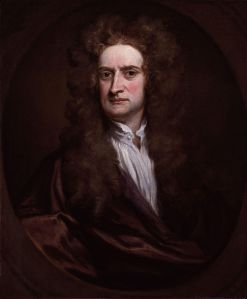
Here is a quote from the obituary of an African man born somewhere between modern-day Liberia and Benin in 1710, and enslaved and shipped to become a slave in America: “Thus died Negro Tom, this self-taught arithmetician, this untutored Scholar! — Had his opportunities of improvement been equal to those of thousands of his fellow-men, neither the Royal Society of London, the Academy of Science at Paris, nor even Newton himself, need have been ashamed to acknowledge him a Brother in Science” [Columbian Centenial, December 29, 1790, No. 707, p.123, col.32, Boston, Massachusetts]. So who was this Negro Tom, a slave who was given an obituary in an American journal in the 1700s?
Thomas Fuller, also known as Negro Tom or the “Virginia Calculator”, can be called today a mental calculator or simply a human calculator. In today’s world when most people run to their phones or calculators to find answers, He solved problems faster than over 99% of men of his time, and in his head!
When Thomas Fuller was 70 years old, a Philadelphia Quaker and businessman, William Hartshorne, and three fellow Quakers traveled from Philadelphia to meet the slave known for his arithmetic feats. One of the visitors took notes and made calculations on paper, and the others fired questions at the gray-haired old slave.
First question: How many seconds are there in a year and a half? In about two minutes came Tom Fuller’s reply — 47,304,000.
Next question: How many seconds has a man lived who is 70 years, 17 days and 12 hours old? Fuller’s answer — 2,210,500,800 — came in a minute and a half. “Objection,” called the recorder, who was busily multiplying on paper. He challenged Fuller’s answer as being too large. But Fuller retorted promptly” ” ‘top, massa, you forget de leap years.” By adding the seconds of the leap years, the recorder finally acknowledged the correctness of Fuller’s result.
Calcul
The final question was proposed to Fuller: Suppose a farmer has 6 sows and each sow has 6 female pigs the first year, and they all increase in the same proportion each year. At the end of the 8th year, how many sows will the farmer have? The question was stated in such a way that Fuller misinterpreted it. As soon as the statement was clarified, his lightning mind responded: 34,588,806. (Fuller misinterpreted the question because the term “proportion” was ambiguous.)
These questions were asked at a time when Thomas Fuller was 70 years old; just imagine how fast he must have been when he was younger? It is such a pain that such a great mind was imprisoned in slavery!
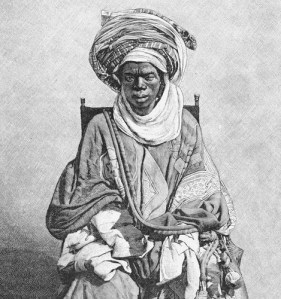
Yoruba man ca 1800s
His capacities were not a rarity in Africa. It is now known that Thomas Fuller must have already developed his calculation abilities in Africa. John Bardot’s 1732 account of people in Fida on the coast of Benin: “The Fidasians are so expert in keeping accounts, that they easily reckon as exact, and as quick by memory, as we can do with pen and ink, though the sum amount to never so many thousands: which very much facilities the trade the Europeans have with them.”
To learn more about Thomas Fuller, please check out the original article in the American Museum, Vol.V, 62, Phila., 1799., and the work of the Mathematicians of the African diaspora. Also check out this article in The Christian Science Monitor by Jane H. Pejsa, “A Wizard in any age.”I think the title should have been “a wizard in any age, and under any circumstances” because without slavery Tom Fuller would have been a genius and his name would have been on our lips the same way Newton’s has been for the past 300 years!
The BBC recently published an article about Lalibela and its churches in Ethiopia, and I thought about reblogging the article I wrote about it many years ago. The article I wrote, “Lalibela, Ethiopian churches carved in the stone,” was one of the first posts on my blog. It talked about the bees being a central part of Lalibela’s churches; this article also helps to see the evolution of the blog, from the very beginning to now. It is sweet to realize that some of the stories on this blog caught our eyes before they caught those of the BBC: Ethiopia’s miraculous underground churches. Cheers!
When I was younger, there was a cartoon on television in which they always mentioned the churches of Lalibela, and somehow I used to think that it was not actually real,… you know like these made-up places in cartoons! Isn’t it interesting that the name Lalibela always made me think of honey bees (abeille in french)… Imagine my surprise when I found out that it is said that at birth a swarm of bees descended on the baby king’s head, and his Mother named him Lalibela, meaning “the bees have recognized him as king!”
Carved straight from red volcanic stone, and actually from a single stone, Lalibela is the place of pilgrimage of thousands of christians every year, and is one of Ethiopia’s holiest places. It was intended to be the New Jerusalem, in response to the capture of Jerusalem by Muslims. The architecture of Lalibela was revealed…
Yes… I think most of Egypt is truly a treasure for archaeology, and for humanity as a whole. I would love to have the chance to work on one of those excavations!
The excerpt below is from the BBC. For the full article, please go to the BBC article.
=======
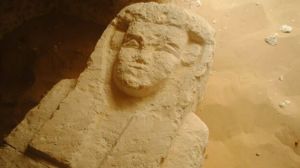
Archaeologists have discovered three tombs that date back around 2,000 years in southern Egypt.
They were found in burial grounds in the Al-Kamin al-Sahrawi area in Minya [Governorate ]/ province, south of Cairo.
The tombs contained a collection of different sarcophagi, or stone coffins, as well as clay fragments.
Egypt’s antiquities ministry said the discovery “suggests that the area was a great cemetery for a long span of time“.
One of the tombs, which was reached through a shaft carved in rock, contained four sarcophagi that had been sculpted to depict a human face.
In another, excavators found six burial holes, including one for the burial of a small child. …
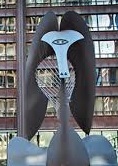
I already knew that the great Pablo Picasso had been inspired by African art (just a look at his sculpture on the Chicago plaza reminds you vividly of a Fang mask of Cameroon, Gabon, or Equatorial Guinea), but this is the first time I read it clearly in the BBC, an international magazine. It is about time that the world knew how much Africa has inspired the world, and this throughout the ages from ancient Egypt to modern-day Congo as in the case of Picasso, Matisse, and others. See… and then we are told that our ancestors were not savvy: have you ever looked at an African mask? The geometry, symmetry, symbolism, and emotions are amazing! Enjoy! This is just an excerpt of the article by Fisun Güner of the BBC. For the full article go to the BBC.
=========
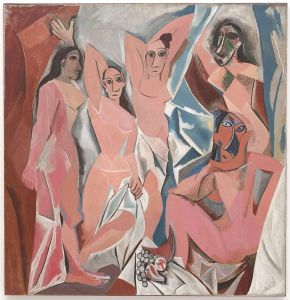
A small seated figurine from the Vili people of what is now the Democratic Republic of the Congo was instrumental in the lives of two of the greatest artists of the 20th Century. The carved figure in wood, with its large upturned face, long torso, disproportionately short legs and tiny feet and hands, was purchased in a curio shop in Paris by Henri Matisse in 1906. The French artist, who liked to fill his studio with exotic trinkets and objets d’art, objects that would then appear in his paintings, paid a pittance for it.
‘Les Demoiselles d’Avignon’ by Pablo Picasso (Source: Wikipedia)
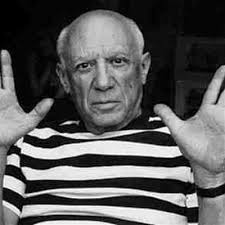
Yet when he showed it to Pablo Picassoat the home of the art patron and avant-garde writer Gertrude Stein, its impact on the young Spaniard was profound, just as it was, though to an arguably lesser extent, on Matisse when the compact but powerful figure had fortuitously caught his eye.
For Picasso, his appetite whetted, visits to the African section of the ethnographic museum at the Palais du Trocadéro inevitably followed. And so precocious was the 24-year-old artist that it seemed that he had already absorbed all that European art had to offer. Hungry for something radically different, something almost entirely new to the Western gaze that might provide fresh and dynamic impetus to his feverish creative energies, Picasso became captivated by the dramatic masks, totems, fetishes and carved figures on display, just as he had with the Iberian stone sculptures of ancient Spain which he also sourced as material. Here, however, was something altogether different, altogether more dynamic and visceral.
….
… artists were struck by a directness, a pared-down simplicity and a non-naturalism that they discovered in these objects. But no thought was given to what these artefacts might actually mean, nor to any understanding of the unique cultures from which they derived. The politics of colonialism was not even in its infancy.
Pablo Picasso (Source: WikiArt.org)
The Trocadéro museum, which had so impressed Picasso, had opened in 1878, with artefacts plundered from the French colonies. Today’s curators, including those of the Royal Academy’s Matisse exhibition in which African masks and figures from the artist’s collection appear, at least seek to acknowledge and redress this to a small extent. A similar effort was made earlier this year for Picasso Primitif at the Musée du Quai Branly, Paris, an exhibition exploring Picasso’s life-long relationship to African art. The sculptures, from West and Central Africa, were given as much space and importance as Picasso’s own work and one could appreciate at first hand the close correspondence between the works.
Paul Gauguin, perhaps the quintessential European artist to ‘go native’, …, had long felt a disgust at Western civilisation, its perceived inauthenticity and spiritual emptiness.
I admire this African anthropologist’s determination. Thanks to his perseverance, he was able to make a discovery which changes our understanding of humanity, or rather of what humans’ ancestors may have looked like. Isaiah Nengo of DeAnza College in the US, made a discovery in Kenya, in the Turkana Basin, of a 13-million-year-old ape skull. When he embarked on his research, no one wanted to follow him, and everybody told him what a waste of time this would be. But determined, he set out by himself, hired 5 local Kenyan fossil finders, and went off to the area he thought would bring results. A month went by without results, and at the end, as the team was leaving the area, they stumbled upon the skull. He had made a discovery, as it turned out, the team found what is thought to be the most complete skull of an extinct ape species in the fossil record. His findings have just been published in the Aug. 10 issue of the journal Nature. You can also read more in this article published in the Washington Post. Talk about perseverance!
I had to share with you this video of Akon at the YouthConnekt in Kigali, Rwanda, this past July. I am not a fan of Akon, but what he says about rebranding Africa is so true. It is just the reason I started this blog, to talk about Africa, the part that we should know: our history, our lives, our realities! The fact that Africa is being represented by wars, when there is only war in maybe 4 countries out of 54, makes me mad. I remember talking to Americans, and they thought I lived on trees in the jungle; when I told them that we had real cities, and that their city in America looked worst than where I came from, they couldn’t believe me. Rebranding Africa is so important… we have to tell OUR own story, and stop letting others tell it! This is also similar to Chimamanda Adichie’s talk: The Danger of a Single Story.
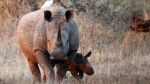
I never thought of flying a rhino until the BBC published an article on the subject the other day. Imagine flying a 1.5 tonne animal in an airplane: what does it entail? what are the challenges? why do it in the first place? Here are a few excerpts from the article; for the full version, check out the article ‘How do you get a rhino to fly‘. At the end of the article, I felt sad that humanity has come to this in order to preserve an endangered species from humans! Is the answer to relocate all endangered species all over the world to avoid extinction? Any ideas?
=======
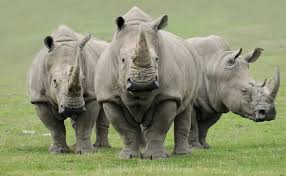
Several rhinoceroses (Source: ndtv.com)
… 12 white rhinos have just left their native South Africa for a new life in a nearby country, as part ofan anti-poaching project.
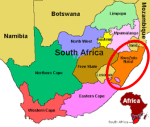
The beasts spent 15 hours in a truck, plane, and helicopter to get from a game park in KwaZulu Natal, on South Africa’s east coast, to their new location.
Step 1: Blindfold and ear plugs
“The animals are caught and put into a steel crate that’s specially designed to contain them, and designed to fit in the aircraft.”
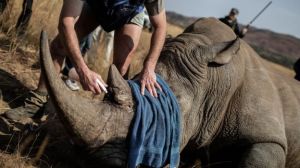
… “You have to immobilize them – make them go to sleep completely, and then blindfold them. And then you put earplugs in their ears.
Original location of the rhinos
And then, you slowly give them a little bit of [sedative] reversal, enough so they can stand up. They’re uncoordinated at that stage – so then you put a rope round their heads and you pull them slowly into the crate.
“They have to walk on their own feet because they’re very heavy. You can’t move a tonne of sleeping meat!”
The rhinos need to be awake throughout the flight so they can move their legs and regulate their own breathing. “The problem with a flight that long and an animal this big, is that if it lies for too long, that restricts circulation to the leg. And they get pins and needles – and then occasionally the animal could lose the use of that leg.”…
Step 2: Roll it into the plane
Then comes the heavy lifting.With the rhinos safely in their transport crates, a crane lifts them onto the back of a truck bound for the airport.
Rhinos being sedated (Source: Getty images)
Next,the crane deposits them on a loading vehicle, which will move them on to a plane.
“In this case we had rollers on the floor,” … “We just laid them onto the rollers, and then rolled them into the aircraft. …
The process involves a significant team of human helpers. “The loading – you’ve normally got between10 or 12 people per rhino. Andwe normally do two at a time, so 25 people.”
Sadly,the move requires an armed security contingent due to the threat from poachers. Trading in rhino horn has been banned globally for four decades, but the substance – traditionally used in Chinese medicine – has a higher black market value than gold or cocaine.
… there are four rhinos airborne at any one time, “in a big military transport plane”.
Everybody on the blog loved this video of Timbuktu about its great university, one of the world’s oldest universities. I loved these centuries’ old manuscripts on medicine, art, literature, astronomy, and other subjects. The idea that my ancestors knew all these things, and that even today people are still trying to decipher these, make me so proud. The great historian Ibn Battuta talked about Timbuktu’s great universities, scientists, and scribes, and the beauty and wealth of the place when he visited in the 1300s. Enjoy the video below.




 Thomas Fuller


 African Heritage