The other day I went to the museum of arts where I visited the Native American section, and realized that there was a strong difference between Native American baskets and African baskets. This is when I thought of discussing African baskets on my blog.
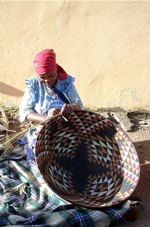
Wolof basket (Senegal)
Well, first of all, you should know that African baskets are different from country to country. You will find out that West African baskets (Togo, Senegal, Ghana…) are different from Central African baskets (Cameroon, DRC, Burundi…), which are different from Southern African baskets (Zimbabwe, South Africa, etc…). This difference is mostly due to the fact that different ethnic groups inhabit those regions, like the bantus in the South, the Nilotes in the North, etc… plus our own experiences in life, and the climate give us different tools to make baskets.
Beaded Bamileke basket (Cameroon)
For instance, in Cameroon (my country), baskets are made out of dried palm leaves, bark wood, or Raffia also known as African bamboo, in Rwanda they are made out of sisal fibers, banana leaves, or grass; in Senegal, njodax grass is used; while in South Africa, they are made out of llala palm leaves, sisal leaves, etc.
Burundi basket
The styles and patterns on the baskets also vary from sub-regions on the African continent. Baskets are dyed with either natural plant pigments, bark, berries, leaves, clay, roots, dung, or tea leaves as well as with commercial dyes.
Zulu basket (South Africa)
Weaving baskets is truly an art, and you can usually recognize which area and sometimes which country in Africa they are coming from.
Dear all, today we will be talking about a great true African legend: Miriam Makeba! Well… where should I start? Zenzile Miriam Makeba, affectionately named Mama Africawas a singer who truly showed that music had no boundaries, and that music could be used as a platform to launch a revolution; above all, if you are passionate and excel in something, you can always do great things! Miriam Makeba started as a singer in South Africa, and was even married to the great South African trumpetist Hugh Masekela at one point. This woman sang about her love for her country, her people, and the struggle of her people. Like she said herself: “I was never politically involved. People always think that I’m political or that I sing politics, but I’m not. I just speak the truth. When I say we’re oppressed, I’m not lying. I’m glad I’ve been vindicated, in a way. I could have been in parliament, but I’m not a politician, I’m a singer. I love to sing, that’s what makes me happy” Miriam was a true warrior dedicated to the liberation of African people.
Miriam Makeba on the cover of her album Pata Pata
Miriam Makeba was never allowed the right to return home for 30 years by the apartheid government (from 1960-1990). She was not able to go to her mother’s funeral. Her song Welelais about a child yearning for her mother. In 1961, she sang at President Kennedy’s birthday, as she puts it: “I was the only foreign artist among the big giants of America paying tribute to him.” She spoke at the United Nations in New York, where she said: “I ask all the leaders of the world: would you act differently, would you keep silent and do nothing if you were in our place, would you not resist if you were allowed no right in your own country because the color of your skin was different from the color of the rulers?” Her records were subsequently banned in South Africa. She used her fame to let the world know about the suffering of Black South Africans. Her most popular songs include Pata Pata, the Click Song, and her beautiful rendition of Malaika! She later sang about the Soweto uprising (1976) in her title “SowetoBlues” written for her by Hugh Masekela.
When Miriam married the Black Panther leader Stokely Carmichael, her shows were canceled in the USA, as the FBI was after him. She picked up her bags with her husband and went to Guinea, where president Sekou Toure allowed them in. She even had a Guinean passport and was a United Nations ambassador for Guinea!
True African Beauty
She was finally allowed to return to South Africa after Nelson Mandela got out of jail. He actually asked her to come back… So 30 years later, this great woman of power return to her country after losing her mother, and only daughter Bongi Makeba. I have attached this beautiful documentary. Please watch and celebrate a strong African Woman… a legend, a woman who loved her people so much that she sang about it, and spoke about it at the United Nations. In later years, she has also been an FAO ambassador (to fight hunger), United Nations Goodwill ambassador, and opened a girls’ school in South Africa for orphans, girls who have been raped, etc…
In a way, even though Miriam Makeba lost her only child, she was a mother to all of us, and fought for all South African, and African children. Thank you Beautiful Mama Africa. God loves you! We have to continue your legacy of strong African women, and legends!
Ousmane Sembene, was indeed the Father of African cinema. To think that this was a man who had stopped school in 6eme, and written one of the most interesting books in Africa (God’s bits of Wood)! To think that this man became the Father of African cinema is impressive! This is a man who fought injustice, and fought for equality. He loved Africa with everything he had! After writing books, he realized that most people in his country spoke Wolof, and some of them could not read his books, he switched to cinema! He would tour villages in his country Senegal to show his movies, and other countries in Africa. He apparently came to Cameroon once to show the movie “Le Mandat“,
Ousmane Sembene en tenue Bamileke
and a police officer came to him and asked him where he had found the story… and Sembene to tell him, he just thought of it… and the officer to say “It actually happened to me“! That was Sembene, a man who could connect with people, and discuss African issues. He showed that it was possible to make a movie in an African language! His movies and books dealt with immigrants in Europe, colonialism, female genital circumcision, African beggarism, etc… “La Noire de …” was the first feature film produced by a sub-saharan African filmmaker. This man was simply a genius! He went from fisherman, railroad worker, docker in Europe, to writer, and filmmaker. He was one of the founders of the FESPACO, the festival of African cinema in Ouagadougou, Burkina Faso. A statue now stands in Ouaga, in honor of Ousmane Sembene!
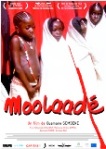
God's bits of WoodMoolaade
The last movie of Ousmane Sembene was “Moolaade“, a gem of African film… it was ranked among the 10 best movies of the year 2004 by the Boston Times. I actually own the movie, and it is simply outstanding! Can you believe that it was ranked among the 10 best movies in the USA, and won an award at the Cannes festival? Wow… I wish Sembene had lived even longer… but I know his legacy lives forever!
Allright, in the category “Great Art”, I would like to introduce you to Bògòlanfini commonly known as bogolan which is a traditional Malian fabric dyed with fermented mud, particularly associated with the Bamana people of Mali. The name is a Bamana word meaning “earthcloth” (Bogo = earth, lan = the way to obtain a result from the earth). Bogolan became mainstream when the genius stylist Chris Seydou (who worked with stylists such as Yves Saint Laurent) modernized its use in society, incorporating it in western coats, and dresses. Today, as you walk down the streets of New York City, you would definitely encounter these beautiful African American ladies wearing Bogolan coats in the midst of winter. The Bamana people have used Bogolanfini in all parts of their lives for centuries, and the art of making it is centuries old, and is passed from generations to generations.
Couvre-Lit en Bogolan
The Smithsonian made a beautiful page about the Bogolan and some of its artists, including the great Chris Seydou. One of the artists, Nakunte Diarra says that in the Bamana creation, “Since God created the world,… Bogolan was there.” What a beautiful to emphasize the importance of Bogolan in the Bamana society, and today in Malian life.
The video below was chosen particularly because the artist, Issiaka Dembele, gives a historical background to the art of making Bogolan. You will find shorter videos on how Bogolan is made , but this one was the most profound!
Pathe’O is a renowned African Stylist. Nicknamed “the princes’ stylist,” Pathé Ouedraogo is from Burkina Faso and established himself in Côte d’Ivoire in the 70’s. He is an outstanding stylist, just like the late Malian stylist Chris Seydou who revolutionized the use of Bogolan. Pathe’O is a baobab of African couture. He even made ‘Madiba‘ (Nelson Mandela)’s clothes. Yup… that’s right! Pathe’O designed clothes for Madiba! Do you remember when Madiba opened the African Cup of Nations in South Africa in 1996? Guess who designed that beautiful
Nelson Mandela clothed in a Pathe’O shirt
shirt Madiba wore (Mao/African style)?…Pathe’O! From then on, many African leaders have switched from 3-piece suits to Pathe’O!








 African Heritage