How the Lion Became the King of the Jungle

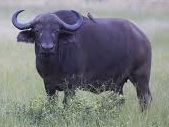
Buffle / Buffalo

At that time, the buffalo was the King of the animals. To drink from the river, you had to wait until it had quenched its thirst first and bathed in it. One day, a lioness whose cub was about to die of itself broke this rule…

The lion was not the king of the animals. At least, he wasn’t at first. Rather, it was Dankélé, a large black buffalo from the savannah, who reigned over the beast people. King Dankélé was a great tyrant, a king who ruled without faith or law. Whether you were right, you were afraid. Whether you were wrong, you were right to be afraid of him.

Riviere / River

At that time, there was only one river where all the animals came to drink, but no one was allowed to drink before Dankélé. And Dankélé did not just quench his thirst, he bathed in the river, rolled around in it and did all his business there. It was only after that the others could drink the already dirty water in turn. It was unfair, but that was how it was. You had to put up with it.

But the mother lioness, that day, could not wait for the king to arrive. Her lion cub, who had just arrived in the world, was going to die of thirst. She gave him a little water. She drank a tiny bit herself.

King Dankélé arrived. He was accompanied by members of his court, griots and griottes who sang his praises:

Soundiata Keita a l'Assemblée constitutive de l'empire du Mandé avec les chefs de guerre (Source: Wikipedia.fr)
Soundiata Keita a l’Assemblée constitutive de l’empire du Mandé avec les chefs de guerre (Source: Wikipedia.fr)

« Ô ! Great Buffalo ! 

You are greater than Sunjata the great

Greater than Da Monzon the great

Greater than Alexander the Great! » 

But King Dankélé, when he was at the edge of the river, saw that they had dared to drink before him, the king. He turned towards his people and, threatening them with his gaze, shouted his anger. And his anger made everyone tremble:

Who is it… But who dared to drink the king before me? If you don’t point out the culprit, you are all guilty!

The animals, terrified, looked into each other’s eyes. Everyone had seen the lioness giving her cub a drink. But who could take the responsibility of reporting her to this brute of a king? The hyena did so:

I’m not going to pay for a mistake I didn’t make. It was the lioness who drank before you. That’s it! I just said it.

And immediately, with a leap, King Dankélé crushed the lioness with his big paws.

But the lion cub did not die. He ran away as fast as he could and went into hiding.

He waited and waited until he grew up. When he became a big lion whose roar echoed across the savannah, he went out and said to the buffalo:
Lion
Lion

Buffalo, where did my mother go?

The buffalo, intimidated by the strength the lion gave off, stammered:

Your, your, your mother the lioness.

A counselor whispers in her ear:

This is the lioness you killed a few years ago because she dared to drink before you.

Oh yes, that’s right, said the buffalo, turning to the lion. It’s the law, not me. The law is the law. Your mother dared to drink before me, so the law was applied to her. The law is the law, the law is not me.

The law which applies only to the weakest is an unjust law.

And the lion throws himself on the buffalo, overpowers it, and frees the kingdom of animals.

It is since that day that he is the king of the animals. It is also since that day that he strives to be just and upright.

The French original can be found on Ouologuem BlogTranslated to English by Dr. Y., Afrolegends.com

Le temps guérit toutes les blessures/ Time Heals all Wounds

Savon / Soap

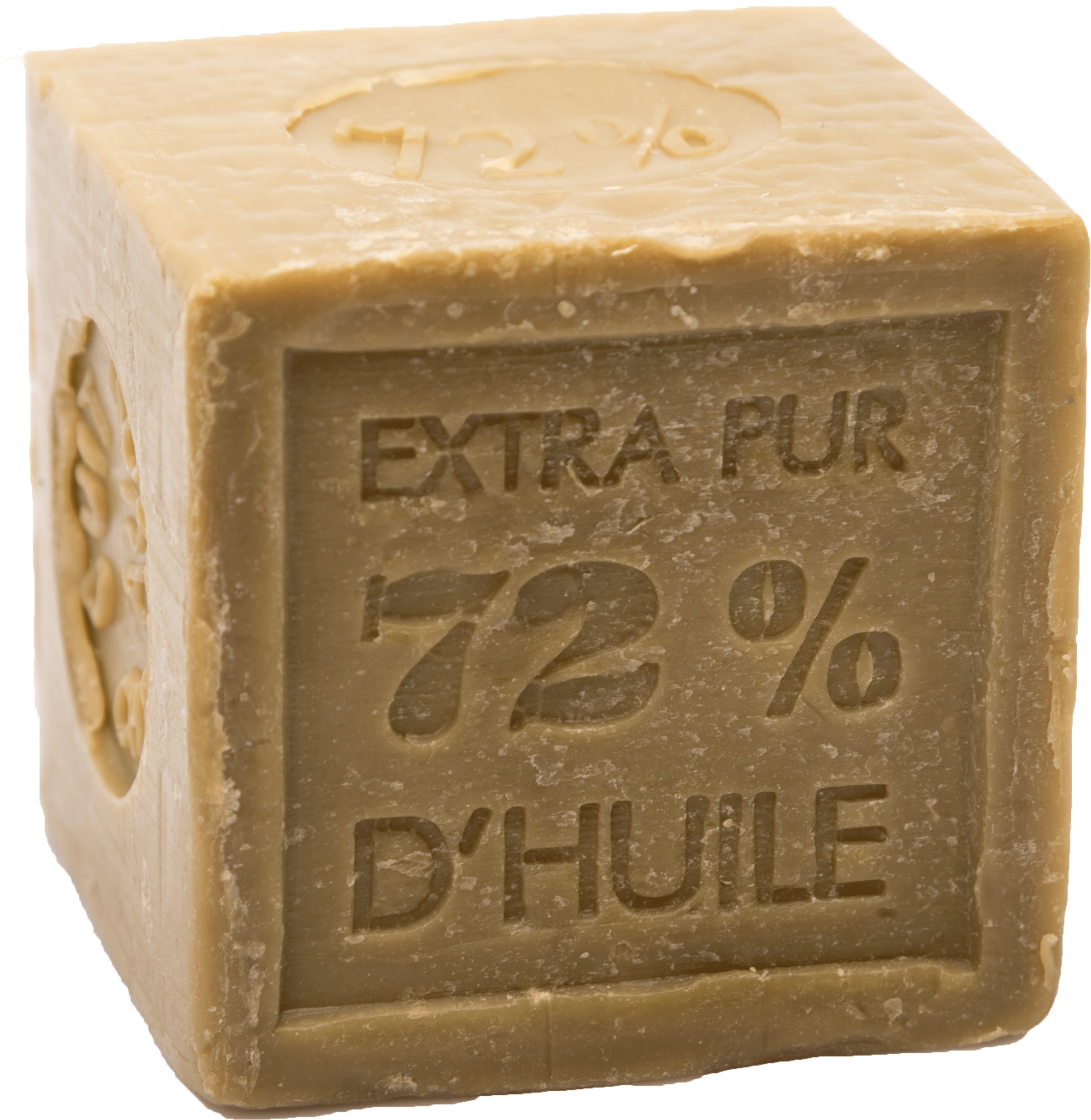
Yàgg du sabbu waaye dina fóot.

Le temps n’est pas le savon, mais il nettoie les vêtements (Proverbe Ouolof – Sénégal, Gambie). – Le temps guérit toutes les blessures.

Time isn’t soap, but it will clean clothes. (Wolof proverb – Senegal, Gambia). – Time heals all wounds.

UN Calls for Ceasefire in the Democratic Republic of Congo (DRC)

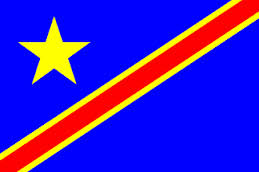
Flag of the Democratic Republic of Congo

For once the United Nations has decided to intervene in the situation in the Democratic Republic of Congo (DRC). Please remember that this is an organization that is two-faced, saying one thing from one side of the mouth and another from the other. History has told us never to trust the UN because it is an organization that only serves the “strong” nations of this world, helping them exploit the “weaker” ones. Anyways, this past Friday, the UN has called for a ceasefire in the DRC after Goma and Bukavu, two of the largest cities in the eastern part of Congo, in regions rich in minerals that could power the entire earth, were captured by the M23 rebel group backed by Rwanda and its Western masters.

Excerpts below are from Africanews.

=====

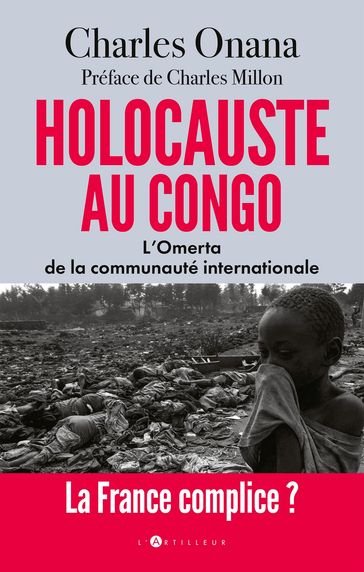
“Holocauste au Congo, L’Omerta de la Communaute Internationale” by Charles Onana

The United Nations Security Council unanimously adopted a resolution on Friday calling for an immediate and unconditional ceasefire in the Democratic Republic of the Congo (DRC).

Rwanda-backed rebels have taken control of two key cities in Congo’s mineral-rich eastern region in less than a month, following a major escalation in their long-standing conflict with Congolese forces.

Nicolas de Rivière is the Representative to the United Nations in France: “There is no military solution to the conflict. The M23 offensive, supported by Rwanda, must end. The priority now is to reach an effective, unconditional, and immediate ceasefire agreement.”

… “While it took the Council some time to reach a consensus, its resilience is evident. On behalf of the Government and all citizens of the Democratic Republic of the Congo, especially those from Bunagana to Kamanyola, Goma, Sake, Minova, Nyabibwe, Kalehe, Kavumu, and Bukavu, I sincerely thank all members of the Council,” said Zénon Mukongo Ngay, the Representative to the United Nations in the Democratic Republic of the Congo.

The rebels are supported by roughly 4,000 troops from neighbouring Rwanda, according to U.N. experts [UN experts, always present on the ground while atrocities are ongoing]. At times, they have threatened to march as far as Congo’s capital, Kinshasa, located over 1,000 miles away.

Proverbe sur la sagesse / Proverb on Wisdom

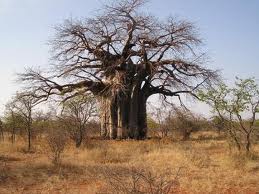
Le Baobab / The baobab tree

La sagesse est comme un baobab; aucune personne ne peut l’encercler. (Proverbe Ewe – Ghana, Togo).

Wisdom is like a baobab tree; no one individual can embrace it. (Ewe proverb – Ghana, Togo).

The Kente Cloth is now in the UNESCO Cultural Heritage List

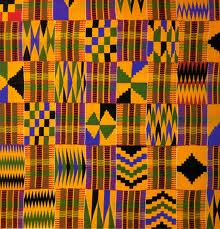
Kente scarf

Last week, the Kente cloth, Ghana’s national textile, has been recognized and added to the UNESCO list of Intangibla Cultural Heritage of Humanity. A few years ago, we published the article Kente Cloth: An Ashanti Tradition dating Centuries back. Here, we will go down memory lane.

=====

Have you ever seen those beautiful bright multicolored scarves worn on graduation day by thousands of African Americans and African students across the United States?  Those scarves are usually hand-woven, bright, and multicolored, worn to represent the membership to a Black sorority, fraternity, or to just an African student organization at the different colleges and universities.

Kente cloth
Kente cloth

Well, those scarves are made from a material commonly known as Kente cloth, which originates from the Ashanti people of Ghana and Cote d’Ivoire.  The Ashanti people used to (and still do) hand weave these bright multicolored clothes for their kings and noblemen.  The tradition of kente cloth is said to have been developed in the 17th century, and stems from ancient Akan weaving techniques dating as far back as the 11th century AD (this is one of Africa’s textile tradition).  Kente cloth is known as nwentoma (meaning woven cloth) in Akan language, and is a type of silk, cotton, or rayon fabric made of interwoven cloth strips which is native to the Akan/Ashanti ethnic group of Southern Ghana (and also Cote d’Ivoire).  It is woven on a wooden loom, which produces a band about 10 cm wide; several bands will then be sewn together to make a larger cloth.  The elaborate patterns arise from the mixture of different weaving techniques applied to the same band of cloth.  The quality of the fabric, and weaving indicates the rank of the person, the best being reserved for the kings.  It is worn by men as a toga, and by women as upper and lower wrappers.  The art of weaving kente is passed down only to males, from generation to generation.  The main center of weaving kente is around the Kumasi region of Ghana.

Continue reading “The Kente Cloth is now in the UNESCO Cultural Heritage List”

Their Blood Waters Our Freedom

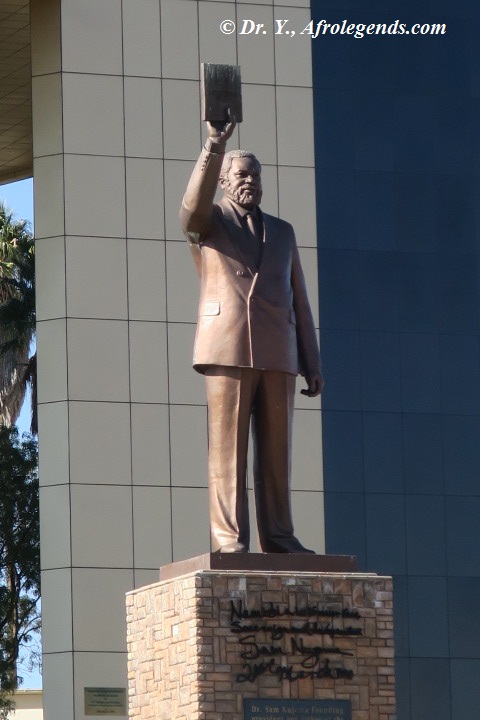
We owe a lot to those who lost their lives for us to enjoy amazing freedoms. In Windhoek, the capital of Namibia, there is a monument, The Genocide Memorial, erected to celebrate those who went before, who lost their lives for us to be free. The Genocide Memorial can be found south of the Sam Nujoma statue on Independence Museum in Windhoek, Namibia. On the monument, is written, “Their blood waters our freedom.” On the inner plaque, whether on the back or front of the statue, are found images of the Herero and Nama people of Namibia who were almost entirely exterminated by the Germans, Germany in Namibia: the First Genocide of the 20th Century. At the top of the monument, are a man and woman in an embrace who have broken their shackles of the South African military occupation. The couple stands atop a rendering of a traditional Namibian dwelling.

So wherever we are, it is important to know that our ancestors gave their blood and sweats for us to stand tall today, and it is our duty to continue to battle for the next generations. Their blood waters our freedom!!!

“Their Blood Waters Our Freedom” Monument at the Independence Museum, in Windhoek, Namibia

“Their Blood Waters Our Freedom,” back of the monument

So Long to Sam Nujoma, Namibia’s First President

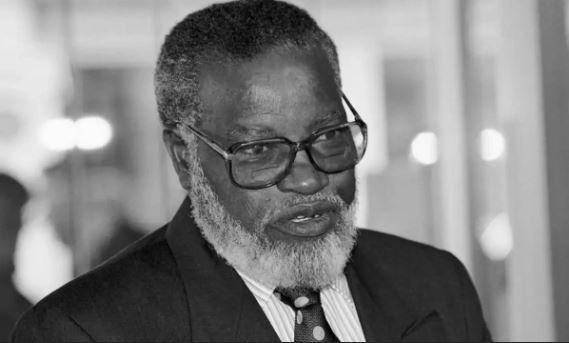
Sam Nujoma (Source: newscentral.africa)
This past Saturday, February 8 2025, Sam Nujoma, Namibia’s first president and founding father passed away at the age of 95. The ancestors are greeting this illustrious brother who fought for the independence of his country. Nujoma led the long fight for independence from South Africa for many years, which culminated with independence on 21 March 1990 of South West Africa, as the country was formerly known. Nujoma helped found Namibia’s liberation movement known as the South West Africa People’s Organisation (SWAPO) in the 1960s. After independence, Nujoma became president in 1990 and led the country until 2005.
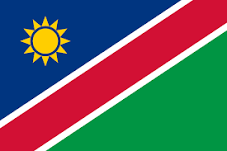
Flag of Namibia
Samuel Shafiishuna Daniel Nujoma was born at Etunda, a village in Ovamboland, on 12 May 1929, to Daniel Uutoni Nujoma and Helvi Mpingana Kondombolo, an Uukwambi princess. From his mother, he inherited his strong charismatic influence during his political career.  He was the oldest of 11 children. His childhood was spent taking care of his siblings, tending to the family’s cattle, and farming.
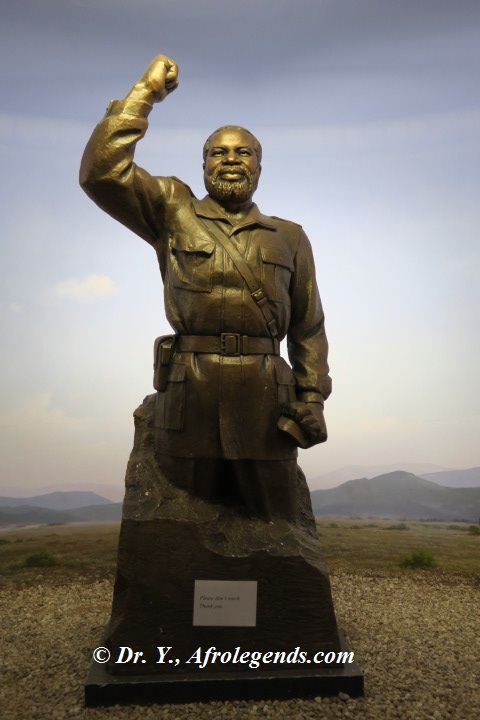
Statue of Sam Nujoma in front of the Independence Museum in Windhoek, Namibia
At the age of 17, Nujoma moved to the harbor town of Walvis Bay, where he slowly learned about the plight of Black people under white-minority rule; he also worked at a general store and later at a whaling station. In 1949, Nujoma moved to Windhoek where he worked as a railway sweeper for the South African Railways (SAR), while he went to night school. It was there that he was introduced to the Herero tribal chief Hosea Kutako, who was lobbying to end apartheid rule in Namibia, then known as South West Africa. Kutako took the young Nujoma under his wing, and mentored him as he became politically active among Black workers in Windhoek who were resisting a government order to move to a new township in the late 1950s. First, he joined with the Ovamboland People’s Congress (OPC) co-founder Jacob Kuhangua to start a Windhoek branch; at its first congress, he was elected president. At Kutako’s request, Nujoma began life in exile in 1960, first to Bechuanaland (now Botswana), then Bulawayo in then Southern Rhodesia (Zimbabwe), and later ending in Tanzania where he was welcomed by President Julius Nyerere. The same year, he was elected president of the South West Africa People’s Organization (SWAPO) in abstencia. The problem of South West Africa, similar to Kamerun, was that they were former German colonies, which had been placed under League of Nations mandate of South Africa in the case of South West Africa, and France and Great Britain for Kamerun; thus the country should have been independent a while back. Nujoma spent a few years asking the United Nations to ensure that the occupying power that was South Africa released control of South West Africa. After many unsuccessful tries, while shuttling from capital to capital in quest for support, he authorized the launch of armed resistance in 1966 against South African forces. The attack marked the beginning of the Namibian War of Independence, which would last more than 25 years.
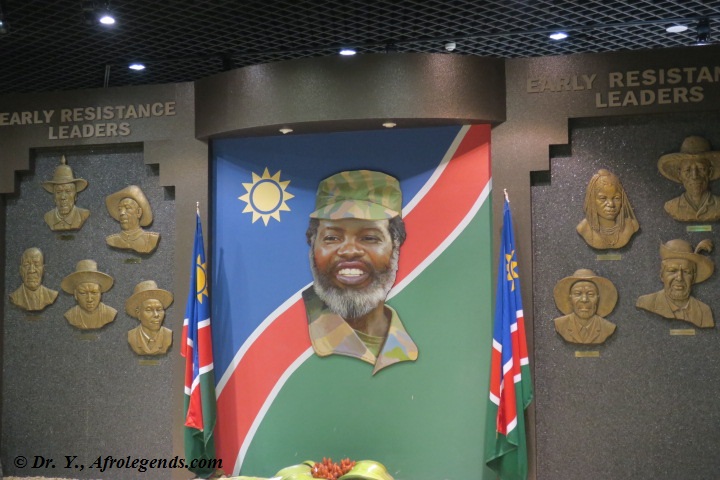
Sam Nujoma on a plaque to Early Resistance Leaders inside the Independence Museum in Windhoek, Namibia
On 19 March 1989, the signing of the cease-fire agreement with South Africa took place. After 29 years in exile, Nujoma returned to Namibia in September 1989 to lead SWAPO to victory in the UN-supervised elections that paved the way for independence. Nujoma was elected first president of the new nation which became independent on 21 March 1990. He was re-elected in 1994 and 1999, and stepped down in 2005. The current president of Namibia, President Nangolo Mbumba said of Sam Nujoma, He “inspired us to rise to our feet and to become masters of this vast land of our ancestors,” … “Our founding father lived a long and consequential life during which he exceptionally served the people of his beloved country.” Namibia’s Vice-President Netumbo Nandi-Ndaitwah, who is due to be inaugurated as president in March after leading SWAPO to victory in elections, said his “visionary leadership and dedication to liberation and nation-building laid the foundation for our free, united nation“.
Bust of Sam Nujoma, inside Independence Museum, in Windhoek, Namibia
South Africa’s President Cyril Ramaphosa said the former Namibian president was an “extraordinary freedom fighter” who played a leading role in not only his country’s fight against colonialism, but also in the campaign that led to the end of the apartheid regime in South Africa in 1994. “President Nujoma’s leadership of a free Namibia laid the foundation for the solidarity and partnership our two countries share today – a partnership we will continue to deepen as neighbours and friends.” South African President Cyril Ramaphosa said Nujoma led Namibia’s independence movement “against the seemingly unshakeable might of colonial and apartheid authorities and forces” and spurred the anti-apartheid movement in South Africa on its own final steps to freedom. “Sam Nujoma inspired the Namibian people to pride and resistance that belied the size of the population,” Ramaphosa said. “Namibia’s attainment of independence from South Africa in 1990 ignited in us the inevitability of our own liberation.”

Fenus unciarum in the African Slave Trade

Inspection of a slave for sale

Fenus unciarum refers to an ancient Roman concept of interest on loans. The term “unciarum” comes from the latin “uncia,” which means “twelfth,” and “fenus” means interest. Essentially, it was a legal term used to describe the interest rate of 1/12 (or about 8.33%) per month, which translates to an annual interest rate of approximately 100%. The Twelve Tables, an early Roman legal code, established this rate to protect borrowers from exorbitant interest rates. This was a common practice in Roman law which was applied in Africa during the slave trade. The debtor who cannot redeem himself becomes a slave: he can redeem himself by selling his son to the creditor. According to the law of the XII tables, the creditor can sell the debtor beyond the Tiber.

The fidelity of this scheme in Black Africa under the slave system is corroborated by Mungo Park, the Scottish explorer who visited West Africa in the 1790s. After an exploration of the upper Niger River around 1796, he wrote a popular and influential travel book titled Travels in the Interior Districts of Africa in which he theorized the Niger and Congo merged to become the same river, though it was later proven that they are different rivers. In this book, he shed a light also on the fenus unciarum use in Africa. 

Slave capture

When a Negro takes goods on credit from Europeans on the coast and does not pay at the agreed time, the creditor has the right, according to the laws of the country, to seize the debtor or, if he cannot find him, someone from his family, or finally, as a last resort, someone from the same kingdom. The person thus seized is detained while his friends are sent to search for the debtor. When the latter is found, an assembly of the chiefs of the place is called, and the debtor is forced, by paying his debt, to release his relative. If he cannot do this, he is immediately seized: he is sent to the coast, and the other is set free. If the debtor is not found, the arrested person is obliged to pay double the amount of the debt, or he himself is sold as a slave…

From this, one can easily see how an entire kingdom could be captured.

Technique of Disinformation about Slavery

Slave capture

We have been told by many that “Africans sold their brothers” into slavery. However, we have seen before, When the Kongo King, King Mvemba a Nzinga, most commonly known as Afonso I of Kongo, or Nzinga Mbemba,  wrote to the King of Portugal against Slavery, that many kings fought against such. King Afonso I was concerned about the depopulation of his kingdom through the exportation of his own citizens into slavery, and complained to the Portuguese king against it. Below, we will see that the above statement is mostly a false statement invented by the guilty to turn the victim into an accomplice.

Here is Guillaume Bosman in La Traite des Noirs au Siècle des Lumières (Témoignages de négriers), p.38  who also confirms the disorganization of Black Africa by slave-trading Europe. He writes:

there are many people among us who imagine that fathers sell their children here, husbands their wives, and brothers their brothers, but they are wrong. This never happens except out of necessity and for some crime; most of the slaves taken to us are people who have been taken prisoner in war, and whom the victor, considering as his booty, has sold to make a profit.”