Last week, the government of Ghana made history by granting citizenship to 524 Afro-descendants, as part of the “Beyond the Return,” program aimed at reconnecting the diaspora with their ancestral roots. This is part of Ghana’s attempt to market itself as a mecca for African descendants in the diaspora to visit and return back to the continent. Over five centuries, millions of Africans were taken into slavery from the shores of the continent, many passing through the Elmina Castle (Reclaiming African History: Elmina Castle – West Africa’s Oldest Slave Fort) in Ghana. Granting citizenship in an African country to these Afro-descendants is a major step in embracing our brothers and sisters of the diaspora and recognizing and acknowledging that all of Mama Africa’s offspring are needed and welcome. During the citizenship ceremony, President Akufo-Addo of Ghana told all present, “Your presence here is already making a difference… “You are human bridges connecting us to both sides of the Atlantic.” … “Your ancestors left these shores under tragic and inhumane circumstances. Today, we reclaim that connection by welcoming you as part of our Ghanaian family,”
Quoting icons of Pan-Africanism, including Marcus Garvey and Peter Tosh, the President underscored the shared heritage that unites all people of African descent. “Africa is your home, and Ghana welcomes you with open arms. This is not just a ceremony—it is a powerful affirmation of our collective identity and destiny,” he concluded.
Poster commemorating the 80th anniversary of the Thiaroye Massacre (Source: Seneplus.com)
Five days from the celebration commemorating 80 years since the Thiaroye: A French Massacre in Senegal, French parliamentarians called on Tuesday 26 November for the establishment of a commission of inquiry to shed light on the bloody chapter in the French colonial history in Senegal that is the Thiaroye Massacre. If the commission receives the green light, then the work will start in March 2025, when they could then summon and hear historians, descendants of the victims of the massacre, and more. As a refresher, on the night of 30 November to 1 December 1944, African soldiers who had who had fought alongside French people to liberate France of the Nazi menace, were shot by Frenchmen, for asking for their pay in Thiaroye, thus the Thiaroye massacre !
An Australian mining company, Resolute Mining, has agreed to pay Mali’s government $160 millions to settle a tax dispute. The company was operating in Mali and had significant back taxes it was refusing to pay. As we have seen before, many of these multinationals operate in many African countries, particularly French-speaking ones, without paying any taxes to local governments. This is an ongoing issue in many countries, where the multinationals operate freely, and pay taxes in their home countries, thus giving almost nothing to local governments and as we saw in the case of Niger, paying almost nothing for the resources. The Malian government arrested the British boss of Resolute Mining, Terry Holohan, and his 2 collaborators for 10days at the end of which Holohan agreed to pay $80 millions immediately, and the remainder over some time. The Western media are in uproar about this, stating that Malians have used blackmail, and unorthodox methods. Quick question: What happens in Western countries, when someone does not pay taxes? Just ask Lauryn Hill or Wesley Snipes or Robert T. Brockman, to name a few … they will tell you that they ended up in jail! So why should it be different in Africa? Why is it okay for these multinationals to operate in our countries with carte blanche? Should they not be held to the same standards?
An Australian mining company, Resolute Mining, says it will pay Mali’s military government $160m (£126m) to settle a tax dispute, after the company’s British boss and two other staff were unexpectedly detained 10 days ago.
Reports say Terry Holohan and his colleagues were arrested while travelling to the capital city, Bamako, … Resolute, which owns a gold mine in Mali, said on Sunday it would pay $80m immediately from existing cash reserves, and the rest in the coming months.
Mali is one of Africa’s top gold producers.…
Part of the conditions for their release were that they must sign the memorandum of understanding and complete the initial payment, …
… Since taking power in a coup in 2021, Mali’s junta has sought to reconfigure its political and trade relationships with international partners.
Last year, President Col Assimi Goïta signed into law a new mining code increasing the maximum stake for state and local investors from 20% to 35%.
France is the biggest electricity seller in the world, and this because of Niger who contributes up to 15% (probably more – they don’t want to tell us). Niger is the third uranium provider of the European Union. At one point, France was paying Niger 0.80 Euro/kg of uranium, while paying Canada 200 Euro/kg for the exact same quality; and this has been going on for decades! Is this not pillaging a country?
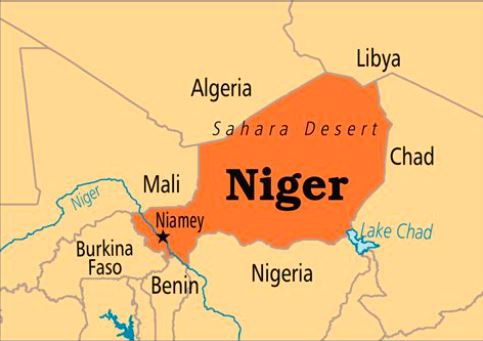
Map of Niger
Orano, previously known as Areva, has been in Niger for over 70 years. Yet in 70 years, they have not built a single school, roads, or even hospital for the locals (Mali and Niger end Long-Standing Tax Treaties with France). These French companies have similar behaviors in all of their previous colonies, in Cameroon for example, Safacam has been there 130 years, but the road there is impracticable – they can grab everything, without even giving simple things like roads to the locals! Moreover, many do not pay taxes in the local countries, but back to their home countries. Such contempt! How are the locals supposed to develop themselves? And then if one adds the FCFA scheme (The 11 Components of the French Colonial Tax in Africa) and it is game over!
Well, good riddance to bad rubbish… goodbye to Orano. The French thought that by having the Benin-Niger border closed via ECOWAS sanctions, that Niger, a landlocked country, will suffocate. When Benin realized that their sanction was affecting their own economy via the Benin port, given that Niger’s exports were no longer going through Benin, they back-pedaled trying to bring Niger in. However, it has been proven via intelligence, that there are French military bases in Benin and so Niger has refused to reopen their border with Benin. They have reopened all other borders with neighboring countries but Benin. Recall that Benin also tried to stop Niger oil going through the Niger-Benin Oil pipeline (at 1950 km, it is the longest oil pipeline in Africa) on Benin territory, until the Chinese government gave Talon a small tap on the back questioning his poor judgement to stop crude oil, forcing Talon to reopen the tap for oil.
To learn more, please check out RFI, and VOA. Excerpts below are from the VOA.
=====
NIAMEY, NIGER — Niger’s military junta is disputing a decision by French nuclear fuel firm Orano to halt uranium production, according to a document from a state partner in the venture seen Friday by Agence France-Presse.
Orano announced last month that it was stopping production as of Thursday, owing to what it termed increasingly difficult operating conditions in the country and financial issues.
… The French lamented the withdrawal by the junta in June of a permit for one of the largest uranium deposits in the world, Imouraren, and the impossibility of exporting the raw material with Niger’s border with Benin closed for what Niamey says are security reasons.
“Despite its status as a co-shareholder, Sopamin was not consulted on this serious decision” to halt production, the company, which has operated for half a century in the country’s north, said in a document dated Thursday.
The Nigerien firm complained that the decision “lacks transparency” and “violates a number of principles and practices essential to governance and commitments between stakeholders.”
… The ruling [government], which took power last year in a July coup, says it will revamp rules regulating the mining of raw materials by foreign companies in what is the world’s seventh-largest uranium producer.
… In September, Niger’s Council of Ministers adopted a draft decree creating a state entity, “Timersoi National Uranium Company,” abbreviated to TNUC
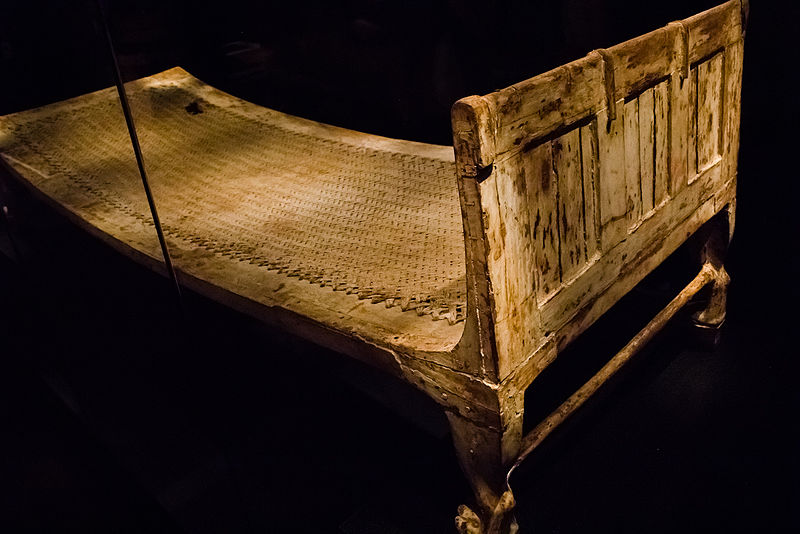
Bed found in Tutankhamun’s tomb in Egypt (Source: Wikimedia)
Mai-gado ya so kwana mai-tabarma sai shi nade.
Le propriétaire du lit veut dormir, l’homme avec la natte doit la plier (proverbe Haoussa – Afrique de l’Ouest et quelques parties de l’Afrique Centrale). Le propriétaire est de retour!
The owner of the bed wants to sleep, the man with the mat must roll it up (Hausa proverb – West and parts of Central Africa). The owner is back!
Official portrait of President Donald J. Trump, Friday, October 6, 2017. (Official White House photo by Shealah Craighead)
This past Tuesday, November 5 2024, Donald Trump made an amazing and spectacular comeback to the highest office of the American nation, winning both the electoral and popular votes by a landslide, with the Republican party taking both the House and the Senate. In essence, he was given a mandate by the people. His victory, unlike what mainstream media had promised, was a real red tsunami (MMs should be sued for blatantly lying and taking sides in elections). Overall, many Africans rejoice because as it is well-recorded, Trump is the only American president in recent years who has not started a war. In the warmongering climate in which the world currently is, with fears of a third world war, this position offers a great appeal to many Africans. Relationships between countries are not love affairs, but business deals, and Africans need to remember what they stand for and seek benefits for themselves. Congratulations to the new president of the United States, and best wishes. Africans need to take advantage of the upcoming 4 years of a new establishment to enable policies that will strengthen them economically, politically, and socially.
There is no doubt that Donald Trump’s victory will have great impacts on Africa. There are many areas that will be affected by this change; but we will focus on two key ones. 1) The economy: what will happen to the African Growth and Opportunity Act (AGOA), and is it any good? What will happen to the significant American deals in Africa such as the Lobito Railway construction meant to go through Angola, Zambia and the Democratic Republic of Congo (DRC), contract which had been won initially by China? or other deals across the continent?; 2) Geopolitical dynamics: what will be Trump’s take on Africa this time around, particularly as it pertains to the slap taken in recent years by France in the Sahel or the closure of the American base in Niger and the countries of the AES federation, or the wars in Sudan and DRC, or Russia’s growth in Africa, or China’s deals on the continent? Will America continue its expansionist vision? Only time will tell.
Messages have come from all corners of Africa, congratulating Donald Trump for his victory. Excerpts below are from The Africa Report.
=====
Flag of Egypt
… Egypt’s Abdel Fattah el-Sisi, … was quick to congratulate Trump… “Egypt and the US have always presented a model of cooperation and succeeded together in achieving the common interests of the two friendly countries, which we look forward to continuing in these critical circumstances that the world is going through,” said Sisi in a statement early Wednesday.
… The South African president [Cyril Ramaphosa] looks forward to “continuing the close and mutually beneficial partnership between our two nations across all domains of our cooperation.” In the global arena, said: “South Africa looks forward to our presidency of the G20 in 2025, where we will work closely with the US who will succeed us in the G20 presidency in 2026.”
Flag of South Africa
… Earlier, Clayson Monyela, South Africa’s head of public diplomacy, took to X to respond to a user’s assertion that Kamala Harris would be better for South Africa than Trump. “Historically relations between South Africa and the US thrive under a Republican White House,” he wrote, adding that during Trump’s first term, he appointed a woman born in South Africa as the US Ambassador to South Africa. “She was brilliant and helped to enhance the strong and mutually beneficial ties between our two nations.”
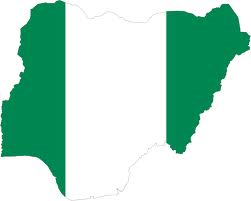
Flag and map of Nigeria
… Nigerian President Bola Tinubu in a statement expressed “heartfelt” congratulations to the US president-elect, seeking to strengthen the ties between the two countries “amid the complex challenges and opportunities of the contemporary world”. Tinubu said: “Together, we can foster economic cooperation, promote peace and address global challenges that affect our citizens.” … “Given his experience as the 45th president of the US from 2017 to 2021, his return to the White House as the 47th president will usher in an era of earnest, beneficial and reciprocal economic and development partnerships between Africa and the US.”
Flag of Kenya
Kenya’s William Ruto has been slower to congratulate Trump than his impeached deputy Rigathi Gachagua, who congratulated the American leader for “one of the greatest political come-backs of our generation”. He wrote on X: “Your victory is clear proof that resilience and a never-say-die attitude will always TRUMP obstacles on the path to your destiny.” … President Ruto has since congratulated in a statement, celebrating the “longstanding partnership with the United States spanning over 60 years, grounded in our shared values of democracy, development and mutual respect”.
Flag of Ethiopia
… it was no surprise to see Ethiopian Prime Minister Abiy Ahmed among the first African leaders to congratulate Trump on his victory.
… Zimbabwe’s President Emmerson Mnangagwa congratulated Trump, saying, “The world needs more leaders who speak for the people”.
The DRC’s Félix Tshisekedi, whose controversial first-term victory was waved through by the first Trump administration, congratulated Trump, “in the name of the Congolese people, for his great victory”, saying he was ready to work together.
Kome nisan dare, gari ya waye (Karin Magana Hausa).
Quelque soit la durée de la nuit, le matin viendra (proverbe Haoussa – Afrique de l’Ouest et quelques parties de l’Afrique Centrale). – Les épreuves ne durent pas à jamais.
However long the night is, the morning will come(Hausa proverb – West and parts of Central Africa). Trials don’t last forever.
Today, we will talk about the capital of the great country of Niger, Niamey. Growing up, I often pondered on the name of the capital of Niger: was it a name that had something to do with Niger? Did it have to do with the fact the city is located on the banks of the Niger River, the third longest river of Africa, which has its source in Guinea near the Sierra Leone border, and runs in a crescent shape through Mali, Burkina Faso, Niger, Benin, and Nigeria? What is the origin of the name Niamey?
Niamey in 1930 – in the center is the house of the French governor (Source: Photo by Walter Mittelholzer – Dec 1930)
The region of Niamey has been inhabited by local populations for as long as forever; the Songhay , Gurma, Hausa are some of its inhabitants. Niamey is said to have been founded by the Maouri, a subgroup of the Hausa people, who came from Matankari (the historic capital of the Arewa) towards the end of the 19th century. From local folklore, they first settled on the island called Neni Goungou (pronounce Neni Gungu) which faces the actual city of Niamey, before settling on the left bank of the Niger river, near a tree. This gave rise to the name Niame, from Niathe name of the tree, and mein the Zarma language which means ‘shore where water is drawn from.’ There is another legend, less likely in my opinion, which claims that the chief of a Kalle (subgroup of the Zarma people) clan would have exclaimed, talking to his slaves: Wa niammané, meaning “take this country.” The first version seems more likely.
Aerial view of Niamey in 2021 (Source: Adrien Barbier / AFP / Getty Images)
Niamey started expanding from a village to a city in the year 1900 in a place which was previously a crossroad between several villages Foulani Koira, Gaweye, Kalley, Maourey, Zongo, Gamkalé, and Saga. The city grew on the left bank of the river as it meanders from west to east. European explorers arrived in the area quite late. Thus, European explorers who traveled through West Africa, such as Heinrich Barth and Charles Monteil never made it to the area. It is only in 1898 that the name of Niamey appears in the reports of the Hourst expedition, named after the French officer Émile Auguste Léon Hourst who was directing a hydrographic expedition. Thus, in 1901, Niamey was a village numbering 600 inhabitants at the arrival of the French mission Lenfant. Niamey replaced Zinder as the capital of Niger on 28 December1926, because of its strategic position closer to major cities of French colonies, Upper Volta/Burkina Faso and Dahomey/Benin, contrary to Zinder which was closer to Nigeria a British colony. During the colonial period, Niamey also served as an important connection point in overland trade of agricultural goods. Niger is still a major provider of agricultural goods to neighboring countries, uranium, and more recently with oil discovery.
Niamey in 2020 (Source: NigerHeritage.org)
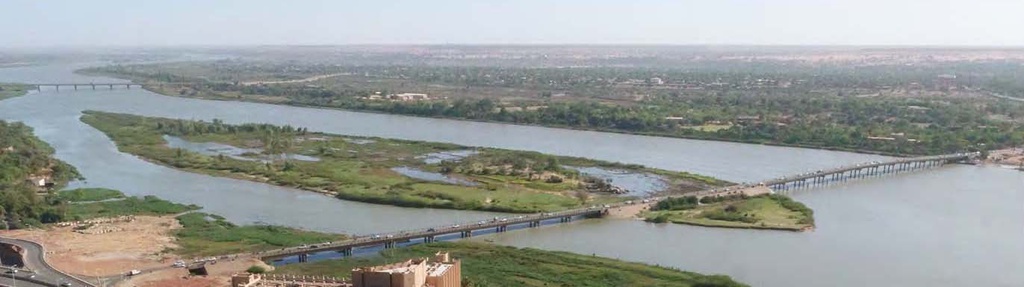
Today in Niamey, the vast majority of the population and government and commercial buildings are located on the eastern bank of the Niger river. The city center contains a number of wide boulevards linking roundabouts. Two bridges connect the two sides of the city – the Kennedy Bridge and the Friendship Bridge. The western bank area consists mainly of residential areas such as Gaweye, Saguia, Lamorde, Saga, and Karadje, as well as Abdou Moumouni University. This year, the government renamed major streets of the city after local heroes, as it should normally be. Over the years, the population has grown significantly and today Niamey counts almost 1 million inhabitants.
View of the Isle of Gaweye and the Kennedy Bridge (Source: NigerHeritage.org)
If you ever visit Niamey, do not forget to visit the Niger National Museum, which incorporates a zoo, a museum of vernacular architecture, a craft center and exhibits including dinosaurskeletons and the Tree of Ténéré, which was until 1973, one of the few remaining trees in the Sahara Desert and one of the most isolated trees on earth used as a landmark by caravans through the Ténéré region of northeast Niger. Other places of interest include the seven major market centers, the most popular being the large Niamey Grand Market, a traditional wrestling arena, the Great Mosque, and a horse racing track. Most of the colorful pottery sold in Niamey is hand made in the nearby village of Boubon. As you walk through the city, try to see if you can find that tree at the origin of the name Niamey, and enjoy the well-renowned Nigerien’s hospitality.
In November 2023, while on his first visit to Kenya as a monarch, King Charles gave one of those empty speeches in which he acknowledged the past atrocities committed by Great Britain and its colonial legacy. He said there were ‘no excuses‘ for it, yet did not apologize! He told guests that “the wrongdoings of the past are a cause of the greatest sorrow and the deepest regret.” (No Apology from King Charles III in Kenya). This year, at the Commonwealth Summit which took place last week in in Samoa, the leaders of the Commonwealth somehow expected an apology from the King of Great Britain about slavery, the part that Great Britain played in the slave trade, and possible reparations. Has anything changed in a year? It would seem that these Commonwealth leaders had not paid attention to the King’s visit to Kenya, or maybe they thought it was going to be different? If King Charles III had not apologized for the atrocities committed by the British during the colonial era in Kenya, what made them think that he was going to apologize for slavery? or that they could now talk about reparations?
The back of a slave
This year, the King of the British made another empty speech at the Commonwealth Summit, telling everyone how the “most painful aspects of our past continue to resonate“, as if we did not know, for our ancestors were on the receiving end, their pains still resonate with us. He added, “None of us can change the past. But we can commit, with all our hearts, to learning its lessons and to finding creative ways to right inequalities that endure.” What does this even mean? What is Britain going to commit to, with all its heart? Learning its lessons? Which lessons? What lessons can one learn when one’s coffers have been filled to the brim from others’ pain? What lessons can one learn when because of the slave trade, one has become one of the richest empires in the world? Those lessons are definitely different from the ones the enslaved and the victims have learned. From this, it is clear that the British monarch is truly mocking us!
Below is an excerpt from the BBC telling us, why King Charles III cannot quite apologize for slavery!
=====
The “most painful aspects of our past continue to resonate“, King Charles III said this week to Commonwealth leaders in Samoa, as arguments about reparations and apologies over the slave trade rumbled once again.
That’s become an occupational hazard for the Royal Family, as it can’t shake off questions about the long shadow of historic links to slavery.
It’s even more pointed in a forum such as the Commonwealth summit, with leaders representing some of the countries most affected by the legacy of colonialism and slavery.
But even if the King had a personal belief that there should be a symbolic apology or a commitment to reparations, he wouldn’t have been able to deliver it [as if he could think otherwise, when his family and entire kingdom has benefited from it]. Monarchs speak on the advice of ministers – and on a question of such political sensitivity, his speeches will have to stay within the boundaries of government policy. In other words, he has to stick to the script.
… “None of us can change the past,” the King said diplomatically, neatly aligning with Prime Minister Keir Starmer’s line that we “can’t change our history”.
… As head of state, the King is the symbolic focus of calls for such redress, whether that’s financial reparations or some other ways addressing of historic wrongs. That’s not going to go away.
That’s awkward but he’ll take that in his stride, as it’s a political decision that he can’t change and reparations for the past seem unlikely when current UK budgets are under intense stress. [their coffers were filled from your pain, now that you ask for something, their budgets are under stress].
But there’s also the more complicated question of how much the monarchy, as both a family and an institution, might have a closer responsibility.
For example, the Royal African Company, founded in the 17th Century under royal patronage, has been claimed as transporting more enslaved people from Africa across the Atlantic than any other company.
But history, like people, can be full of contradictions. When it came to Britain’s pioneering efforts to abolish slavery, in the early 19th Century, research by historian Prof Suzanne Schwarz found the Royal Family itself was divided. The nephew of George III, the Duke of Gloucester, was one of the most important campaigners to abolish slavery – a tireless opponent of the cruel trade and a supporter of the Royal Navy’s efforts to intercept slave ships. But before the royals feel the clouds lifting, George III’s son, the future William IV, was one of the most enthusiastic defenders of slavery.


 Quoting icons of Pan-Africanism, including Marcus Garvey and Peter Tosh, the President underscored the shared heritage that unites all people of African descent. “Africa is your home, and Ghana welcomes you with open arms. This is not just a ceremony—it is a powerful affirmation of our collective identity and destiny,” he concluded.
















 African Heritage