
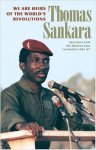
 Every October 15, we talk about Thomas Sankara, the father of the Burkinabe revolution. Today, we will bring back some of his words, from “We are Heirs of the World’s Revolutions, Speeches from the Burkina Faso Revolution 1983-87” by Thomas Sankara, Pathfinder Press (2007) p. 46 – 48. You will see that President Ibrahim Traoré in particular, and the leaders of the AES as a whole (Mali, Burkina Faso, and Niger Sign a Mutual Defence Pact), are following in Thomas Sankara’s footsteps in the defense of their homeland against foreign forces which have used terrorism to balkanize the region and terrorize the people for over a decade now. “Each citizen should work to revolutionize his sector of activity. … a conscious people cannot leave their homeland’s defense to one group of men, however competent they may be. Conscious people take charge themselves of their homeland’s defense.” Tomorrow, we will talk about points (2) and (3).
=====
The August revolution does not aim to establish one more regime in Upper Volta [Burkina Faso]. It represents a break with all previously known regimes. Its ultimate goal is to build a new Voltaic [now Burkinabe] society, within which the [Burkinabe], driven by revolutionary consciousness, will be architect of his own happiness, a happiness equal to the efforts he will have made.
To do this, the revolution – whether the conservative and backward forces like it or not – will be a deep and total upheaval that will spare no domain, no sector of economic, social, and cultural activity.
Revolutionizing all domains and all sectors of activity is the slogan of the day. Strengthened by the guiding principles laid out here, each citizen should work to revolutionize his sector of activity, whether he finds himself.
The philosophy of revolutionary transformations is already affecting the following sectors: (1) the national army; (2) policies concerning women; and (3) economic development.
(1) The national army: its place in the democratic and popular revolution

According to the defense doctrine of the revolutionary Upper Volta, a conscious people cannot leave their homeland’s defense to one group of men, however competent they may be. Conscious people take charge themselves of their homeland’s defense. To this end, our armed forces constitute simply a detachment that is more specialized than the rest of the population for Upper Volta’s internal and external security requirements. …
The revolution imposes three missions on the national armed forces:
- To be capable of combating all internal and external enemies and to participate in the military training of the rest of the people. This presupposes an increased operational capacity, making each soldier a competent fighter, unlike the old army, which was merely a mass of employees.
- To participate in national production. Indeed, the new soldier must live and suffer among the people to which he belongs. The days of the free-spending army are over. From now on, besides handling arms, the army will work in the fields and raise cattle, sheep, and poultry. It will build schools and health clinics and ensure their functioning. It will maintain roads …
- To train each soldier as a revolutionary militant. Gone are the days when the army was declared to be neutral and apolitical, while in fact serving as the bastion of reaction and the guardian of imperialist interests. Gone are the days when our national army conducted itself like a corps of foreign mercenaries in conquered territory. Those days are gone forever. Armed with political and ideological training, our soldiers, … will instead become conscious revolutionaries, at home among the people like a fish in water.
As an army at the service of the revolution, the National Popular Army will have no place for any soldier who looks down on, scorns, or brutalizes his people. An army of the people at the service of the people – such is the new army we are building in place of the neocolonial army, which was utilized to rule over the people as a veritable instrument of oppression and repression in the hands of the reactionary bourgeosie. …

 African Heritage