

Today, we will talk about another African textile, the Kanvô of Benin. The Kanvô, which means “woven cloth” in the Fon language of modern-day Benin, is a prestigious cloth once worn only by kings from the Dahomey Kingdom, including the great King Behanzin. It is said to have been introduced to Benin by King Agonglo, one of the kings of the Dahomey who reigned at the end of the 18th century. Legend has it that, during one of his conquests in Yoruba lands in modern-day Nigeria, King Agonglo came across a young weaver whose work impressed him; he was so astounded that he asked the young man to follow him to his kingdom to become his personal tailor, and thus was born the Kanvô. Later, King Ghezo popularized it by giving rise to large families of weavers throughout the kingdom. The Kanvô used to be worn by kings on great occasions, and is woven from threads of cotton, linen, or hemp fabric. The origin story of the Kanvo is also different whether you are in the south or the north of the country; as we saw in the south, the cloth was introduced by King Agonglo, while in the north, legend has it that the Gurma people of Burkina Faso brought it into the country, that is why there is some resemblance to the Faso Dan Fani of Burkina Faso.
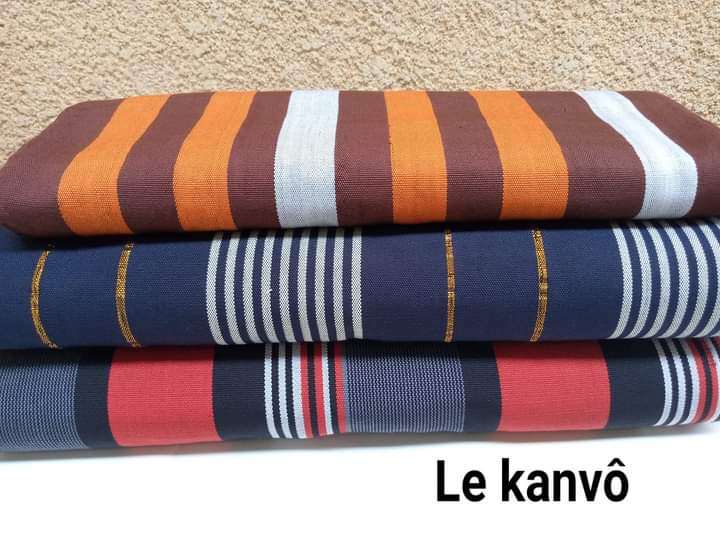
In its original form, the Kanvô is very heavy and not so easy to work with as a tailor. Thus, today, a new generation of tailors has worked to make the woven cloth more malleable and lighter for general consumption, mixing it with other fabrics such as silk, cotton, etc to appeal to the modern palate.
Check out UniversCulturelEtArtistique who wrote a really good article on the Kanvô, or RFI which interviewed some young generations of Beninese fashion designers who are modernizing the Kanvô.

 African Heritage