
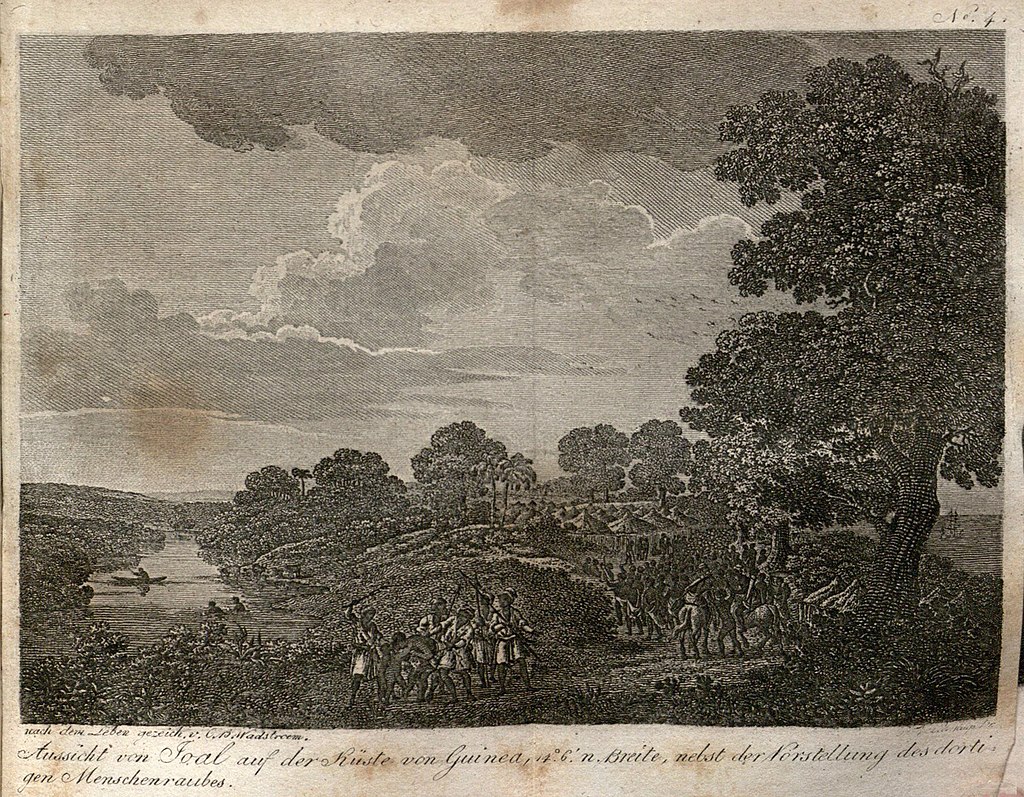
The Swede abolitionist and explorer Carl Bernhard Wadström (Charles Berns Wadstrom) once described his travel in Africa from 1787-1788 with fellow Swede Anders Sparrman. He wrote of an African king’s resistance to slavery and the kindness he observed. In 1790, he was called to testify in front of the British Government Select Committee; his testimony was published on 11 May 1790 in a report entitled “Minutes of the evidence taken before a Committee of the House of Commons, being a Select Committee, appointed to take the Examination of Witnesses respecting the African Slave Trade.”
An African King who was called King of Almamany [Dalmanny] “had entirely prohibited the Slave trade throughout his whole Kingdom, so that they could no longer contact the French slave traders anchored in the mouth of the Senegal [river].” He also banned the sale of alcohol. However, the Senegal Company [Compagnie du Sénégal], a French company which administered the territories of Saint-Louis and Gorée island as part of French Senegal, initially attempted to bribe the King to change his policy on the trade in people, but he refused their presents. Consequently, the Senegal Company resorted to bribing the lighter-skinned Moors to attack and kidnap Dalmanny’s subjects. The Company supplied the Moors with the necessary arms, gunpowder and ammunition to carry out the raids [does it not remind of something today in West Africa with all these jihadists? History repeats itself]. Many of his subjects were made prisoners and taken into slavery. Wadstrom himself had seen a few in the enclosures. They were chained two by two by the ankles; wounded in combat, they did not receive any kind of care. There were also individual kidnappings. Wardstrom said that “Negroes never venture to go out into the fields unless very well armed.”
From Bwemba Bong, Quand l’Africain etait l’or noir de l’Europe. L’Afrique: actrice ou victime de la traite des noirs? MedouNeter (2022), p. 165; George Kay, La Traite des Noirs, Robert Laffont (1968) p.129

 African Heritage